
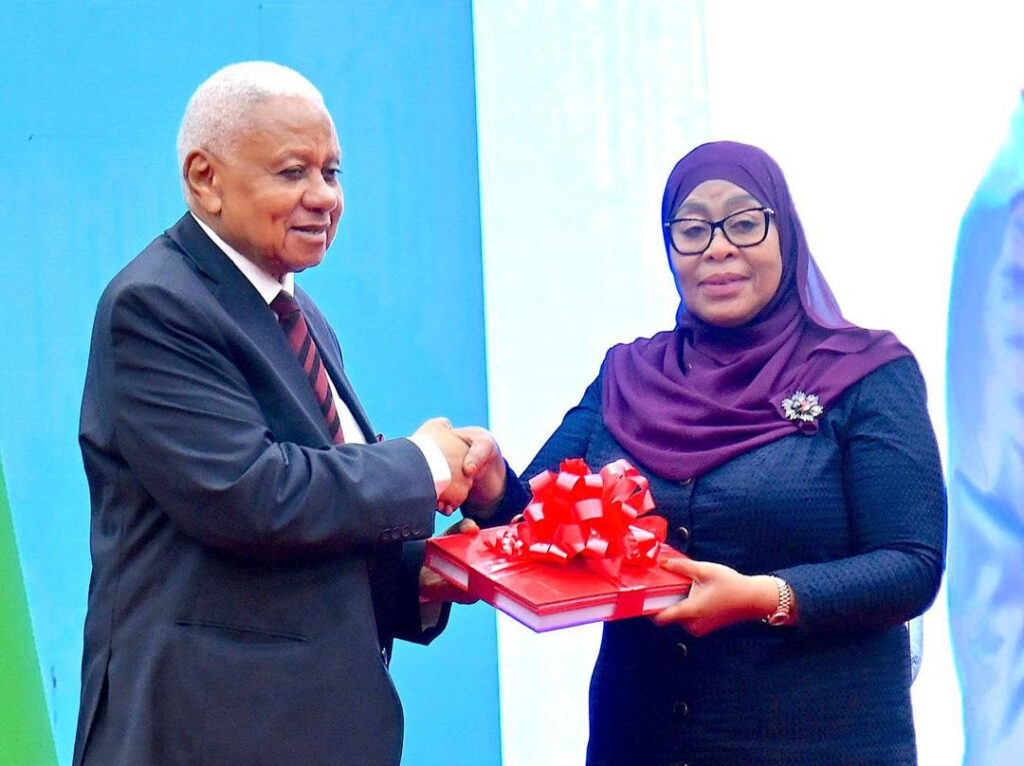
Now, with the release of the report by the Presidential Commission of Inquiry chaired by former Chief Justice Mohamed Chande Othman, the government of President Samia Suluhu Hassan is attempting to guide the country from pain towards reflection, reconciliation and reform.
The significance of the Commission’s work lies not only in the scale of its investigation, but also in the political message surrounding it. In a region where governments are often accused of suppressing uncomfortable truths, Tanzania’s leadership chose instead to establish a nationwide inquiry, listen to victims and publish its findings openly.
Receiving the report at State House in Dar es Salaam, President Samia spoke not as a distant head of state, but as a leader visibly aware of the emotional scars left behind by the crisis.
“If it were possible, we would wish to turn back time so that the events of October 2025 had never happened,” she said. “History could be rewritten to erase the stain left on our nation.”
It was a striking admission from a president whose administration has consistently promoted national unity and reconciliation as central pillars of governance. Rather than downplaying the crisis, Samia acknowledged its gravity openly, recognising both the human suffering and the broader impact on Tanzania’s identity as one of Africa’s most stable nations.
“It is we who lost our children, our relatives and our friends,” she said. “No one outside Tanzania can feel greater pain than those of us who lived through these losses.”
That sense of collective responsibility runs throughout the Commission’s findings. Over 153 days, investigators travelled across 11 regions and 21 districts, listening to victims, security officials, religious leaders, political actors and ordinary citizens.
The Commission reviewed thousands of submissions, forensic analyses and witness testimonies in what became one of the most extensive national inquiries in Tanzania’s recent history.
For Judge Othman, the process was never simply about assigning blame. It was equally about understanding how a country known for peace reached such a painful moment.
“Everywhere we went, the citizens who appeared before the Commission spoke about what had happened… and acknowledged that such conduct is not in keeping with who we Tanzanians are by our very nature.”
The report itself presents a complex picture. It concluded that the unrest emerged from long-standing political, economic and social frustrations, including concerns surrounding governance, economic inequality, unemployment and declining public trust in institutions.
Yet the inquiry also found evidence suggesting that some elements of the violence were organised and coordinated in advance.
According to the Commission, groups were mobilised through digital platforms and recruited in ways designed to disrupt the electoral process and overwhelm security agencies.
For the government, those findings reinforced the argument that the unrest represented not simply spontaneous disorder, but a serious threat to national stability.
Even so, President Samia’s response avoided the language of vengeance or political confrontation. Instead, she framed the report as a pathway towards healing.
“The Commission has examined what affected us and has provided both treatment and guidance,” she said. “Our task now is to apply that treatment effectively. At times, the remedy may be difficult, but if we are to heal, we must take it.”
That metaphor ‘the nation as a wounded body requiring treatment’ has become central to how the government is presenting the next phase of the process. The administration has already announced plans for a follow-up investigative body to examine additional issues raised in the report, including the co-ordination and financing of the unrest.
Politically, the inquiry also reflects President Samia’s broader leadership philosophy built around what she calls the “4Rs”: Reconciliation, Resilience, Reform and Rebuilding. Since taking office, she has sought to position herself as a consensus-building leader focused on easing tensions while strengthening institutions.
The handling of the Commission’s findings appears carefully aligned with that approach. By publicly acknowledging failures, encouraging accountability and emphasising unity, the government is seeking to project confidence in Tanzania’s institutions rather than fear of scrutiny.
The report’s findings on institutional preparedness are particularly revealing. The Commission concluded that warning signs of possible unrest had appeared months before the election, particularly through social media activity and inflammatory online messaging.
Yet authorities struggled to anticipate the scale and co-ordination of the violence that eventually unfolded across multiple regions simultaneously.
Rather than responding defensively to those conclusions, the government appears to be using them to argue for stronger institutional co-ordination and reforms aimed at preventing future instability.
There is also a broader political calculation behind the process. Tanzania’s reputation for peace and stability has long been one of its strongest diplomatic and economic assets. The unrest threatened not only domestic confidence but also international perceptions of the country’s stability.
By commissioning an independent inquiry and publicly releasing its findings, the government appears determined to demonstrate that Tanzania remains capable of confronting crises through lawful and institutional means.
Justice Othman repeatedly returned to the idea of national healing during his remarks.
The report, he explained, carries a collective national intention: to heal wounds, ensure accountability where necessary, and above all learn and move forward.
That message may ultimately define how Tanzania chooses to remember this chapter.
The violence of October 2025 exposed vulnerabilities within society and institutions that many had assumed did not exist in Tanzania. Yet the response now unfolding suggests that the government wants the legacy of the crisis to become one of reform and renewal rather than permanent division.
In her closing remarks, President Samia made clear that recovery would require collective effort, not government action alone.
“I will carry this responsibility with courage, confidence and caution,” she said. “But we must do this together. Do not leave this burden to me alone.”
It was both a warning and an appeal a reminder that national unity, long regarded as Tanzania’s defining strength, may also prove to be its most important safeguard for the future.
Notes to Editors
· The Presidential Commission of Inquiry into the October 2025 post-election violence was established by President Samia Suluhu Hassan as part of a broader national reconciliation and accountability process.
· The Commission was chaired by former Chief Justice Mohamed Chande Othman and conducted its work over a period of approximately 153 days.
· Investigations covered 11 regions and 21 districts across Tanzania, involving testimonies from victims, security agencies, political actors, religious leaders and members of the public.
Media Contact:
Information Services Department and Office of The Chief Government Spokesman
E-mail: maelezotv@gmail.com
Phone: +255 754 750 765; +255 754 698 856; +255 759 714; +255 713 381 904
Availability: EAT, UTC +3
ENDS