
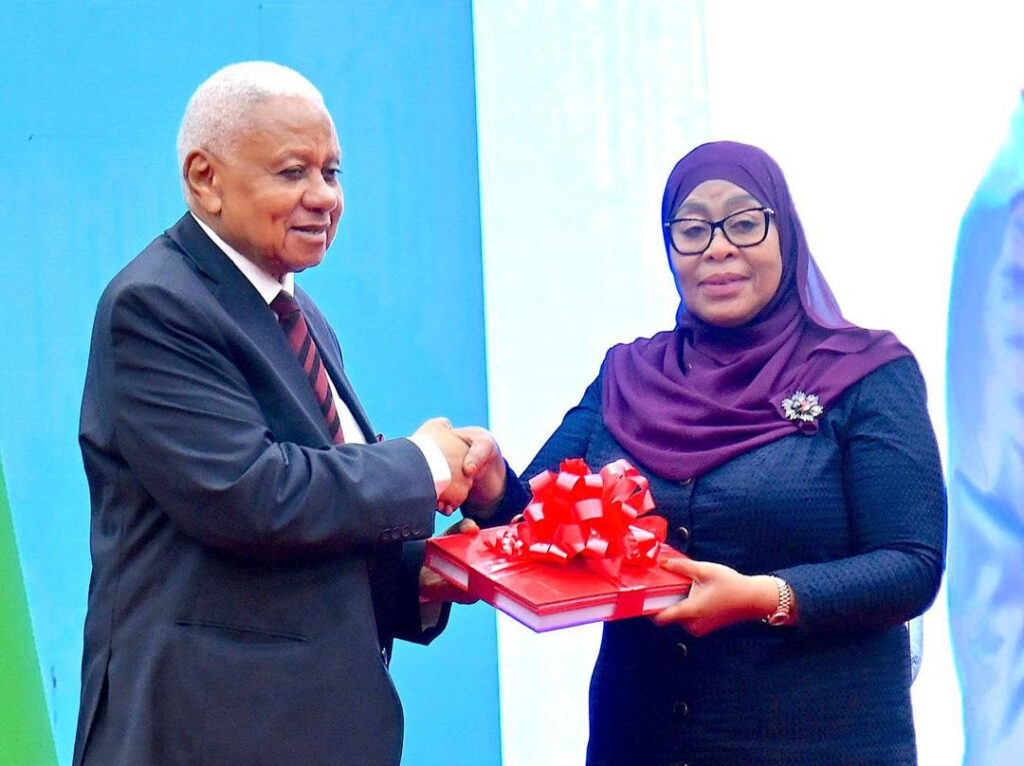
The report concludes an important period of national reflection while opening a new chapter centred on strengthening institutional accountability, improving governance systems and reinforcing Tanzania’s long-standing reputation as a pillar of peace, unity and stability in the region.
Receiving the report at State House on April 23, 2026, President Samia Suluhu Hassan signalled that the process would continue beyond the commission’s findings.
She announced the establishment of a special investigative body to conduct further inquiries into issues identified in the report, including the organisation, coordination and financing of the unrest.
The move reflects the government’s commitment to strengthening accountability, upholding justice and ensuring thorough follow-up action on matters raised by the commission.
The Commission’s work has been about establishing clarity in a moment that was, for months, defined by competing narratives.
Chaired by Mohamed Othman Chande, the commission undertook what President Samia Suluhu Hassan described as a major national assignment carried out with professionalism, expertise and patriotism under challenging circumstances.
She noted that the commission applied methodologies consistent with international standards, demonstrating the country’s capacity to address complex challenges through credible, independent and nationally driven processes.
Beyond institutional performance, the report reopens a deeper national conversation, one anchored not only in facts, but in memory, loss, and meaning.
“If it were possible, we would wish to turn back time so that the events of October 2025 had never happened,” President Samia reflected, “and history could be rewritten to erase the stain left on our nation.” It is a striking admission that captures both the gravity of the events and the emotional weight they carry.
The unrest, as now documented, left a visible and painful imprint. Lives were lost, families were affected, and public and private infrastructure was damaged. But the President’s remarks suggest that the impact extends beyond physical destruction. It is also about national identity and how a country long defined by stability processes a moment that tested that foundation.
“It is we who lost our children, our relatives and our friends,” she said. “No one outside Tanzania can feel greater pain than those of us who lived through these losses.”
This framing shifts the conversation from external interpretation to internal ownership. While acknowledging criticism from international actors and media, the President pointed to what she described as significant misinformation surrounding the events, particularly from foreign outlets. Such reactions, she noted, were not unexpected given differences in perspective.
President Samia invoked an African normative perspective that places emphasis on solidarity in moments of crisis. “In times of loss and sorrow, the expectation should be comfort and solidarity rather than criticism or mockery,” she said.
This tension between external narratives and internal experience has shaped much of the post election discourse. It also reflects a broader challenge of how countries communicate their realities during periods of strain while maintaining space for honest internal reflection.
The Commission’s findings, as reflected in the President’s remarks, point to a complex set of dynamics underlying the unrest. According to the report, the violence was not spontaneous. Rather, it bore clear indications of planning, coordination, and financing, and was carried out by individuals with prior training. Reflecting these findings, the President noted that the events were organised with specific intent, raising important questions about the actors involved and the broader objectives behind the unrest.
According to the President, the stated objectives included attempts to disrupt the electoral process and create a leadership vacuum. There were also indications that critical infrastructure and service delivery systems were deliberately targeted in order to affect economic activity and weaken the state.
These findings, once fully detailed, shift the discussion beyond the language of protest into the terrain of organised disruption, with implications for both accountability and interpretation.
At the same time, the President acknowledged the broader environment in which the events unfolded, including mobilisation through digital platforms. She commended Tanzanians for exercising restraint, noting that despite calls, particularly through social media, to escalate unrest, many chose not to engage in further acts of violence.
“I thank Tanzanians for not continuing acts of unrest despite the mobilisation that was taking place, especially through social media,” she said. “I also thank them for their calmness and trust in the Government as we awaited this report.”
This emphasis on restraint reflects a long standing feature of Tanzania’s political culture, the centrality of peace as both a value and a public expectation. It also highlights the role of citizens, not only institutions, in shaping outcomes during moments of uncertainty.
The President’s remarks extended further, placing the events within a broader historical and geopolitical context.
The United Republic of Tanzania, she reminded, did not come into being by accident, but was built by its founders through vision and action as a united nation. Unity and cohesion, in this view, are strategic assets.
“A country with unity and cohesion is difficult to exploit or dominate, politically or economically,” she noted, adding that many resource rich nations have been destabilised through internal conflict, often to the benefit of external actors.
This perspective introduces another dimension, the relationship between internal stability and external vulnerability. It suggests that the preservation of peace is not only a domestic priority, but also a safeguard against broader risks.
The events of October 2025, she acknowledged, shook the nation. “Losing one’s way is part of finding the way,” she added. “We have learned.”
It is within this context that President Samia reaffirmed her longstanding 4R philosophy of Reconciliation, Resilience, Reform, and Rebuilding, noting that reconciliation has been central to her agenda since the campaign period.
She observed that the events of October 2025 have only reinforced the urgency of that agenda, while also calling for a refined national direction that takes into account the findings of the Commission.
This sense of learning is therefore not abstract. It is anchored in a framework that seeks to bring the country back together, strengthen its institutions, and guide its transition from disruption to renewal.
The establishment of a follow up investigative body indicates that the government intends to move beyond acknowledgment toward action. Its effectiveness will depend on the depth of its inquiries, the transparency of its processes, and the credibility of its outcomes.
More broadly, the Commission’s report and the President’s response mark a transition from shock to reflection, and from reflection to reform.
The key question now is whether this moment will translate into lasting institutional strengthening.
Tanzania’s experience offers a broader lesson. Stability, even when deeply rooted, can be tested. Yet such moments do not necessarily signal systemic failure. They can, under the right conditions, prompt recalibration.
The difference lies in response.
If the findings are engaged with seriously, accountability pursued consistently, and reforms implemented with clarity and commitment, this period may come to be seen not only as one of recovery, but as a step toward stronger governance and renewed public trust. As the President emphasised, “The recommendations put forward by the Commission are the remedy for healing our nation. It is a remedy we must be willing to take.”
For a country whose identity has long been anchored in peace, such an outcome would carry particular significance. The events of October 2025 may not be erased from history, but how they are interpreted, and what is built in their aftermath, remain firmly within Tanzania’s control.
Notes to Editors
· The Presidential Commission of Inquiry into the events following Tanzania’s October 29, 2025 General Election was established by President Samia Suluhu Hassan as part of a broader national process aimed at accountability, reconciliation and institutional strengthening.
· The Commission was chaired by Mohamed Chande Othman and conducted extensive investigations across multiple regions, gathering testimonies from victims, security agencies, political stakeholders and members of the public.
· The report was officially received at State House, Dar es Salaam, on April 23, 2026.
Media Contact:
Information Services Department and Office of The Chief Government Spokesman
E-mail: maelezotv@gmail.com
Phone: +255 754 750 765; +255 754 698 856; +255 759 714; +255 713 381 904
Availability: EAT, UTC +3
ENDS