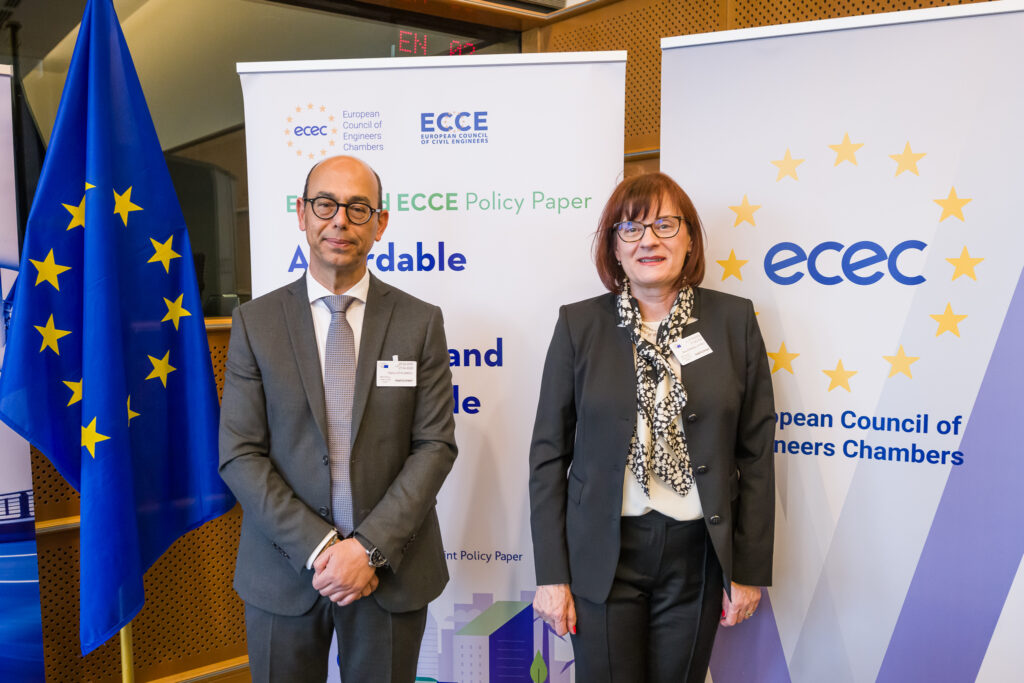
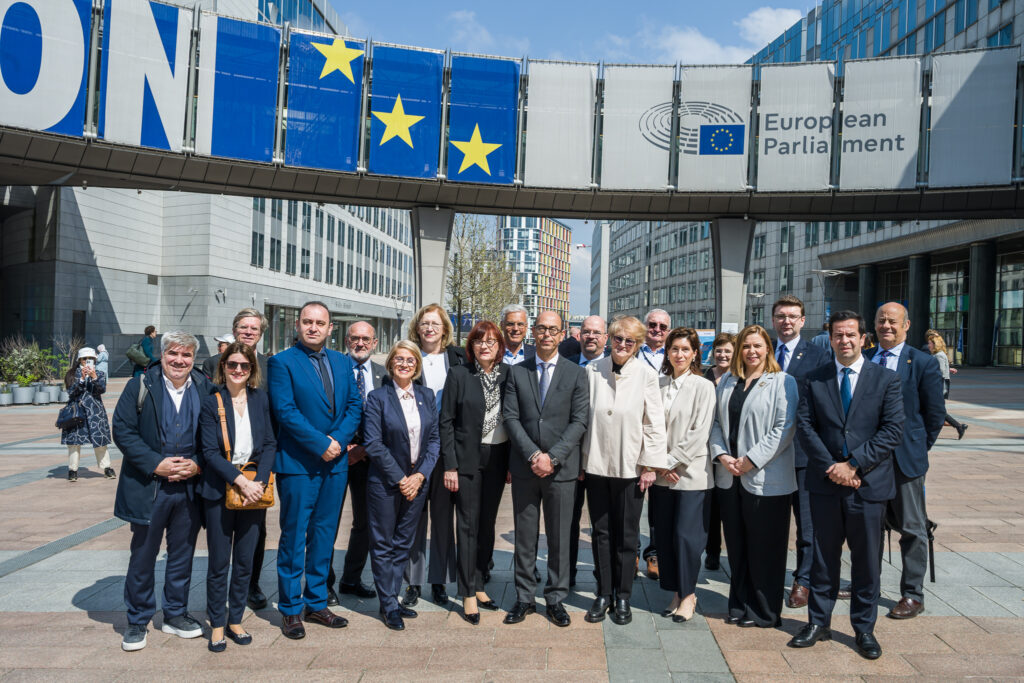
Dražin Lovrec and Stylianou presented the document at the roundtable “How to Build Better?”, dedicated to solutions for affordable housing in Europe. The roundtable was organised by the Member of the European Parliament and the European People’s Party (EPP) coordinator in the Housing Crisis Committee (HOUS), Nikolina Brnjac, in cooperation with and at the initiative of ECEC and ECCE.
Europe is facing a serious housing crisis, and this document sets out a development direction aimed at making housing affordable, safe and sustainable for all citizens. It highlights the growing housing crisis and proposes concrete measures to address it—from accelerating construction and modernising regulations to strengthening public-private partnerships. The document emphasises the role of engineers and innovation in creating higher-quality and more accessible housing in Europe.
The roundtable brought together representatives of the European Commission, the European Parliament, and leading representatives of the engineering sector from various member states with the aim of exchanging concrete proposals on how to increase housing availability and accelerate construction across the European Union. The roundtable was also attended by Matthew Baldwin, Head of the European Commission’s Housing Task Force, presented key elements of the European Affordable Housing Plan and Members of the European Parliament Borja Gimenez Larraz, Regina Doherty, and Andreas Schieder.
In her opening remarks, MEP Brnjac emphasised that Europe is currently facing a serious housing crisis, marked by sharp price increases and a lack of supply.
Europe must build more housing, but also build smarter, faster and more sustainably. Estimates indicate that Europe is currently lacking around 10 million housing units. Housing is no longer just a social issue, but also a matter of economic development, competitiveness and demographic stability.
Brnjac highlighted that in March 2026 the European Parliament adopted a report on the housing crisis, providing guidelines for increasing housing supply, mobilising investment, regulating market distortions and strengthening energy efficiency. She particularly stressed the importance of simplifying procedures and strengthening the role of local communities in planning housing policies.
Matthew Baldwin, Head of the European Commission’s Housing Task Force, presented key elements of the European Affordable Housing Plan. The plan is based on increasing supply, strengthening financial instruments and targeted support for the most vulnerable groups, especially young people.
Nina Dražin Lovrec, President of the European Council of Engineers Chambers (ECEC) said that “Europe can no longer afford to view housing solely as a social or market issue, as it is also a matter of resilience, security and long-term competitiveness. Affordable housing must be developed through a coordinated European approach that connects public policies, investments and the engineering profession, in order to ensure homes that are safe, sustainable and truly adapted to people’s needs.“
Platonas Stylianou, President of the European Council of Civil Engineers (ECCE), emphasised the need for a long-term coordinated approach: “Housing challenges in Europe require a coordinated and long-term approach that brings together public policies and engineering expertise. As we discuss how to build better, we must ensure that affordability is not achieved at the expense of safety, resilience or sustainability—these are not trade-offs, but fundamental standards. Housing must be recognised as key infrastructure and treated as a public priority. To respond to the scale of the challenge, Europe must demonstrate political determination in removing barriers, simplifying procedures and accelerating project implementation.”
MEP Brnjac emphasised that the European Parliament’s report clearly recognises the importance of innovation in construction, the need for digitalisation and industrialisation of construction processes, and the urgency of addressing labour shortages through education and skills development. The construction sector accounts for around 9% of the European Union’s GDP and employs approximately 18 million people.
All participants agreed that addressing the housing crisis requires stronger cooperation between European institutions, Member States, local authorities and the private sector, along with clear political will to increase housing supply and accelerate investments.
Finally, Europe’s housing crisis requires systemic innovation and cross-professional collaboration. Engineers, architects, urban planners and policymakers must work together to deliver safe, sustainable and affordable housing. Industrialised construction, fair financing, digital tools, education and regulated modernisation will shape the future of Europe’s housing. Stronger and more efficient cooperation across borders is essential to promote sustainable, resilient, rapid and industrialised housing solutions. Affordable housing for all Europeans demands mobilising talented professionals. Engineers and architects are ready to lead this transformation.
Media Contact
office@ecec.net
ENDS