
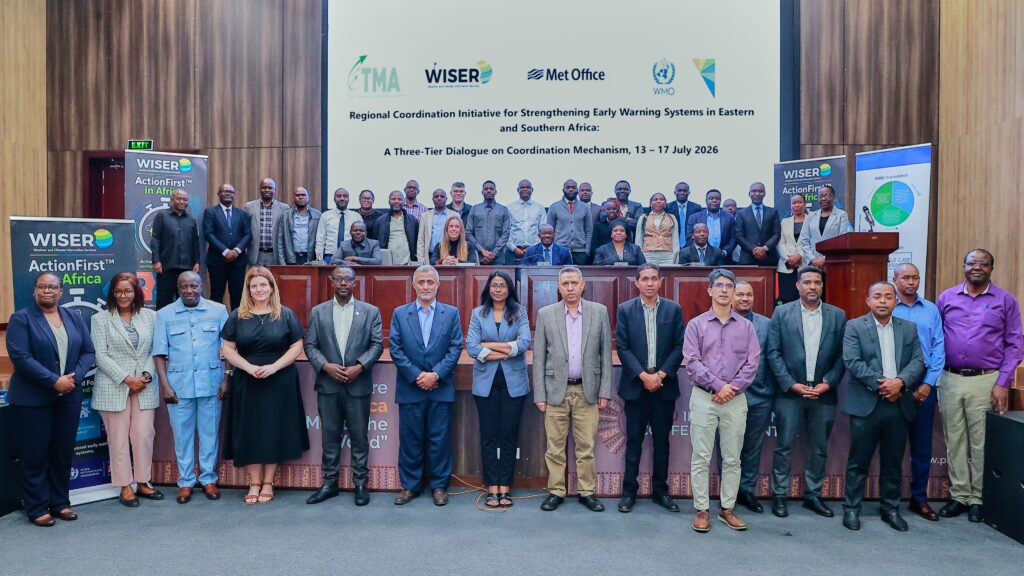
The call was made during a high-level regional dialogue in Arusha that brought together Permanent Representatives to the World Meteorological Organization (WMO) and Heads of National Meteorological and Hydrological Services (NMHS) to advance strategies for strengthening climate resilience and disaster preparedness.
Opening the meeting, Tanzania Meteorological Authority (TMA) Director General and Tanzania's Permanent Representative to the WMO, Dr Ladislaus Chang'a, said accelerating investment in modern forecasting systems and climate services had become critical as climate change intensifies floods, droughts, heatwaves, severe storms and other extreme weather events.
"Climate change and climate extremes continue to present unprecedented challenges to our countries. Across Eastern Africa, we continue to experience devastating floods, prolonged droughts, severe thunderstorms, heatwaves and other extreme weather events whose impacts are becoming increasingly severe," Dr Chang'a said.
He said the growing scale and frequency of climate hazards pose increasing risks to agriculture, food security, water resources, infrastructure, ecosystems and economic growth, reinforcing the need for resilient weather observation and forecasting systems.
The regional dialogue focused on accelerating implementation of the global Early Warnings for All initiative through stronger collaboration among meteorological institutions, improved coordination and sustainable financing mechanisms.
Delegates explored measures to strengthen regional climate centres, reinforce the authoritative role of National Meteorological and Hydrological Services in issuing weather forecasts and warnings, expand impact-based forecasting and improve the delivery of climate information to governments, businesses and communities.
Participants also discussed enhancing regional data sharing, increasing the adoption of digital technologies and leveraging artificial intelligence (AI) and machine learning to improve forecasting accuracy and climate services.
Dr Chang'a said effective early warning systems depend not only on scientific accuracy but also on ensuring that climate information reaches vulnerable communities in time to support informed decision-making.
"Working in the spirit of leaving no one behind, we must ensure that climate information reaches vulnerable communities and supports timely decisions that protect lives and livelihoods," he said.
He said Tanzania continues to modernise its meteorological infrastructure through investment in weather radars, automatic weather stations, numerical weather prediction systems, digital dissemination platforms and impact-based forecasting as part of its contribution to the Early Warnings for All initiative.
The country is also expanding South-South cooperation by sharing technical expertise with other African nations in meteorological legislation, quality management systems, severe weather forecasting, equipment calibration, professional training and digital meteorological services.
Representing the UK Met Office, Ms Fionne Marshal said stronger regional coordination is essential because climate risks routinely extend beyond national borders.
"Floods, droughts, extreme heat and severe storms do not recognise borders. Strengthening cooperation enables institutions to better anticipate risks and provide more consistent and effective early warnings," she said.
Ms Marshal said harmonising regional early warning systems does not require countries to perform identical functions but rather to strengthen coordination, clarify institutional responsibilities and ensure national and regional capabilities complement one another.
She added that closer collaboration among regional climate centres, meteorological agencies, disaster management authorities, regional economic communities, humanitarian organisations, media and local communities would significantly improve disaster preparedness and climate resilience across Eastern Africa.
"The goal is to build an Eastern African region where weather warnings and climate information are trusted, coordinated and linked to timely action that protects communities and supports sustainable development," she said.
The regional dialogue forms part of broader efforts by African governments and international partners to strengthen climate resilience through improved forecasting, disaster risk reduction and climate adaptation while advancing the global objective of ensuring everyone is protected by effective early warning systems.
Notes to Editors
– The regional dialogue brought together Permanent Representatives to the World Meteorological Organization (WMO) and Heads of National Meteorological and Hydrological Services (NMHS) from across Eastern Africa.
– The meeting focused on accelerating implementation of the Early Warnings for All initiative, a global effort to ensure that everyone is protected by effective multi-hazard early warning systems.
– Delegates called for increased investment, sustainable financing and stronger regional cooperation to improve climate resilience as extreme weather events become more frequent and severe.
Media Contact:
Information Services Department and Office of The Chief Government Spokesman
E-mail: maelezotv@gmail.com
Phone: +255 754 750 765, +255 754 698 856, +255 759 714, +255 713 381 904
Availability: EAT, UTC +3