
[PRESSWIRE] DAR ES SALAAM, Tanzania – 2026-02-05 — 5th February, 2026
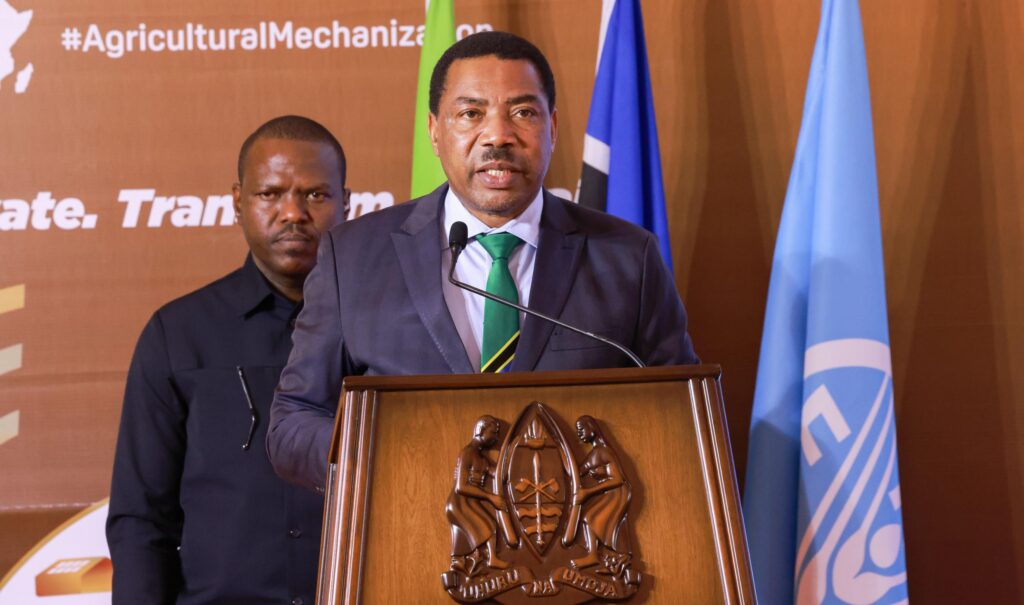
Tanzania plans to procure 10,000 tractors and establish 1,000 ward-level integrated agricultural mechanisation service centres as part of a drive to modernise farming, cut production costs and raise productivity, Prime Minister Mwigulu Nchemba said on Tuesday.
Speaking at the First Africa Regional Conference on Sustainable Agricultural Mechanisation, Nchemba said the initiative aims to transform agriculture into a competitive, climate-resilient and commercially viable sector capable of supporting inclusive economic growth.
Africa remains the least mechanised farming region globally, with an estimated two tractors per 1,000 hectares of arable land, compared with about eight in Latin America and more than 10 in parts of Asia, according to development partners. Limited access to machinery has been cited as a key factor behind low yields, high post-harvest losses and persistent rural poverty.
“Tanzania is committed to reversing this trend by investing in modern, sustainable and climate-smart mechanisation systems that reduce drudgery, raise productivity and protect the environment,” Nchemba said.
He said the government’s plan goes beyond equipment acquisition to building service-based delivery models that allow small- and medium-scale farmers to access machinery without bearing full ownership costs — an approach increasingly adopted in countries such as Ethiopia, Ghana and Rwanda.
The prime minister stressed that mechanisation strategies must respond to climate pressures facing African agriculture, including drought, erratic rainfall and shorter planting seasons.
“These tools must be able to withstand climate impacts while reducing post-harvest losses and freeing farmers’ time for other economic activities,” he said.
Nchemba underscored the role of the private sector, calling on governments across Africa to establish enabling policy, legal and investment frameworks to support local manufacturing, distribution and maintenance of agricultural machinery.
“Our governments must create a conducive environment so that the private sector can participate fully, expand access to machinery and reduce costs for farmers,” he said.
He also highlighted the need to deliberately integrate youth and women into mechanisation-related businesses, innovation and service provision, noting that the two groups represent an underutilised engine of growth.
“Youth and women possess labour, creativity and innovation. With training, capital, technology and market access, they can rapidly transform this sector,” he said, adding that progress should be measured through indicators such as job creation, enterprise sustainability and participation across mechanisation value chains.
The conference brings together African governments, the Food and Agriculture Organization of the United Nations (FAO), the African Union (AU), financial institutions, private sector actors, researchers and development partners to strengthen regional cooperation under the Framework for Sustainable Agricultural Mechanisation in Africa (F-SAMA).
Participants aim to develop robust mechanisation service systems tailored to the needs of small- and medium-scale farmers, improve institutional coordination and promote the exchange of best practices across countries.
During the event, Nchemba officially launched the second phase of Tanzania’s National Agricultural Mechanisation Strategy (2025/26–2036), which focuses on expanding the use, local manufacture, promotion and coordination of labour-saving technologies along the entire agricultural production and value-addition chain.
Agriculture Minister Daniel Chongolo said the conference would deliberate on policy formulation and emerging sector challenges, with the goal of building a shared understanding of sustainable mechanisation pathways.
FAO Deputy Director-General Beth Bechdol said mechanisation should be seen not only as a technical intervention but also as an economic and social strategy capable of generating employment, particularly for young people.
African Union Commissioner for Agriculture, Rural Development, Blue Economy and Sustainable Environment Moses Vilakati said stronger public-private partnerships are essential to scale mechanisation across the continent.
FAO Assistant Director-General and Regional Representative for Africa Abebe Haile Gabriel thanked Tanzania for hosting the conference, saying it demonstrated the country’s commitment to advancing agricultural transformation in Africa.
“We appreciate the Government of Tanzania for its leadership and hospitality in convening this important dialogue,” he said.
· Tanzania has launched an ambitious programme to expand agricultural mechanisation, including plans to procure 10,000 tractors and establish 1,000 ward-level integrated mechanisation service centres.
· The service-centre model is designed to allow small- and medium-scale farmers to access machinery on a rental or service basis, reducing ownership costs and barriers to adoption.
· Africa is the least mechanised farming region globally, with an estimated two tractors per 1,000 hectares of arable land, contributing to low productivity and high post-harvest losses.
Media Contact:
Information Services Department and Office of The Chief Government Spokesman
E-mail: maelezotv@gmail.com
Phone: +255 754 750 765; +255 754 698 856; +255 759 714; +255 713 381 904
Availability: EAT, UTC +3
ENDS