
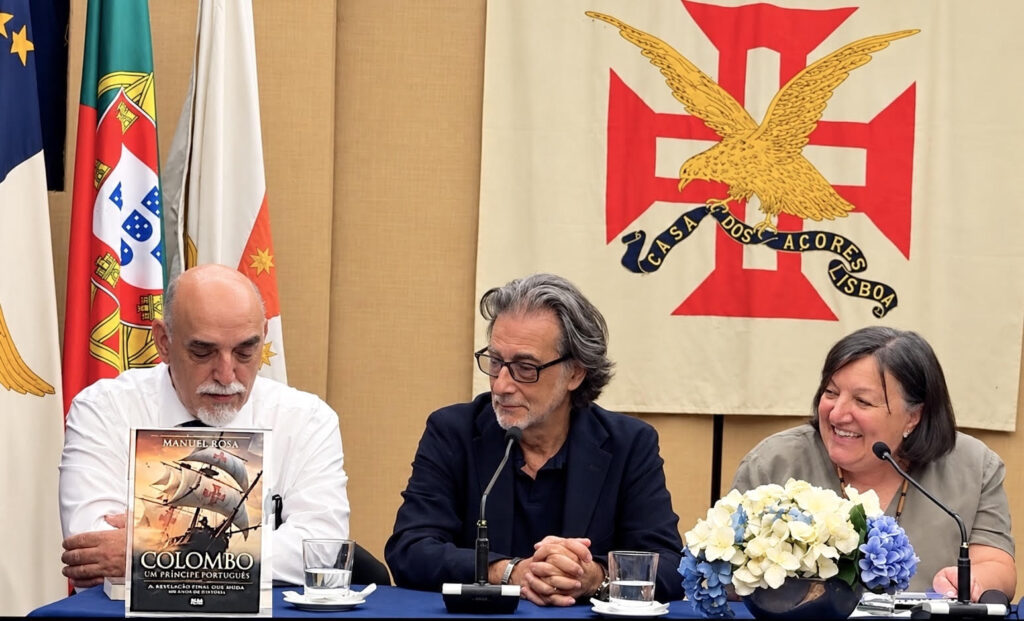
The book COLOMBO — Um Príncipe Português (COLUMBUS — A Portuguese Prince), by historian Manuel Rosa, PhD in Insular and Atlantic History (15th–20th centuries), will be presented on October 13, 2026, at 6:00 p.m., at Lagares d’El Rei, in Tomar, the former headquarters of the Knights Templar in Portugal.
The book brings together the findings of 35 years of research into the hidden identity of Don Cristóbal Colón. The investigation challenges the centuries-old belief that the 1492 discoverer of America was a peasant wool weaver from Genoa named Christopher Columbus. Documentary and genealogical evidence uncovered during the investigation, Rosa argues, disproves Columbus’s Italian origins and identifies him as Segismundo Henriques, a Portuguese prince of Polish-Lithuanian royal descent, born in the village of Madalena do Mar to King Władysław III of Poland.
Two Men, Two Biographies: A Five-Century Mystery Exposed
According to the book, the biographies of the Genoese weaver Columbus and the nobleman known in Spain as Don Cristóbal Colón were mistakenly merged into a single identity, a historically inconsistent narrative that historian Henry Harrisse helped consolidate in the nineteenth century and that has endured to the present day.
Dr. Rosa identifies three fundamental discrepancies: the absence of a continuous chain of contemporary documents linking the Genoese Christopher Columbus to Don Cristóbal Colón; the widespread acceptance among historians that “Cristóbal Colón” was a pseudonym; and incompatible birth dates. While the Genoese weaver was born in 1451, the man who sailed in 1492 wrote that he was 28 years old in 1484, placing his birth in 1456.
The argument goes further, stating that the navigator who married a Portuguese noblewoman in 1479, negotiated directly with European monarchs, and possessed advanced knowledge of navigation, science, and languages had a background incompatible with that of the Genoese weaver. The Catholic Monarchs appointed him “captain of the said three caravels” on April 30, 1492, acknowledging his social standing, maritime experience, and career.
Drawing on royal correspondence, court proceedings, chronicles, heraldry, and genealogical records, the investigation maintains that the discoverer’s true identity was deliberately concealed by royal courts as part of a strategic geopolitical secret.
Documents Link Polish Royalty to Madeira
While conventional history maintains that the young King Władysław III of Poland died fighting Ottoman forces at the Battle of Varna in 1444, the historian argues that no surviving document conclusively establishes his death on the battlefield and that Portuguese chronicles place the Polish king on Madeira.
The investigation uncovered a 1445 letter from the Polish court to Emperor Frederick III reporting the survival of Władysław III after the Battle of Varna. It also highlights another letter dated February 16, 1445, attributed to the monarch himself and preserved in Budapest, whose existence Rosa considers decisive: the king could not have written it if he had died in 1444.
The book also emphasizes that three years elapsed between the disappearance of Władysław III and the coronation of his brother Casimir as his successor on June 25, 1447. Rosa argues that such a delay could not happen if the king had died on the battlefield on November 10, 1444.
Furthermore, the research presents a German document from 1472, a genealogy from 1666 preserved in Lithuania, and fifteenth-century Portuguese records that, according to Rosa, make it possible to identify the lord of Madalena do Mar, Madeira, as King Władysław III.
The genealogical investigation traces the ancestry of Prince Segismundo Henriques of Madeira to royal families from Belarus, Poland, Constantinople, France, and Lithuania.
The research confirmed that Segismundo was also related to the historical figure known as Colombo the Younger, a Byzantine prince and Vice Admiral of France involved in late fifteenth-century naval warfare. Rosa maintains that this genealogical connection corroborates what Don Hernando Colón wrote about his father in 1539 in his biography of the Admiral.
Segismundo and his two brothers subsequently adopted the surname Colón in Spain, a veiled reference to the House of Colonna, to conceal their father’s identity. Segismundo’s kinship with the House of Colonna is documented in the sources presented in the book.
Academic Recognition and Historical Implications
Professor João Paulo Oliveira e Costa, Full Professor of History at NOVA University Lisbon, holder of the UNESCO Chair in Ocean Cultural Heritage, a leading Portuguese historian specializing in the Age of Discovery, and supervisor of Rosa’s doctoral dissertation, described the research as “a landmark in Portuguese historiography.”
In his assessment, Oliveira e Costa concluded:
“The navigator was necessarily born in Portugal and was necessarily a nobleman. Regardless of what other historians claim, it is impossible for the discoverer to have been the Genoese weaver Colombo.”
In 2007, Joaquim Veríssimo Serrão, one of Portugal’s most distinguished historians, former Rector of the University of Lisbon and longtime President of the Portuguese Academy of History, also expressed his support for Rosa’s research, writing:
“I agree with 99% of your research.”
Dr. Rosa also collaborated with Professor José Lorente of the University of Granada on earlier forensic investigations involving remains attributed to Columbus and his relatives and disputes claims that genetic studies have established the navigator’s Sephardic Jewish identity.
He emphasizes that DNA alone cannot conclusively establish a historical identity without a verifiable genetic match and that, in its absence, genetic findings can only provide indications that must be evaluated alongside documentary, genealogical, and heraldic evidence.
Among the elements he considers significant are Don Cristóbal Colón’s marriage in 1479 to Filipa Moniz, a lady of the Portuguese Christian high nobility, and the marriage of his son, Don Diego Colón, in 1508 to a cousin of King Ferdinand the Catholic. According to historical sources, the latter marriage was arranged at the insistence of the monarch himself to prevent a union with Doña Mencía de Guzmán, of the House of Medina Sidonia.
Although Oliveira e Costa supports rejecting the traditional Genoese identification of Christopher Columbus, the new evidence Rosa presents identifying the navigator as Prince Segismundo Henriques has only just been presented and has not yet been evaluated by the academic community.
A Historical Mystery Returns to Portugal
The presentation of COLOMBO — Um Príncipe Português in Tomar carries particular significance: Rosa brings his findings to a city deeply connected with the Knights Templar and the Order of Christ, which held Madeira Island as a possession and played a central role in Portugal’s maritime history. The book deciphers the navigator’s alias, XpoFerens Colón, as his motto, meaning Christ-Bearing Member.
Born on the island of Pico in the Azores, Rosa has published 15 books internationally and has received several literary awards for his historical research. His latest book builds on earlier investigations, including COLUMBUS — The Untold Story, recognized by The Huffington Post as the best world history book of 2016, and his doctoral dissertation, COLUMBUS versus COLÓN. The new work brings together documentary evidence collected over 35 years from archives across several European countries.
Although the Genoese identification of Christopher Columbus remains the prevailing historical consensus, the book presents an alternative reconstruction based on documents, many of them contemporary with the events, that can be independently examined.
The findings also carry implications beyond academic history. As President Donald Trump celebrates Christopher Columbus as an Italian historical hero during Columbus Day celebrations, Dr. Rosa’s investigation challenges the very foundation of that national identification. If the documentary evidence is confirmed, traditional Italian-American Columbus Day celebrations, including the famous parades in New York, Chicago, Cleveland, Pittsburgh, San Francisco, and Baltimore, may face an extraordinary historical reassessment: the man honored for generations as an Italian discoverer may actually have been a Portuguese prince of Polish royal descent.
If its conclusions are confirmed, they could transform our understanding of Portugal’s role in the Age of Discovery, Madeira’s place in world history, and Poland’s contribution, requiring history books to be rewritten.
For the Italians, these results may not be welcomed, but for the people of Madeira, the possibility is extraordinary: the navigator whose 1492 voyage transformed our world may have been born in Madalena do Mar, a village on the island where Rosa recently presented the documentary findings supporting his investigation.
Media Contact: Bruno Sancci
Email: brunosancci@gmail.com
Phone: +54 280 459-2884 | +54 9 280 429-8898
Radio Chubut – LU20, Patagonia, Argentina, 9100
Web: radiochubut.com
PHOTO: Dr. Manuel Rosa, Dr. José Calazans Duarte, and Dr. Delfina Porto during the presentation of COLOMBO — Um Príncipe Português at the Casa dos Açores in Lisbon.