
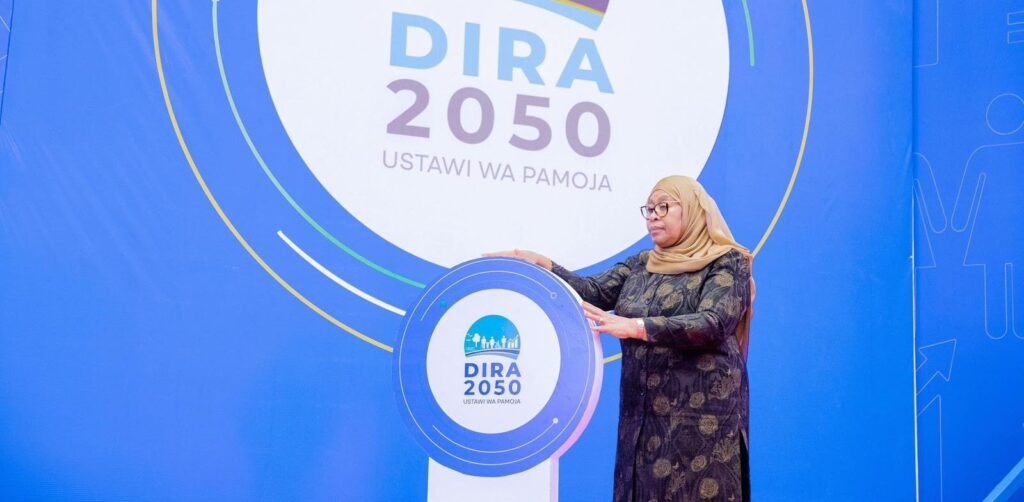
The Tanzania Development Vision 2050 outlines the country’s aspiration to become an upper-middle-income, competitive, inclusive, and sustainable economy, driven by productivity, knowledge, technology, and human capital.
For international investors and development partners, the vision signals policy continuity and strategic clarity at a time when global uncertainty has made long-term planning increasingly rare.
Unlike short-term policy programmes, Vision 2050 is designed as a generational framework. Its central premise is that structural transformation—rather than episodic growth—will determine Tanzania’s future prosperity. By articulating a clear direction over the next 25 years, the government aims to reduce policy risk and strengthen confidence among domestic and foreign stakeholders.
Tanzania’s economic performance over the past two decades provides much of the foundation for the new vision. Despite global shocks ranging from the COVID-19 pandemic to geopolitical tensions and financial market volatility, the country has maintained average annual GDP growth of around 5–6 per cent in recent years.
That resilience has distinguished Tanzania from many developing economies that experienced sharper slowdowns. While growth at this pace alone is insufficient to deliver upper-middle-income status, it provides a stable platform from which deeper reforms can be pursued.
Policymakers argue that Vision 2050 builds on this record by shifting the emphasis from growth driven largely by factor accumulation to growth underpinned by productivity, value addition, and technological adoption. In this respect, the vision reflects lessons drawn from East Asian and emerging-market development experiences.
A defining feature of Vision 2050 is its emphasis on economic diversification, widely viewed by international institutions as a key buffer against external shocks.
Agriculture remains central to Tanzania’s economy, contributing approximately 26.5 per cent of GDP and employing around 65 per cent of the workforce. The vision does not seek to diminish agriculture’s role, but to transform it. Priorities include modern farming techniques, irrigation, mechanisation, and agro-processing, aimed at raising productivity, increasing incomes, and strengthening food security.
Industry is positioned as the primary engine of structural change. Although industry already accounts for about 28 per cent of GDP, manufacturing’s share remains below 10 per cent. Vision 2050 sets a clear target: manufacturing and industry together should contribute 35–40 per cent of GDP by mid-century, driven by industrialisation, domestic value addition, and export-oriented production.
The services sector—including tourism, logistics, finance, and information and communications technology—is expected to continue expanding rapidly. Tourism alone accounts for roughly a quarter of export earnings, while services employ around 20 per cent of the workforce. The vision calls for globally competitive services underpinned by a digital economy, efficient logistics, and modern financial systems.
Mining, which generates around 30 per cent of export revenues but employs fewer than 5 per cent of workers, is targeted for deeper domestic beneficiation. Policies promoting local processing, stronger domestic participation, and value addition are intended to increase the sector’s contribution to employment and industrial development.
Together, agriculture, industry, services, and mining are intended to strengthen systemic economic resilience—a quality increasingly valued by global investors and credit-rating agencies.
Macroeconomic stability as an anchor
Vision 2050 places strong emphasis on preserving macroeconomic stability, long regarded as one of Tanzania’s core strengths. Inflation has remained relatively contained compared with many African peers, public debt is being managed within internationally accepted thresholds, and foreign exchange reserves have strengthened, supporting currency stability and import cover.
For international markets, these indicators are critical. Stable inflation and prudent debt management help lower sovereign risk premiums, while adequate reserves provide reassurance during periods of global financial tightening.
The vision explicitly acknowledges external vulnerabilities, including commodity price volatility, global interest rate cycles, and geopolitical shocks, framing economic resilience as a strategic objective. Domestic production capacity, reliable energy supply, and regional market integration are identified as key buffers against such risks.
A regional gateway strategy
Tanzania’s geographic position features prominently in Vision 2050. With access to the Indian Ocean and borders with eight countries, the nation is positioning itself as a regional hub for trade, logistics, and production.
Membership in the East African Community (EAC), the Southern African Development Community (SADC), and the African Continental Free Trade Area (AfCFTA) provides Tanzania with preferential access to a combined market of more than 1.3 billion people.
Investments in ports, railways, roads, and energy infrastructure are central to realising this gateway role. By improving connectivity with landlocked neighbours in East and Central Africa, Tanzania aims to capture greater value from transit trade and regional supply chains.
For manufacturers and logistics firms, this positioning offers scale advantages that are difficult to replicate elsewhere in the region.
Compared with several neighbouring countries, Tanzania’s relative strengths stand out. Long-standing political stability, social cohesion, and internal peace have reduced the risk of disruptive shocks that deter long-term investment.
The country also benefits from abundant natural resources, a large and growing domestic market, and infrastructure that—while still developing—has improved significantly in recent years.
These attributes place Tanzania among a group of African economies well suited to patient, long-horizon capital, particularly in infrastructure, manufacturing, agribusiness, and energy.
International financial institutions have repeatedly highlighted Tanzania’s progress in policy discipline, infrastructure investment, and business environment reforms. The International Monetary Fund, World Bank, and African Development Bank have all cited the country’s efforts to balance growth with macroeconomic stability and social inclusion.
Such assessments lend credibility to Vision 2050 as an implementable framework rather than a purely aspirational document. For development partners, this credibility is critical when aligning financing and technical assistance with national priorities.
Growth with citizens at the centre
While Vision 2050 is framed in economic terms, its core objective is social transformation. Job creation—particularly for young people—features prominently. Raising household incomes, reducing poverty, and expanding access to essential services such as education, healthcare, water, and energy are explicit goals.
This emphasis reflects a recognition that sustained growth must translate into tangible improvements in living standards to remain politically and socially sustainable.
At the launch of the vision in July 2025, President Samia Suluhu Hassan underscored the importance of leveraging domestic resources to build a more self-reliant economy, while acknowledging the scale of the challenges ahead.
Her remarks were echoed by the Minister for Planning and Investment, Kitila Mkumbo, who highlighted democracy, justice, unity, environmental sustainability, and cultural values as guiding principles underpinning Vision 2050.
Notes to Editors
- This is an in-depth policy and economic analysis rather than a breaking news report. It is best positioned as a strategic outlook, policy explainer, or investor-focused feature on Tanzania’s long-term development trajectory.
- The article centres on Tanzania Development Vision 2050 as a generational framework, emphasising policy continuity, macroeconomic stability, diversification, and structural transformation.
- It is particularly relevant to audiences interested in Africa’s long-horizon growth prospects, including institutional investors, development finance institutions, multilateral organisations, and policy analysts.
Media Contact:
Information Services Department and Office of the Chief Government Spokesman
Email: maelezotv@gmail.com
Phone: +255 754 750 765, +255 754 698 856, +255 759 714, +255 713 381 904
Availability: EAT (UTC +3)
ENDS