

[PRESSWIRE] 31 October 2026 — The strike on a crowded railway platform in Ukraine illustrates the human consequences of drone warfare. A developing Russian satellite network raises a separate concern: how future remotely controlled systems could challenge civilian security far beyond the battlefield.
A passenger train was standing at a platform in the Ukrainian city of Dnipro when a Russian jet-powered drone struck the railway station. By the following morning, 15 people had been reported dead. Among the injured was an 11-year-old boy.
Photographs released by Ukraine’s emergency services showed damaged trains, casualties on the platform and rescue workers carrying injured passengers to safety.
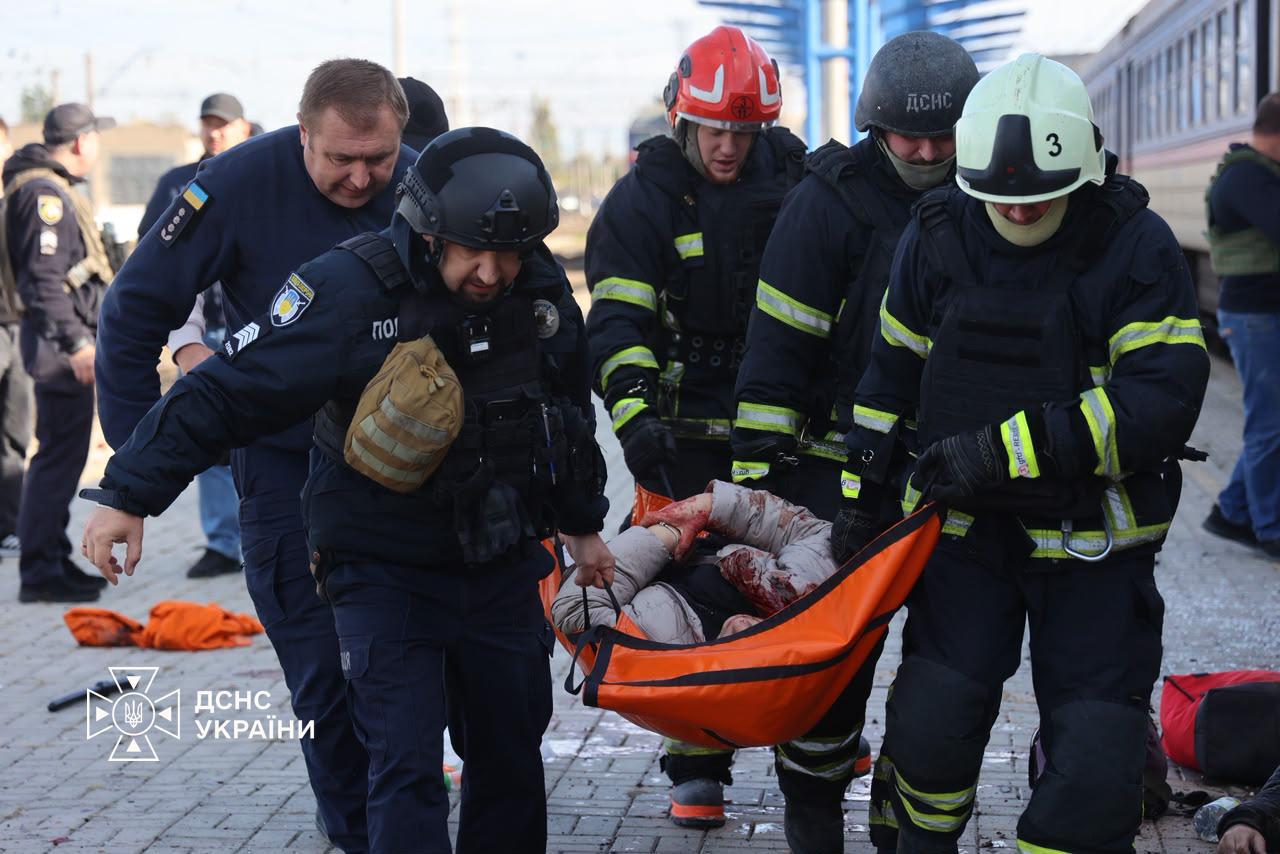
The attack was a documented incident of Russia’s ongoing drone campaign against Ukraine. It also raises a broader question for governments responsible for protecting European and American civilians: what additional risks could emerge as long-range weapons become increasingly capable of receiving information and instructions through independent satellite networks?
Russia is developing precisely such a communications infrastructure.
Its name is Rassvet.
A railway platform, a drone and the question of human control
The strike in Dnipro occurred on an ordinary railway platform where a commuter train and a scheduled passenger service were standing.
These were not military vehicles. The station served people making everyday journeys.
Images from the aftermath showed the consequences of a weapon striking a place where civilians had gathered: shattered windows, damaged railway carriages, emergency responders and the bodies of victims.
The question of what the drone’s operator could see is particularly important.
Some attack drones follow pre-programmed routes. Others can transmit information from onboard sensors and receive instructions from an operator during flight. Such capabilities can allow a human controller to observe a target area, assess changing conditions or alter a planned course of action.
There is no publicly verified evidence establishing whether the particular drone that struck Dnipro transmitted a continuous live video feed to its operator, or precisely what information was available in the moments before impact.
That distinction matters. But it does not diminish the significance of developing weapons that can provide their operators with increasingly immediate information about where they are heading.
The development of satellite communications could extend the distances across which some of those capabilities are available.
The operator may be far away. The consequences are local.
Imagine a drone launched from a concealed location somewhere in Europe.
It could be close to a busy railway station, an airport, an embassy district or a city centre. Its operator might be far beyond the immediate area, receiving information and potentially issuing commands through a satellite communications network.
The buildings below could be a library, a restaurant, a cafe or a crowded transport terminal.
A satellite connection would not, by itself, allow a drone to strike any location at will. Such an attack would still require a suitable aircraft, launch access, operational communications coverage and the ability to overcome security measures.
Nevertheless, the possibility of separating the operator from the launch site introduces additional complications for intelligence agencies, law enforcement and air-defence planners.
This is not merely a hypothetical scenario invented for a newspaper article.
In an interview with Interfax-Ukraine, Major General Illia Pavlenko, a former deputy chief of Ukrainian military intelligence, described the possibility of a drone being launched from a civilian vessel in the English Channel or a rented trailer in Europe and then directed towards London or Paris using Russian satellite communications.
Pavlenko warned that Rassvet could provide infrastructure for operations against countries outside Ukraine.
His comments described a prospective threat, not a confirmed attack plan. The technical and operational feasibility of such an operation would depend on several factors, including the maturity of the satellite constellation.
For Western governments, however, the broader security question is clear: remote communications technology could alter the relationship between the location of an attacker, the location of a weapon and the civilian infrastructure potentially at risk.
What Russia is building
Rassvet, meaning ‘Dawn’, is Russia’s developing low-Earth-orbit broadband satellite network.
The programme is led by Bureau 1440, part of the Russian technology group ICS Holding.
In March and July 2026, Russia launched two groups of 16 production satellites. The resulting constellation remains considerably smaller than SpaceX’s Starlink and does not yet provide comparable continuous coverage.
Nevertheless, Rassvet has moved beyond the experimental stage.
According to reporting by defence intelligence publication Janes, Ukrainian military intelligence observed Russian forces using the initial satellites for communications over Ukrainian territory for several hours by late July.
Ukrainian military officials have identified potential military uses ranging from secure data transmission to communications with reconnaissance and strike drones.
The public evidence does not demonstrate that Rassvet directed the attack on Dnipro’s railway station.
The immediate concern is the military potential of the infrastructure being constructed.
On 29 October, Russian Digital Development Minister Maksut Shadayev described government control and filtering of internet traffic as one of the intended features of the network.
Russia has also announced plans for a constellation of approximately 300 satellites by 2028.
The proposed expansion would require substantial industrial resources, specialised manufacturing equipment, electronics, communications technology and launch infrastructure.
It is at this industrial level that Western sanctions and export controls become especially relevant.
Forty-nine organisations and the international supply-chain question
An investigation published through Ukraine’s War&Sanctions database identified 49 Russian and Belarusian organisations associated with the Rassvet programme.
The list includes satellite manufacturers, electronics suppliers, engineering companies, scientific institutions, financial organisations and entities associated with Russia’s space industry.
Among the organisations identified are:
- Bureau 1440, the principal developer and system operator.
- ICS Holding, the parent technology group.
- Roscosmos, responsible for significant elements of Russia’s space infrastructure.
- Rocket and Space Centre Progress, associated with launch vehicles.
- NPO Lavochkin, involved in space hardware and launch-related systems.
- Special Technological Centre, identified as a participant in the development of satellite communications equipment.
- VTB Bank, identified as an investor in the programme.
According to the intelligence assessment, 23 of the 49 organisations were not subject to sanctions from any member of the international sanctions coalition when the findings were published.
The figures provide a starting point for regulatory investigation rather than proof that every identified organisation has engaged in unlawful conduct.
They also raise a specific question about the international availability of equipment required to manufacture, expand and maintain the constellation.
Modern satellite systems depend on specialised microelectronics, advanced manufacturing machinery, optical components, communications equipment and software.
Many of these technologies are produced or supplied through international markets, including companies and intermediaries operating in Western jurisdictions.
The presence of foreign technology in a Russian industrial programme does not necessarily establish a current violation of sanctions. Equipment may have been obtained before restrictions, through lawful transactions or through channels requiring further investigation.
But the distinction between the origin of technology and the effectiveness of restrictions on its supply is central to the sanctions debate.
What the European Union and United States can control
The European Union has already adopted significant restrictions targeting Russia’s military-industrial sector.
On 12 October, it announced sanctions listings affecting 1,569 individuals and entities, including companies involved in supplying components for missiles, drones, aircraft and satellite-related systems.
The restrictions cover areas such as semiconductors, microcircuits, communications equipment, optical technology and navigation systems.
The United States, United Kingdom and other international partners also operate sanctions and export-control regimes affecting Russian military procurement and access to advanced technology.
The issue is therefore not whether the West has acted at all.
It is whether existing measures comprehensively cover the Rassvet programme’s relevant suppliers, intermediaries, financial channels and technical dependencies, and whether those measures are being effectively enforced.
A company listed under one jurisdiction’s restrictions may not be subject to identical measures elsewhere. A component prohibited for direct export may still be vulnerable to diversion through intermediaries.
Such differences create enforcement challenges that require cooperation between customs agencies, regulators, financial institutions and manufacturers.
A targeted review of the Rassvet supply chain could identify where additional legal restrictions, investigations or compliance measures are justified.
What sanctions could achieve – and what they cannot
Rassvet’s expansion is not simply a matter of launching more satellites.
A larger constellation requires a continuing supply of components, qualified manufacturing capacity, specialised equipment, software development, ground terminals and financing.
Restrictions affecting critical inputs could increase procurement costs, complicate maintenance, delay manufacturing or slow the expansion of the network.
Those consequences could provide additional time for European and American governments to assess possible threats, strengthen critical-infrastructure protection and improve counter-drone capabilities.
Such an outcome is not guaranteed.
Russia could seek alternative suppliers, substitute technologies or additional domestic production. Nor would restrictions on Rassvet eliminate the threats posed by drones that use different navigation and communications systems.
Sanctions should therefore be evaluated alongside air defence, intelligence cooperation, infrastructure protection and law-enforcement preparedness.
The practical question for Western policymakers is which additional measures could materially affect the programme’s development, how quickly they could be implemented and whether international coordination could make them more effective.
A threat that requires careful assessment before it matures
The Rassvet constellation remains incomplete, and its future military applications are not all established.
But the development of the infrastructure is real. Satellites have been launched, organisations have been identified and Russian officials have described plans to expand the system.
The attack in Dnipro is a separate documented event. It demonstrates the consequences of drone warfare against a civilian transport hub, not the operational capability of Rassvet itself.
For European and American security agencies, the relevance lies in the combination of existing threats to civilian infrastructure and the possibility that new communications systems may provide future weapons with additional operational flexibility.
A cafe in Paris, a railway station in Warsaw, an embassy in London or a passenger bus in another European city would remain civilian places regardless of how an attacking weapon received its instructions.
Protecting such places involves more than responding after an attack.
It also involves examining the industrial systems that could enable new capabilities, applying existing export restrictions effectively and determining where further controls may be justified.
For governments reviewing the Rassvet programme, the question is not whether sanctions alone can prevent every future threat. They cannot.
The question is whether coordinated controls over technology, equipment and financing can slow an emerging capability while European and transatlantic security institutions improve their preparedness.
That is a question worth addressing while the constellation is still under construction, rather than after its capabilities have expanded.
Sources and verification
Publisher links embedded directly in the preceding article are also clickable.
01 Dnipro: casualty figures and rescue reporting
Ukrainska Pravda (30 October); Ukrinform (30 October)
Open source document
02 Remote drone scenario attributed to Illia Pavlenko
Interfax-Ukraine interview (13 October)
Open source document
03 Rassvet satellite communications observed by Ukraine
Janes, interview with Ukrainian Defence Intelligence
Open source document
04 Russian minister on Rassvet traffic control and expansion
iXBT report quoting Maksut Shadayev (29 October)
Open source document
05 Industrial participants in the Rassvet programme
War&Sanctions enterprise registry, Ukrainian Defence Intelligence
Open source document
06 EU sanctions package against Russia military industry
Council of the European Union (12 October)
Open source document
Reporting, attributed assessments and scenarios are distinguished in the article. A cited assessment is not evidence that Rassvet guided the Dnipro attack.