
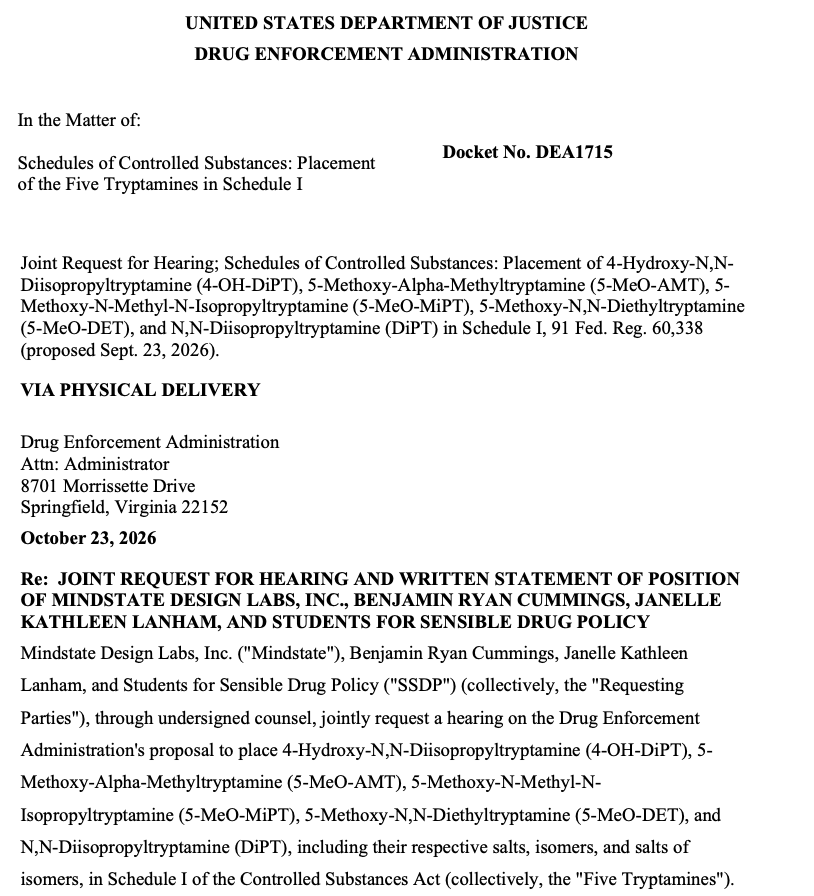
[PRESSWIRE] October 26, 2026 – WASHINGTON, D.C. —Students for Sensible Drug Policy (SSDP), alongside two early-career scientists and MindState Design Labs, represented by Robert T. Rush of the Rights and Reason Project and SSDP General Counsel Brett Phelps, have filed a formal request for an administrative hearing challenging the Drug Enforcement Administration's (DEA) proposal to place five psychedelic research compounds in Schedule I of the Controlled Substances Act (CSA). The proposal would criminalize unauthorized activities involving currently unscheduled compounds, create new barriers to scientific research, and potentially jeopardize the development of a promising postpartum depression treatment that has received FDA Breakthrough Therapy Designation.
"President Trump has directed federal agencies to accelerate psychedelic research and expand access to promising treatments, and the FDA is recognizing breakthrough therapies and advancing clinical development. So why is the DEA acting like a lone wolf, working against science, medicine, the President's own priorities, and the American people who stand to benefit from these discoveries?" said Kat Murti, Executive Director of Students for Sensible Drug Policy. "Instead of removing barriers to medical innovation, the DEA is proposing to criminalize promising research compounds. It's time for the DEA to get on the same page as the rest of the administration."
The joint hearing request challenges the proposed scheduling of
the proposed scheduling of 4-Hydroxy-N,N-Diisopropyltryptamine (4-OH-DiPT), 5-Methoxy-alpha-Methyltryptamine (5-MeO-AMT), 5-Methoxy-N-Methyl-N-Isopropyltryptamine (5-MeO-MiPT), 5-Methoxy-N,N-Diethyltryptamine (5-MeO-DET), and N,N-Diisopropyltryptamine (DiPT) in Schedule I of the Controlled Substances Act (CSA).
The consequences extend well beyond drug policy. One of the compounds targeted by the DEA is closely related to an investigational treatment for postpartum depression that has received FDA Breakthrough Therapy Designation. Another has already advanced into human clinical trials. SSDP argues that imposing Schedule I restrictions would criminalize unauthorized activities involving these research compounds and create unnecessary regulatory barriers just as scientists are investigating their potential medical applications.
For Young Scientists, the Stakes Are Personal
For Dr. Benjamin Cummings and Dr. Janelle Lanham, both members of SSDP's Science Policy Committee (SPC), this challenge is about protecting years of research and their ability to continue making scientific discoveries. Both have joined SSDP and MindState Design Labs as named parties in the hearing request because the proposed restrictions would directly affect their work and professional futures.
Dr. Cummings, a postdoctoral researcher conducting work at Louisiana State University Health Sciences Center and participating in research programs at the University of South Florida, has spent approximately six years studying how psychedelic compounds interact with the serotonin 2A receptor. His research investigates whether beneficial anti-inflammatory and therapeutic effects can be separated from hallucinogenic effects — an important question for developing new medicines.
His research with DiPT and 4-OH-DiPT has identified a meaningful difference between two closely related compounds: 4-OH-DiPT exhibits anti-inflammatory activity that DiPT does not. This is precisely the kind of compound-specific evidence SSDP argues the DEA must consider before imposing broad restrictions.
Dr. Cummings has research manuscripts under peer review or in preparation and is seeking his next academic position based on this work. Schedule I placement could make it more difficult to find an institution willing and equipped to support his research, complicate grant and fellowship applications, and delay the experiments on which his future work depends.
“I’ve spent the last five years leveraging several of these substituted tryptamines and their related analogues in researching psychedelic functional selectivity,” said Dr. Cummings. “Compounds in this family are demonstrating unprecedented efficacy in the treatment of a wide range of mental health disorders for which we don’t currently have good pharmacological answers. My work aims to untangle the hallucinogenic properties of these compounds, which limit their potential as therapeutics, from the beneficial outcomes that patients desperately need. We won’t be able to develop this next generation of treatments without the tools needed to understand the underlying mechanisms. Schedule 1 designation increases barriers to research, harming in-need patient populations by preventing care, and in some cases outright preventing science that would reduce harm.”
Dr. Lanham, a postdoctoral researcher at the Medical College of Wisconsin, earned her doctorate in December 2025. Four of the five compounds targeted by the DEA — 4-OH-DiPT, 5-MeO-MiPT, 5-MeO-DET, and DiPT — were integral to her graduate research. She is preparing a manuscript representing a substantial portion of her doctoral work for publication.
If additional experiments are needed to complete the manuscript, respond to peer reviewers, or validate her findings, Schedule I restrictions could delay that work. For a scientist at the beginning of her career, those delays could affect publication opportunities, future research positions, and professional advancement.
These are not hypothetical concerns about research that might someday happen. They involve scientists who have already devoted years to studying these compounds and whose ongoing work could be disrupted by new regulatory barriers.
MindState Design Labs also has a direct stake in the proceedings. The company is actively developing 5-MeO-MiPT-based treatments and has accumulated controlled human clinical data, dose-response observations, physiological measurements, and neuroimaging findings. Schedule I placement would introduce additional registration, security, storage, transfer, and recordkeeping requirements that could complicate its research, partnerships, and drug-development pipeline.
Although the DEA states it will notify the requesting parties of acceptance or nonacceptance "within a reasonable period of time," SSDP expects to hear the decision on the petition in the next one to two months.
In addition to the hearing request, SSDP has filed an official comment in the Federal Register docket. The comment highlights the ongoing clinical developments of these compounds and the serious research harms that Schedule I placement would produce. These compounds warrant further study — not a return to failed prohibitionist policies.
Five Compounds, Distinct Scientific Applications, and Serious Consequences for Research
Like most psychedelic drugs, 4-OH-DiPT, 5-MeO-AMT, 5-MeO-MiPT, 5-MeO-DET, and DiPT interact with the serotonin 2A receptor. However, sharing a receptor does not mean these substances have identical pharmacological properties, effects, risks, or potential applications. Each compound has a distinct scientific profile, and the available evidence varies considerably among them. Grouping these five substances together for Schedule I placement risks overlooking important differences in their abuse potential, therapeutic applications, and value to scientific research. Each should therefore be evaluated individually, based on compound-specific evidence rather than structural similarities or shared mechanisms of action.
The stakes are particularly high for a promising new treatment for postpartum depression. Reunion Neuroscience’s lead drug candidate, luvesilocin (RE104), is a patented, shorter-acting prodrug of 4-OH-DiPT that has received Breakthrough Therapy Designation from the FDA for postpartum depression. This designation recognizes the potential of an investigational treatment to offer substantial improvement over existing therapies for a serious condition. The DEA’s proposal to place 4-OH-DiPT and its “salts, isomers, and salts of isomers” in Schedule I could create significant regulatory uncertainty and potentially subject this promising treatment to additional restrictions just as it advances toward Phase 3 clinical trials. At a time when the FDA is working to accelerate promising treatments, the DEA's proposal threatens to introduce new obstacles to their development.
And this is not the only compound already being investigated in human clinical trials. 5-MeO-MiPT has advanced into human clinical research through MindState Design Labs’ formulation, MSD-001. A Phase 1 study involving 47 healthy participants reported that the formulation was well tolerated across the tested dose ranges. These findings underscore the importance of allowing researchers to continue investigating the compound's safety, pharmacology, and potential therapeutic applications rather than imposing additional barriers to that work.
Other compounds targeted by the proposal have distinct scientific value, even where clinical applications remain less developed. Unlike many other psychedelics, DiPT is notable for its unusual effects on auditory perception rather than the visual effects more commonly associated with this class of substances. This distinctive pharmacological profile makes it a potentially valuable research tool for understanding how the brain processes sound and may inform future investigations into debilitating auditory conditions such as tinnitus and diplacusis. Restricting access to DiPT could unnecessarily impede research into neurological processes that remain poorly understood.
5-MeO-AMT has a distinctive pharmacological profile, including a relatively long duration of action and reported differences in psychostimulant effects compared with other serotonergic substances. Preliminary animal research has raised questions about its abuse liability that warrant further investigation rather than assumptions based on its structural similarities to other psychedelics. Its characteristics may make it useful for studying the complexities of the serotonin system, which plays an important role in neuropsychiatric and neurological conditions as well as fundamental physiological functions such as sleep and appetite.
Of the five compounds, 5-MeO-DET remains comparatively understudied, with limited available evidence regarding its human effects, patterns of use, safety, and potential applications. But a lack of evidence is not itself evidence of high abuse potential. Rather, it underscores the need for further scientific investigation. Placing 5-MeO-DET in Schedule I would likely discourage the very research needed to better understand its pharmacology, risks, and potential applications, unnecessarily limiting opportunities for scientific discovery and innovation.
“From an investigational postpartum depression treatment with FDA Breakthrough Therapy Designation to compounds that could help researchers better understand the brain, these five substances represent very different areas of scientific inquiry,” said Murti. “The DEA should evaluate the evidence for each one, rather than treat them as interchangeable simply because they belong to the same broad family of psychedelics.”
SSDP Has Challenged the DEA Before — and Established a Critical Research Precedent
This is not the first time SSDP has challenged the DEA over restrictions that could obstruct scientific research.
Beginning in 2022, SSDP joined the fight to keep psychedelic research legal. In 2024, SSDP was granted a hearing to challenge the DEA’s proposed ruling to place two other psychedelics, 2,5-dimethoxy-4-iodoamphetamine (DOI) and 2,5-dimethoxy-4-chloroamphetamine (DOC), into Schedule I of the CSA. This challenge was led by SSDP’s Science Policy Committee co-founder Dr. Elijah Ullman and current SPC Chair, Dr. Alaina Jaster.
The hearing took place over 10 days and featured key testimony from several students and postdoctoral researchers, as well as experts in the field such as Dr. David Nichols, the inventor of radio-labeled DOI which has changed the course of neuroscience research.
A central focus of the testimony was research harm: the added time, costs, and administrative burden incurred by researchers when a previously legal research chemical is scheduled under the Controlled Substances Act. This hearing marked the first time in a DEA scheduling proceeding where harms to scientific research were recognized as relevant to the agency’s scheduling decision — establishing a precedent that the consequences of scheduling for science cannot simply be ignored.
“This idea that they’re dangerous substances and their regulation by the DEA, in my opinion, has been a disinhibiting effect. It’s kept people out of the field for more than 50 years,” said Dr. Nichols at the Administrative Hearing for DOI/DOC. “These discoveries could have been made years ago if these drugs had been more available for researchers. The claim is that by regulating them, it doesn’t keep legitimate researchers out of the field, but it does, in fact. And if you talk to anyone in the field, they’ll tell you.”
Building on the precedent set in the DOI/DOC case, SSDP argues that scheduling these tryptamines could prevent important scientific discoveries and delay the development of promising treatments for severe psychiatric and neurological disorders. Researchers would face the additional burden of obtaining DEA Schedule I registrations, a costly and time-consuming process that could derail ongoing studies and discourage future research.
“I’m proud to be a part of SSDP’s continued fight against the DEA’s unchecked power to make decisions that impact the larger medical field,” said Dr. Jaster. “As someone who has worked directly with patients and has been involved in all stages of research and development throughout my career, I’ve seen firsthand the complexity of regulations on drug development. The added burden of Schedule I further complicates the already laborious process of medical research from recordkeeping to manufacturing to the research itself. Further, any clinical trials underway must immediately stop participant dosing while the researchers apply for a Schedule I registration and sort out regulatory compliance, which can delay the study up to 18 months. That is unacceptable for patients who are counting on these clinical trials for new treatments.”
Does the DEA Have the Evidence to Justify Schedule I?
The legal challenge goes beyond the impact on scientific research. SSDP and its partners are questioning whether the DEA has met the legal and scientific requirements necessary to place any of these five compounds in Schedule I.
“We are challenging this proposed scheduling because Schedule I is not supposed to be the government’s default response to scientific uncertainty,” said Robert T. Rush, founder and executive director of the Rights and Reason Project. “Before imposing the most restrictive classification available, DEA should be required to demonstrate, with reliable and compound-specific evidence, that each of these substances actually satisfies the statutory requirements for Schedule I. These compounds are important to scientific research, and the government cannot ignore the real harm that unnecessary scheduling can cause by making legitimate research more difficult, expensive, and sometimes impossible. This case is about demanding evidence, transparency, and accountability before the government places another barrier in the way of science.”
Under the Controlled Substances Act, Schedule I placement requires three separate findings: high potential for abuse, no currently accepted medical use in treatment in the United States, and a lack of accepted safety for use under medical supervision. SSDP argues that the DEA must demonstrate that each compound independently meets all three requirements, rather than relying on assumptions about psychedelics as a class.
Central to the challenge is the DEA's interpretation of "high potential for abuse." Psychoactive effects, structural similarities to other psychedelics, or activity at the serotonin 2A receptor do not automatically establish that a substance has a high potential for abuse.
The DEA's proposal relies in part on 65 poison-center exposure cases involving one or more of the five compounds, along with generalized comparisons to other scheduled hallucinogens. But those reports do not necessarily establish high abuse potential for each individual compound, particularly when the available data may involve multiple substances, uncertain product identification, and limited information about the total number of people exposed.
The filing also challenges the DEA's treatment of the other two Schedule I requirements. The absence of FDA marketing approval does not automatically establish that a substance has no currently accepted medical use or lacks accepted safety under medical supervision. Those are separate statutory questions that require independent analysis, not conclusions inferred from one another.
These concerns are especially timely. A September 2026 Government Accountability Office report identified gaps in DEA and FDA procedures for conducting eight-factor scheduling analyses, including the criteria used to evaluate potential and relative potential for abuse. The Department of Justice and Department of Health and Human Services concurred with the GAO's recommendations. Although the report does not determine whether this particular proposal is scientifically invalid, its findings reinforce the need for transparent, consistent standards and careful scrutiny of the evidence.
“Once again the DEA is attempting to schedule compounds in an approach that is not based on science or in the interest of protecting public health,” said Brett Phelps, legal counsel for SSDP. “These tryptamines are being researched for their potential medical benefits and placing them in Schedule I would significantly impede that research. Once again, SSDP is fighting back in the name of science and common sense. We look forward to presenting our case in defense of these molecules.”
Beyond the scientific and legal questions, SSDP is challenging the DEA's assessment of the real-world costs of Schedule I restrictions. The agency assumes that researchers working with these compounds are likely already registered to handle other controlled substances. But for early-career scientists, university laboratories, and independent researchers, that assumption may not reflect reality.
Obtaining access to Schedule I compounds can require additional registrations or institutional authorizations, security measures, storage facilities, research protocols, recordkeeping, and compliance procedures. Those costs can determine whether a laboratory can continue its work at all, particularly when researchers are working under time-limited appointments or grants.
The requesting parties argue that the DEA has not adequately demonstrated that its proposal would avoid significant economic impacts on affected small entities. They are asking the agency to reconsider those costs, make the scientific evidence underlying its proposal available for meaningful review, and evaluate alternatives that protect public safety without unnecessarily obstructing research. These could include considering whether existing laws, such as the Federal Analogue Act where applicable, adequately address unlawful markets; evaluating less restrictive scheduling approaches where legally appropriate; and establishing transition measures or research accommodations to prevent interruptions to ongoing studies.
Ultimately, the challenge asks a fundamental question: If the DEA cannot demonstrate that each of these compounds meets the legal requirements for Schedule I, why should scientists, patients, and promising medical research bear the consequences?
Science, Not Prohibition: A Sensible, Evidence-Based Approach
As the world’s largest youth-led network dedicated to ending the War on Drugs, SSDP believes drug policy should be guided by evidence — not fear.
SSDP's hearing request and public comment urge the DEA to reject the proposed scheduling, which could disrupt critical scientific research, prevent important discoveries, and delay the development of potentially lifesaving treatments for psychiatric and neurological conditions. Rather than improving public safety, these restrictions risk driving production and distribution underground, expanding illicit markets, and repeating the same failed prohibitionist policies that have done little to protect public health.
Instead of prohibition, SSDP calls for continued research and the development of an evidence-based regulatory framework that protects public health without unnecessarily obstructing scientific progress. This includes reevaluating the existing eight-factor analyses, associated research harms, and seeking input from HHS and FDA.
“These are the kinds of policies that actually protect opportunities for medical innovation and the public,” said Naomi Shifman, SSDP Policy Chair and an Elected Director on SSDP’s youth-led Board. “Protecting public health and protecting scientific research should not be competing priorities. Sound drug policy must do both.”
Support the Fight for Science and Sensible Drug Policy
SSDP's challenge to the DEA is part of its ongoing work to protect scientific research, advance evidence-based drug policy, and empower the next generation of advocates. Guided by the belief that the War on Drugs is a War on Us, SSDP works to replace prohibition with policies rooted in science, compassion, and human rights.
Those interested in supporting SSDP's research, education, and advocacy efforts can contribute to the organization. Contributions toward legal expenses associated with the DEA hearing can be made directly to the Rights and Reason Project.
With chapters on campuses and in communities across the country, Students for Sensible Drug Policy (SSDP) is the largest youth-led grassroots network dedicated to replacing War on Drug policies with those rooted in evidence, compassion, and human rights.
###
For more information, please visit ssdp.org.
Contact:
Kat Murti
Executive Director
Students for Sensible Drug Policy