
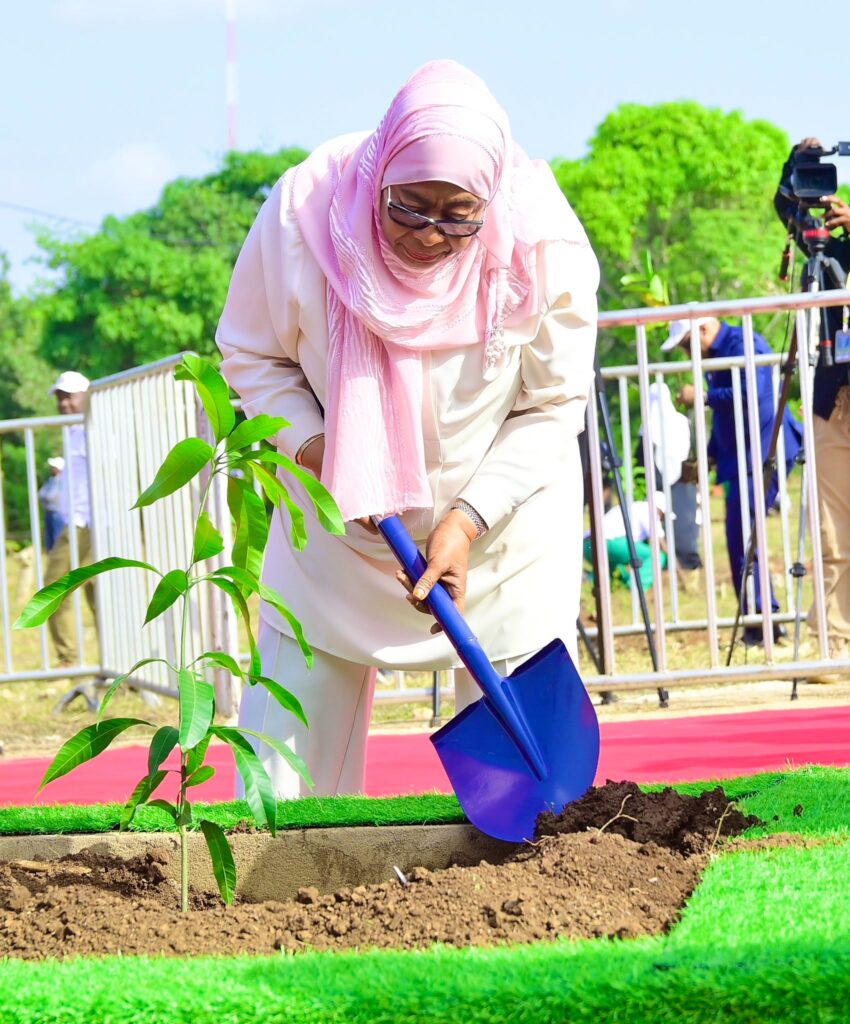
Speaking during a tree-planting event in South Unguja to mark her birthday, Samia said urban development must incorporate environmental protection to safeguard food security, public health and long-term economic stability.
“Tree planting is not a ceremonial act. It is a practical response to climate change,” she said, urging citizens to plant and protect trees around homes, schools, workplaces and community spaces.
The move comes as East Africa faces mounting climate pressures, including prolonged droughts, erratic rainfall and flooding. Kenya and Uganda have in recent years expanded urban greening and watershed protection programmes, while Rwanda has embedded climate-sensitive urban planning into its national green growth strategy.
Across the region, climate shocks have disrupted agriculture, strained water supplies and increased the cost of disaster response, according to regional climate assessments and UN agencies.
Samia linked environmental conservation to poverty reduction, noting that healthy ecosystems support agriculture, clean air and water, and emerging income streams such as carbon trading. She cited projects in western Tanzania where communities are already benefiting from carbon credit initiatives.
Globally, the United Nations has urged governments to accelerate nature-based solutions, including urban tree cover and ecosystem restoration, as cost-effective tools for climate adaptation and mitigation.
The World Bank estimates that green infrastructure can significantly reduce heat stress and flooding in rapidly urbanising countries.
Samia said climate change is already affecting Tanzania through rising temperatures, unpredictable rainfall, floods and coastal pressures, threatening food production, water security and economic development.
She instructed regional and district authorities to rehabilitate degraded land, including former sand-mining sites, through tree planting and ecosystem restoration, and called for the revival of indigenous and fruit tree species lost to deforestation and urban expansion.
Minister of State in the Vice-President’s Office (Environment), Hamad Yussuf Masauni, said Tanzania has accelerated environmental reforms under Samia’s leadership, highlighting the National Clean Cooking Energy Strategy, which aims to ensure more than 80% of households use clean cooking solutions by 2034 to reduce deforestation and emissions.
Local officials said more than 1,700 trees were planted during the Zanzibar event, while over 62,000 trees and 10,000 mangroves have been restored across South Unguja in the past year.
Samia has increasingly framed climate resilience, clean energy and sustainable urban development as central to Tanzania’s long-term growth strategy, aligning national policies with regional climate action and global development goals.
Notes to Editors
– This story focuses on climate change policy, environmental governance and sustainable urban development in Tanzania, highlighting executive-level directives from President Samia Suluhu Hassan.
– It places Tanzania’s urban greening initiative within a broader East African and global context of climate adaptation, nature-based solutions and resilient city planning.
– The article links environmental protection with economic outcomes, including food security, public health, poverty reduction and emerging green finance mechanisms such as carbon credits.
Media Contact:
Information Services Department and Office of The Chief Government Spokesman
E-mail: maelezotv@gmail.com
Phone: +255 754 750 765, +255 754 698 856, +255 759 714, +255 713 381 904
Availability: EAT, UTC +3
ENDS