
In 2026, UK press release distribution costs between roughly £45 and £900 for a single release, with most one-off distributions landing between £95 and £300. Subscriptions start around £290 a month. The American wire services — PR Newswire, Business Wire, GlobeNewswire — do not publish prices at all, but are reported to charge from around $350 to well over $1,000 per release once word-count and multimedia fees are added.
That is a tenfold spread for something described on every website with the same three words. The spread is real, and it is not mostly about quality of service. It is about what you are actually buying, which differs far more between providers than the phrase “press release distribution” suggests.
UK prices, side by side
Every figure below comes from the provider’s own published pricing page, checked on 31 August 2026.
| Provider | One-off release | Subscription / bundle | VAT |
|---|---|---|---|
| PR Fire — guaranteed publishing | from £45 +VAT | — | +VAT stated |
| PR Fire — distribution | £95 +VAT ($150) | Bulk bundles, price on application | +VAT stated |
| Pressat — pay as you go | from £110 per submission | £880 for 10 releases; from £290/month for 5 | Not stated on page |
| Presswire — UK distribution | £185 ($250 / €220) | — | +VAT for UK businesses |
| Presswire — Press Association MEDIAPOINT | £175 ($235 / €205) | — | +VAT for UK businesses |
| PA Media — the same wire, bought direct | £450 +VAT | — | +VAT stated |
| Presswire — online syndication | £215 ($290 / €250) | — | +VAT for UK businesses |
| Presswire — global distribution | £300 ($400 / €350) | — | +VAT for UK businesses |
| PR Fire — UK Regional Newswire | £600 +VAT | — | +VAT stated |
| PR Newswire / Business Wire / GlobeNewswire | No published price | No published price | n/a |
A note on our own entry in that table: Presswire is not the cheapest option on this page and does not try to be. £185 for UK distribution sits above PR Fire and Pressat and well below the American wires. The rest of this article explains what separates those tiers, so you can decide which one your announcement actually needs — which may not be ours.
Why the range is so wide
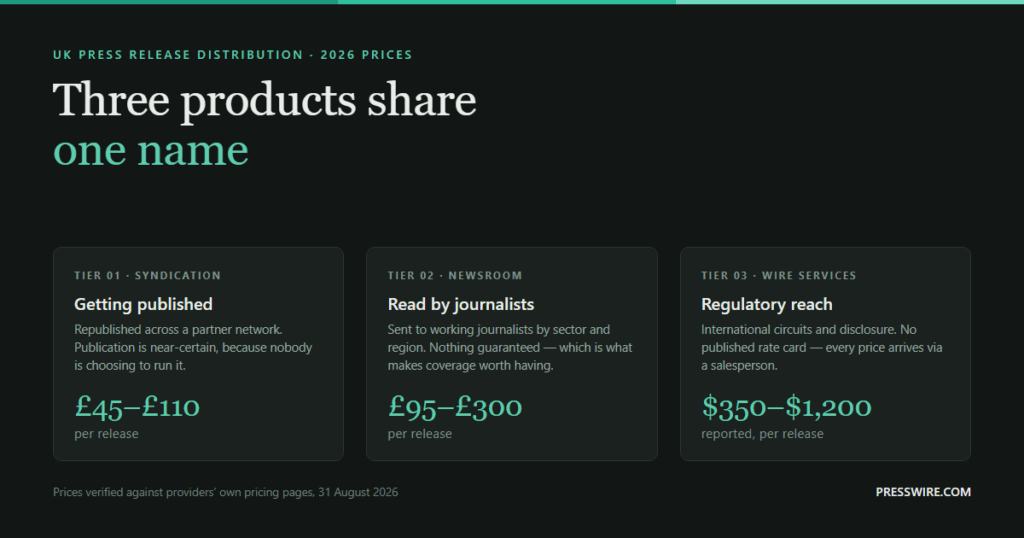
Three genuinely different products share the same name.
Syndication: getting published
The cheapest tier — PR Fire’s £45 guaranteed publishing, and the syndication component of most budget packages — puts your release onto a network of news and business websites that have agreed in advance to republish what they are sent. Publication is close to certain, because nobody is choosing to run it. That is what “guaranteed” means in this market.
This is a real product with real uses. It creates indexed pages carrying your announcement and your links, it is fast, and it is cheap. What it does not do is put your story in front of a journalist who then decides it is worth writing about. Sites in these networks typically carry very little independent traffic, and readers rarely encounter your release there.
Buy this when you want the announcement to exist, findable, on the record. Do not buy it expecting coverage.
Newsroom distribution: getting read by journalists
The middle tier — Pressat’s £110, our £185, PR Fire’s £95 distribution product — sends your release to actual working journalists, chosen by sector and region. Nothing is guaranteed, because a journalist reading it is under no obligation to write anything. That uncertainty is the point: it is the same uncertainty that makes editorial coverage worth having.
What varies enormously inside this tier, and what is worth asking every provider before you buy:
- How the list is built. A bespoke list drawn for your specific story is a different product from a standing category list that every customer in your sector receives.
- Whether anything is checked before it goes. Some services distribute whatever is submitted. Every release we send is read first by someone with years of PR experience — which is slower, and is the reason journalists keep a sender in their inbox rather than filtering it.
- Where it lands. An email to a subscriber list is not the same as delivery onto a newswire that sits inside newsroom production systems. We are an official Press Association partner, and we built a bespoke XML integration into PA MEDIAPOINT so that customers’ releases arrive directly on journalists’ news terminals rather than in an inbox. That is priced separately at £175 +VAT — against £450 +VAT to put the same release on the same wire by going to PA directly.
Wire services: regulatory reach and scale
At the top, the American wires distribute internationally, integrate with financial terminals, and handle regulatory disclosure. If you are a listed company with a disclosure obligation, or you need simultaneous international financial distribution, this tier exists for reasons that have nothing to do with marketing, and the price reflects infrastructure a smaller service does not have.
For a UK SME announcing a funding round, a hire or a product, it is close to pure overspend.
The American wires: why you cannot find a price
None of PR Newswire, Business Wire or GlobeNewswire publishes a rate card. You request a quote, and the number arrives after a conversation with a salesperson.
What third parties report, and we would encourage you to verify independently before relying on it: PR Newswire is described as charging a membership fee of around $195 plus roughly $350 to $805 per release, with additional charges for multimedia and for every 100 words over the base allowance. Business Wire is reported at roughly $760 to $940 for a 400-word release, with $195 to $365 per additional 100 words. GlobeNewswire is reported in the $350 to $1,200 range per release.
Treat all of those as indicative rather than quoted. The reason we cite other people’s reporting instead of the companies’ own pages is that the companies’ own pages do not contain prices.
Two practical consequences. First, the per-word charging model means a long release costs substantially more than a short one, which is not true of any of the UK flat-rate services. Second, you cannot compare providers without entering a sales process — which is itself a cost, in time, and worth counting.
What changes the price
Word count. Flat-rate UK services generally do not charge by length. The American wires do, and the overage rates are steep enough that a 900-word release can cost more than double a 400-word one.
Extra regions and categories. Most UK services include one region and one sector in the base price. Adding more is chargeable — Pressat publishes international add-ons from £49 for a single country, £99 for a continent and £199 globally. Ours are priced per circuit: £185 for UK, Europe or North America, £300 for global.
Multimedia. Images and video are included by several UK services. On the American wires they are reported as substantial separate line items, around $325 to $500.
Writing. If you need the release written as well as sent, expect roughly £200 to £340 on top of, or bundled into, distribution. PR Fire publishes a combined write-and-distribute package at £290 +VAT; Pressat’s equivalent is reported at £340 ex VAT.
Reporting. Ask whether you get a distribution report and what is in it. Ours is a separately priced £70 tracking report; some providers include a basic version.
Translation. For multi-market announcements, budget per language — ours is £285 per language.
VAT: check before you compare
This is the most common way UK price comparisons mislead, including comparisons published by providers themselves.
Almost every price in this market is quoted excluding VAT, but not every provider says so. PR Fire states “+VAT” against its rates. Pressat’s pricing page does not state a VAT position, though third-party reviews describe the £110 rate as ex-VAT. Our own prices are quoted excluding VAT, which is added for UK-based businesses — so a £185 UK distribution is £222 to a UK company, and £185 to an overseas one.
That last point matters more than it looks if you are buying from outside the UK. At the standard rate the gap between an ex-VAT and an inclusive price is 20%, which is larger than most of the price differences between the providers in the table above. Before comparing two numbers, confirm both are on the same basis: a £95 +VAT release and a £110 inclusive release are £114 and £110, and the cheaper-looking one is not the cheaper one.
So what should you spend?
There is no single right answer, but there is a reasonable way to reach yours.
If the goal is a findable, indexed record of an announcement — a name change, a minor appointment, a compliance-adjacent notice — the syndication tier at £45 to £110 does that job and spending more achieves nothing extra.
If the goal is a journalist writing about your story, you need a service that reaches journalists, and the honest questions are the three above: how the list is built, whether anything is checked before sending, and where the release actually lands. Prices in this tier run from £95 to £300, and within that band the price differences are smaller than the differences in what you get.
If you have a regulatory disclosure obligation or a genuine simultaneous international financial announcement, the American wires exist for that and the cost is the cost.
The failure mode we see most often is not underspending. It is spending mid-tier money on a syndication product and expecting editorial coverage, then concluding that press releases do not work. They work; the two products are different, and the market is not always careful about saying so.
You can see our published rates in full, in three currencies, with no quote process. If you want to get the release itself right first, we have a guide on how to send a press release.
Frequently asked questions
What is the average cost of a press release in the UK?
Most single UK distributions cost between £95 and £300. Below that you are generally buying syndication to a partner network rather than distribution to journalists; above it you are usually buying international or regulatory reach.
Are there free press release distribution services?
Free submission sites exist. They publish to low-traffic aggregators, are rarely read by journalists, and can carry an SEO cost if the same text appears across many low-quality domains. For an announcement that matters, they are not a substitute.
Is press release distribution worth the money?
It depends on which product you buy and what you expect. Syndication reliably produces published pages. Newsroom distribution produces a chance of coverage, not a certainty — a well-targeted release on a genuinely newsworthy story does well, and no amount of distribution spend rescues a story that is not newsworthy.
Do I have to pay per word?
Not with UK flat-rate services. The American wires generally charge a base rate for around 400 words and then per additional 100 words, which is the single biggest driver of unexpected cost at that tier.
How much does it cost to send a press release to the Press Association?
Delivery to the PA MEDIAPOINT newswire is £175 +VAT through Presswire, where we are an official PA partner and feed releases in through our own XML integration so they land on journalists’ terminals. PA’s own Press Release Hub lists a standard rate of £450 +VAT for submitting a release directly, so the same release on the same wire costs £275 +VAT less through us. A small number of UK services offer some form of PA distribution and others do not at all, so it is worth asking specifically — both whether it is included and how the release actually reaches the wire.