
Since independence, Tanzania’s economic story has been written patiently. Its progress has been anchored in political stability, long-term infrastructure building and the slow maturation of industry — a sequence that closely mirrors China’s own development experience.
The long-awaited launch of Development Vision 2050 sharpens that rhythm, giving fresh strategic depth to one of Africa’s oldest and most enduring partnerships with China.
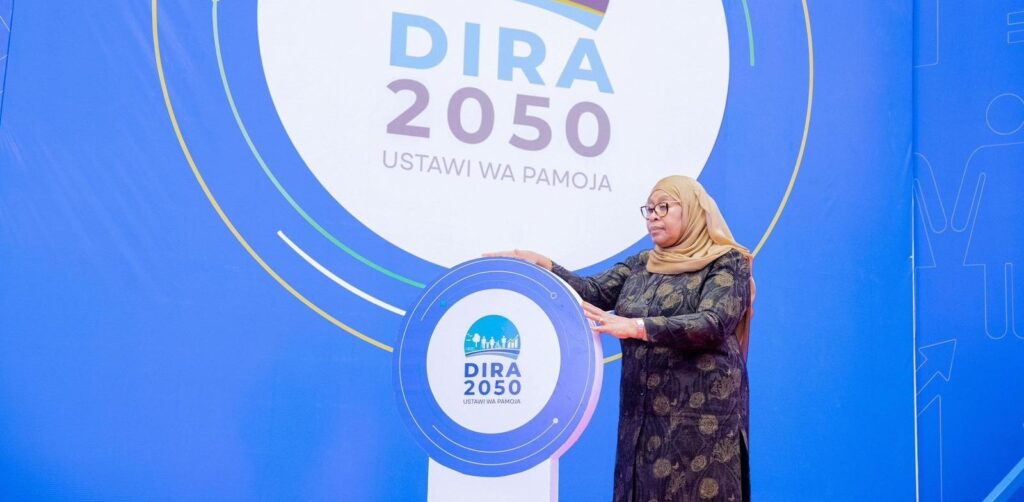
Vision 2050, unveiled as the successor to Vision 2025, sets out an ambitious target; transforming Tanzania into a high-income, industrialised economy with a gross domestic product of roughly US$1 trillion by mid-century.
At its core is a belief that prosperity is built gradually, through productive agriculture, industrial value addition, logistics, energy security and disciplined long-term planning. Those priorities echo the development logic that has underpinned China’s own rise, a resonance not lost on either side.
Speaking in Dodoma in January 15, 2026 during a diplomatic gathering, Tanzania’s President Samia Suluhu Hassan framed Vision 2050 as a continuation rather than a rupture.
“This year marks the launch of Tanzania Development Vision 2050, aiming for double-digit economic expansion through productivity gains in agriculture and industrial value addition,” she said, adding that new frontiers such as the blue economy, logistics, green growth and digital transformation would anchor the next phase.
For China, the vision reinforces a partnership that has evolved from solidarity to strategy.
Infrastructure as economic spine
Chinese engagement in Tanzania has long been most visible in infrastructure. From roads and ports to power generation and industrial construction, Chinese firms have been embedded in the physical reshaping of the Tanzanian economy for decades.
That legacy is now being reframed within a broader regional ambition. President Samia highlighted the launch of the China–Zambia Prosperity Belt, anchored by the revitalisation of the historic Tanzania–Zambia Railway Authority (TAZARA). Securing US$1.4 billion for the modernisation of the railway, she said, would do more than honour history.
“The revitalisation of the historic TAZARA railway will not just honour the legacy of our two founding fathers but position Tanzania as the primary logistics gateway of the entire SADC region,” she said.
Stretching 1,860 kilometres from Dar es Salaam to Zambia’s Copperbelt, TAZARA has long symbolised Sino-African cooperation. Its modernisation — including plans to convert it into an electric railway — aligns with Vision 2050’s emphasis on logistics as an economic multiplier.
As Tanzania modernises the corridor, President Samia issued a broader invitation. “We invite more partners to join us in this Prosperity Belt where our geography, our youth and our peace converge to build a modern and competitive Africa.”
For Chinese investors, infrastructure is rarely an end in itself. Roads, rail and ports lower operating risk, reduce costs and unlock downstream manufacturing, logistics and trade — precisely the ecosystem Vision 2050 seeks to cultivate.
Industry, minerals and patient capital
Beyond transport, Vision 2050 places heavy emphasis on industrialisation anchored in natural resources — but with a decisive shift away from raw extraction.
China’s role in this transition is multifaceted. Chinese firms have invested across manufacturing, construction materials, agro-processing and services, while also supplying machinery and industrial inputs. According to Tanzania Investment Centre data, China has consistently ranked among the top sources of registered foreign investment projects over the past two decades.
President Samia underscored that future investment must deliver tangible domestic benefits. “Our drive will be towards promoting responsible investment that power the technologies of tomorrow, support the global energy transition, industrial development and ensure direct benefits for Tanzanians,” she said, committing the government to manage resources “responsibly, transparently and inclusively”.
The message resonates with Beijing’s preference for long-horizon engagement. Chinese financing in Tanzania has blended concessional loans, supplier credit, equity participation and public-private partnerships — a form of patient capital suited to infrastructure and industrial build-out.
While industry dominates headlines, agriculture remains the backbone of Tanzania’s economy, contributing roughly a quarter of GDP and employing about two-thirds of the workforce. Vision 2050 treats agricultural productivity not as a social issue alone, but as an industrial input.
Chinese engagement in agriculture has often been indirect — through fertiliser supply, machinery distribution, irrigation equipment, storage and logistics. Improvements in power supply, transport corridors and ports have expanded opportunities for agro-processing, allowing Tanzania to retain more value domestically.
Rising rural incomes, in turn, expand markets for consumer goods, construction materials and appliances — sectors where Chinese firms are globally competitive.
Economic diplomacy beyond symbolism
In an era of fragmented supply chains, geopolitical competition and tighter capital flows, economic diplomacy has become as critical to national growth as domestic policy. Governments are no longer competing only on resources or market size, but on their ability to align diplomacy with trade, investment, technology transfer and long-term financing.
For emerging economies such as Tanzania, economic diplomacy increasingly determines access to infrastructure funding, industrial partnerships and strategic markets. Carefully managed bilateral relationships can unlock preferential financing, reduce investor risk and anchor large projects that would otherwise strain public budgets. At the same time, diversification of partners has become a hedge against global volatility.
Tanzania’s Vision 2050 reflects this shift, positioning diplomacy as an economic tool rather than a ceremonial exercise. The strategy explicitly links foreign relations to logistics corridors, value-addition industries and regional trade integration, signalling to partners that engagement is anchored in predictable, long-term planning. For investors, that clarity reduces uncertainty and raises confidence in project continuity across political cycles.
As competition for capital intensifies across Africa, countries able to convert diplomatic goodwill into bankable projects and industrial ecosystems are likely to pull ahead. In that context, Tanzania’s recalibration of its economic diplomacy under Vision 2050 is less about ideology than about securing durable partnerships in an increasingly transactional global economy.
Notes to Editors
· Tanzania officially launched Development Vision 2050 in January 2026, succeeding Vision 2025 and setting a long-term roadmap toward high-income, industrialised status.
· The strategy emphasises infrastructure, industrial value addition, logistics, energy security, agriculture productivity, and green and digital growth.
· China is one of Tanzania’s largest and longest-standing development and investment partners, with decades of engagement in transport, power, construction and manufacturing.
Media Contact:
Information Services Department and Office of The Chief Government Spokesman
E-mail: maelezotv@gmail.com
Phone: +255 754 750 765
Availability: EAT, UTC +3
ENDS