
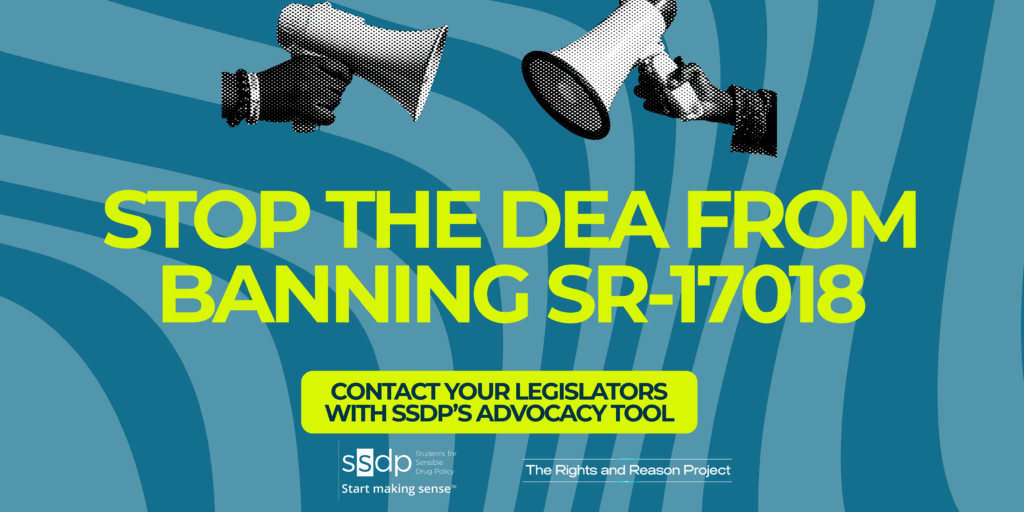
[PRESSWIRE] August 27, 2026 – WASHINGTON, D.C. — The Drug Enforcement Administration (DEA) has announced it will be moving forward with the emergency scheduling of SR-17018, despite a formal administrative request from Students for Sensible Drug Policy (SSDP) and the Rights & Reason Project asking the agency to remove the compound from its emergency scheduling order.
The action places SR-17018 — an opioid agonist developed through NIH-supported research seeking safer approaches to pain treatment — in Schedule I of the Controlled Substances Act (CSA). Researchers have studied the compound for its potential to separate pain relief from some of the dangerous effects associated with conventional opioids, including respiratory depression, tolerance, and dependence.
On July 1st, 2026, the DEA announced, that it intended to use its emergency authority to place 5,6-dichloro-desmethylchlorphine, or SR-17018, into Schedule I. The emergency scheduling process places SR-17018 into Schedule I status for two years without allowing adequate time for meaningful public input, raising serious constitutional, due process, and administrative law concerns.
On July 29, 2026, Rights & Reason Project and SSDP filed an Administrative Request to remove SR-17018 from the emergency scheduling order, arguing, among other concerns, the lack of evidence that this substance is an “imminent hazard to the public safety.”
SSDP became involved because the organization has increasingly challenged drug scheduling decisions that impede legitimate scientific research, a phenomenon referred to as “research harm.” Research harm occurs when drug-control policies create regulatory, legal, or financial barriers that make important scientific and medical research substantially more difficult or even impossible. SSDP’s Science Policy Committee has previously challenged DEA scheduling actions involving research compounds and has advocated for federal reforms intended to reduce unnecessary barriers to controlled-substance research.
“We have seen this playbook before: declare a substance dangerous, put it in Schedule I, and ask questions about its scientific potential later,” said Kat Murti, Executive Director of Students for Sensible Drug Policy. “SR-17018 could prove to be a powerful ally in the fight against the ongoing opioid overdose epidemic. It exists because American taxpayers funded scientists to search for safer alternatives to existing opioids. Now another arm of the federal government is using emergency powers to make that research dramatically harder. Sensible drug policy should protect public health, not stand in the way of the science we desperately need to improve it.”
“This order creates a roadblock to research at a time when the country desperately needs new treatment options for chronic pain management and opioid dependence,” said Robert Rush, founder of the Rights and Reason Project and a member of SSDP’s Advisory Council. “The DEA has used extraordinary emergency powers to shut down research into a compound that may offer solutions and off-ramp for opioid dependence. The federal government through the National Institutes on Drug Abuse funded the very research that created SR-17018 – funding intended to help develop a safer opioid drug. Instead of allowing that science to continue, DEA has effectively slammed the laboratory door shut at precisely the point when the research may be most important”
“What makes this decision particularly troubling is DEA’s own reasoning,” said Rush. “DEA points to online forums that report SR-17018 can reduce or reset opioid tolerance. They argue that a person who later returns to opioid use may therefore face an increased overdose risk because that tolerance is gone. Losing opioid tolerance is what happens when someone stops taking opioids. Are we really going to call getting people off opioids an imminent threat to public safety? The DEA seems to think so.”
SR-17018 was developed through NIH-supported research — funded by American taxpayers — with the goal of discovering safer pain medications. Since 2017, researchers have used SR-17018 to study opioid receptor signaling as part of an effort to separate pain relief from respiratory depression, tolerance, and dependence. The research has raised the possibility that SR-17018 could help scientists develop safer alternatives to existing opioid medications. Schedule I creates substantial new regulatory barriers that could delay, deter, or halt this research.
“It’s disheartening, yet unsurprising, to see the DEA ignore requests from legitimate researchers and organizations that are concerned about the emergency scheduling of SR-17018,” said Dr. Alaina M. Jaster, neuropharmacologist and Chair of SSDP’s Science Policy Committee. “When analyzed alone and with scientific integrity, instead of a punitive lens, SR-17018 does not meet the criteria for emergency scheduling and is quite different from the other substances in this order. It’s a complete failure and abuse of the DEA’s power to ignore these differences.”
Emergency Scheduling Raises Public Health and Research Concerns
At a time when Americans continue to struggle with chronic pain and an unpredictable illicit opioid supply, SSDP argues that policymakers should be removing barriers to research into potentially safer treatments — not creating new ones before scientists can determine their potential.
“Nearly 44,600 Americans died from opioid-involved overdoses in 2025, down from an estimated 55,300 in 2024,” said Murti. “That progress shows what happens when we invest in proven harm reduction tools like naloxone and evidence-based drug education. Yet those very approaches are under attack, even as the DEA creates new barriers to researching potential tools like SR-17018. If we want overdose deaths to keep falling, we should be expanding the harm reduction toolbox — not taking tools out of it before we even know what they can do.”
For SSDP, protecting the ability to research new interventions is part of the same harm reduction approach.
“Students for Sensible Drug Policy holds firmly in the belief of harm reduction, not more harm created by rushed decisions on groundbreaking science: science creating real, promising alternatives to medication that will help reduce or eliminate opioid dependence,” said Naomi Shifman, Elected Director on SSDP’s Board of Directors and Chair of SSDP’s Policy Committee. “But when the DEA and other Federal Agencies hastily intervene and effectively ban promising science on substances like SR-17018, along with cuts to harm reduction programming and funding, we will be mourning more lives in the coming years: something completely preventable.”
Those concerns are compounded by the extraordinary authority DEA is using to place SR-17018 in Schedule I.
“Emergency scheduling was supposed to address genuine imminent threats to public health,” said Rush. “SR-17018 is not implicated in a single death but is reported anecdotally to have helped countless people detox from opioids without significant withdrawal. The DEA’s use of its emergency scheduling power has gotten out of control. When a potentially game-changing avenue for getting people to stop using opioids can be declared an emergency and imminent threat to public health because people may lose their opioid tolerance, something is horribly wrong with the system.”
For SSDP, opposing barriers to scientific research is part of its broader mission to replace the War on Drugs with policies rooted in evidence, compassion, and human rights. Through its Science Policy Committee, SSDP brings together students, early-career scientists, researchers, and advocates to challenge drug policies that obstruct legitimate research and scientific inquiry. SSDP is calling on the DEA to reverse course on SR-17018 and allow potentially lifesaving research to continue — research that could ultimately help reduce opioid-related overdose deaths. SSDP is also urging the public to contact Congress and oppose the scheduling of SR-17018 using SSDP’s easy-to-use advocacy tool.
“Individuals with OUD [Opioid Use Disorder] already face barriers to MOUD [Medications for Opioid Use Disorder] such as cost, insurance coverage, provider access, and regulatory restrictions,” said Shifman. “The scheduling of SR-17018 and loss of novel treatments for OUD will place a great burden on providers and patients who are seeking treatment.”
Placing SR-17018 into Schedule I will force consumers to seek other, potentially more hazardous, opioidergic compounds. Prohibition does not eliminate drug markets; rather, it pushes them underground where regulation, product testing, and labeling standards do not exist. The resulting public health consequences, combined with the United States’ limited investment in harm reduction measures, present a grave threat to the safety, freedom, and well-being of Americans.
With chapters on campuses and in communities across the country, Students for Sensible Drug Policy (SSDP) is the largest youth-led grassroots network dedicated to replacing the War on Drugs with policies with those rooted in evidence, compassion, and human rights — policies that make sense.
###
For more information, please visit ssdp.org.
Contact:
Kat Murti
Executive Director
Students for Sensible Drug Policy