Key Findings
- App downloads: MENA mobile betting-app downloads rose 60% between 2023 and 2026.
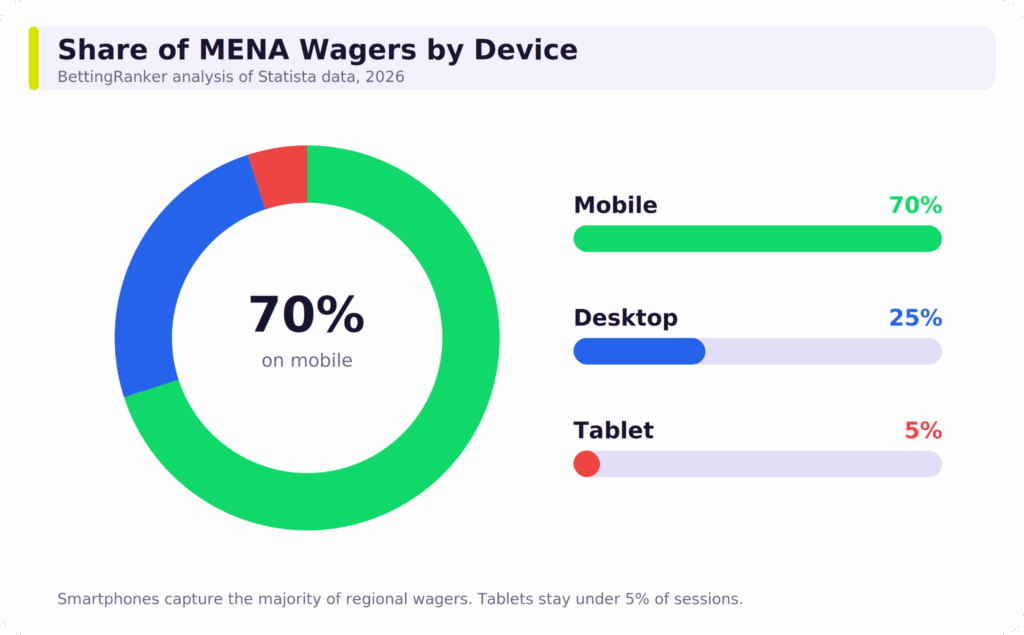
- Mobile share: Smartphones handle more than 70% of regional wagers. Europe sits near 60%.
- Market size: The Middle East & Africa market grows from USD 6.86 billion in 2024 to USD 12.08 billion by 2032, an 8.4% CAGR.
- Regulation: The UAE established the region’s first licensed framework through the GCGRA.
- Demographics: 76% of MENA-3 gamers are under 35, and 73% engage with esports.
A Mobile-First Wagering Region Built in Under Four Years
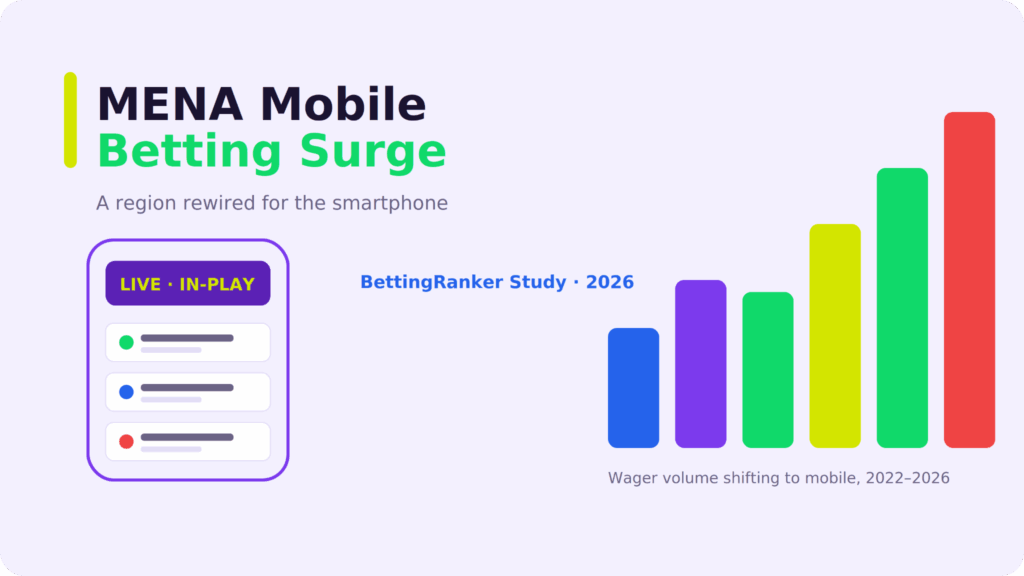
MENA mobile devices now capture more than 70% of all wagers placed across the region, and this mobile share has climbed every year since 2022. The European benchmark, by comparison, still leaves roughly 40% of betting activity on desktop, while tablets across MENA account for under 5% of sessions. The region effectively skipped a chapter of the industry’s evolution and arrived directly at a mobile-first reality. The African and Arabic sports-betting sector was valued at USD 6.86 billion in 2024, according to Data Bridge Market Research.
The sector is projected to reach USD 12.08 billion by 2032 at a compound annual growth rate (CAGR) of 8.4%. The most striking feature of that growth is its location, because it happens almost entirely on smartphone screens rather than desktops. The demographics explain the speed of the shift. 76% of gamers across Egypt, the UAE and Saudi Arabia are younger than 35. This youthful, digitally native population pairs with near-universal internet access and an accelerating 5G rollout. A platform transition that took a decade in mature Western markets compressed into fewer than four years across MENA.
UAE Regulation Anchors the Regional Mobile Shift
The United Arab Emirates (UAE) became the first Arab nation with a centralized federal gaming regulator. The General Commercial Gaming Regulatory Authority (GCGRA) came into play towards the end of 2025.
Play 971 became operational in late November 2025 as the first fully licensed iGaming website for the country. Federal Decree-Law No. 25 of 2025 was enforced on June 1, 2026. The decree stripped gambling laws from the UAE civil code. Analysts predict that five to ten operator licenses will be issued by the end of 2026.
Regulated entry continues to remain mostly an issue for the UAE. Gambling is still prohibited in most other Arab nations. Much gambling occurs online and via off-shore websites.
Explore how mobile betting in arabic countries functions, full article here
Mobile Product and Payment Technology Close the Gap
The mobile product caught up with the regional audience on several fronts at once. Platforms that pair live video streams with in-play bet placement report 35% longer user sessions, because real-time markets keep bettors engaged through the match. E-wallet services such as STC Pay and Vodafone Cash settle deposits and withdrawals within minutes, which removes a long-standing barrier for first-time bettors. Full Arabic-language interfaces, Arabic match commentary and real-time analytics dashboards strip friction out of onboarding for local users.
Distribution mechanics reinforce the mobile-first pattern. Android commands an 82% device share regionally, so APK distribution became the primary delivery channel across the market. The smaller iOS base records higher per-session spend, which gives operators a clear segmentation signal for monetisation.
Together these features explain why bettors move onto the phone and stay there. Live engagement extends session length, fast payments like WebMoney lower the barrier to entry, Arabic localisation builds trust, and broad Android reach maximises the addressable audience. Each element compounds the others, and the combined effect is a product experience that desktop platforms in the region cannot match. The technology now reflects how the MENA audience already prefers to play and wager.
Saudi Arabia and the UAE Lead the National Markets
Saudi Arabia anchors the region’s commercial weight among the national markets. The Saudi Arabia market was valued at USD 1.03 billion in 2025, and the Saudi Arabia market is projected to reach USD 2.07 billion by 2034 at a CAGR of 8.02%. Online channels already represent 82% of all Saudi activity, a direct reflection of Vision 2030 investment and near-universal connectivity across the kingdom. The UAE plays a different role in the regional picture.
The UAE is forecast to be the fastest-growing nation at a 10.9% CAGR through 2032, supported by high smartphone penetration, maturing digital payments and a calendar dense with international sporting events. Segment dynamics matter alongside the national totals.
Football remains the dominant sport for overall betting volume across the region, with bettors using mobile free bets. The combination of a large Saudi base, a fast-growing UAE market and an accelerating esports segment gives operators and investors several distinct entry points, each with its own growth profile and regulatory context to weigh carefully.
“The desktop-to-mobile migration in Arabic markets is no longer a trend — it is the established standard against which the rest of the industry will be measured.” — BettingRanker research team
Conclusion
The BettingRanker study positions the Middle East and North Africa as the fastest desktop-to-mobile transition in the global betting industry. Smartphones now handle more than 70% of regional wagers, and app downloads rose 60% between 2023 and 2026. The Middle East & Africa market is projected to roughly double to USD 12.08 billion by 2032. The UAE leads on regulation through the GCGRA framework, while activity in most other Arab markets remains offshore. Supported by a young, mobile-native audience, the region offers operators and investors a high-growth opportunity that BettingRanker will continue to monitor and report.
Explore BettingRanker’s Full Report
About BettingRanker
BettingRanker is part of the CasinoRank network and focuses on comparing and ranking online sportsbooks.