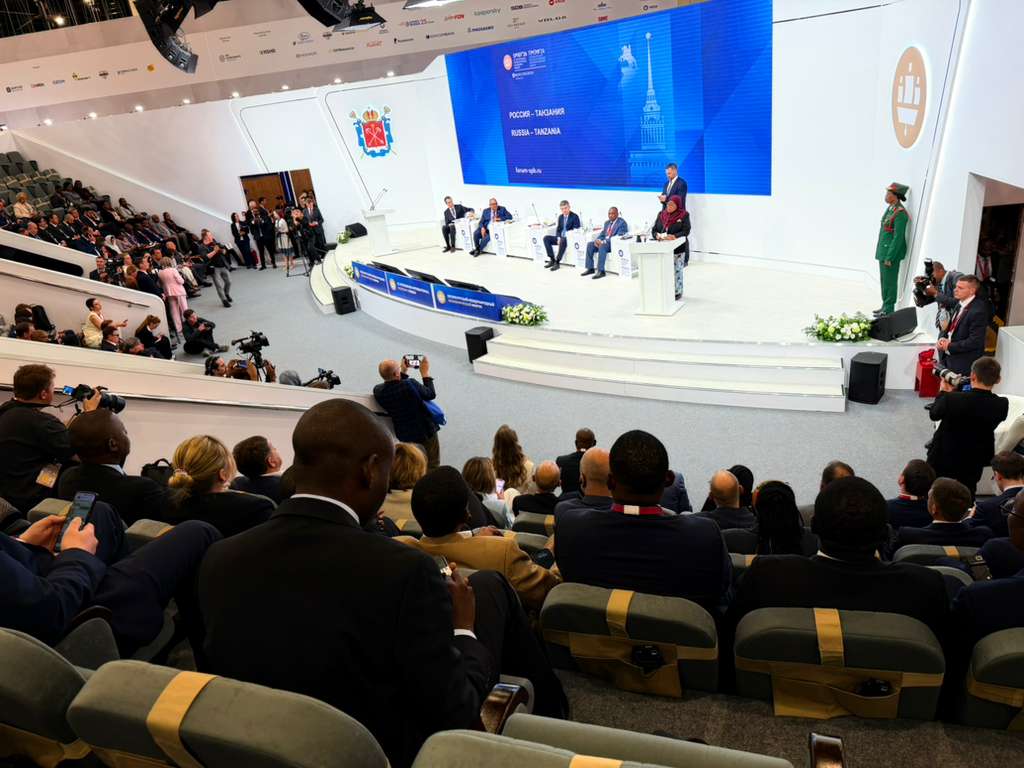
Speaking at the Tanzania-Russia Business and Investment Forum held alongside the 29th St Petersburg International Economic Forum (SPIEF 2026), President Samia urged business leaders from both countries to move beyond dialogue and translate opportunities into concrete investments.
“Move from rhetoric to action. Talking alone will not bear fruits,” President Samia said, stressing that the forum was intended to create partnerships capable of delivering tangible economic benefits.
She said the gathering was not merely a platform for speeches but an opportunity for investors and entrepreneurs to exchange ideas, showcase products and establish ventures that would strengthen economic relations between Tanzania and Russia.
President Samia noted that despite more than six decades of diplomatic friendship and cooperation, trade between Tanzania and Russia remains below its potential, with Russia accounting for less than one per cent of Tanzania’s total trade volume in 2024.
“This is not where we should be,” she said, adding that the current level of economic engagement does not reflect the strong bilateral relations enjoyed by the two countries.
“It is precisely this gap between potential investment and trade and our actual performance that brings us together in this room,” she added.
Presenting Tanzania as a strategic gateway to Africa, President Samia cited the country’s population of more than 61 million people, annual economic growth averaging around six per cent and access to a regional market of more than 500 million consumers across Eastern and Southern Africa.
She said major infrastructure investments, including the expansion of the Port of Dar es Salaam and the Standard Gauge Railway (SGR), are reinforcing Tanzania’s role as a regional logistics and trade hub connecting African markets with global partners.
Mining emerged as one of the key sectors for future cooperation. President Samia said Tanzania is endowed with gold, uranium, nickel, graphite and other critical minerals needed for the global energy transition and modern manufacturing industries.
She invited Russian companies to partner in geological surveys, mineral exploration and value addition through smelters and refineries, saying Tanzania is seeking to move beyond raw mineral exports and develop domestic industrial capacity.
In the energy sector, the President said Tanzania remains committed to a diversified and low-carbon energy mix and is exploring long-term cooperation in small modular reactor technology. She added that Russian companies are also welcome to participate in oil and gas exploration projects.
President Samia further encouraged investment in fertiliser production, pharmaceuticals, medical equipment and vaccine manufacturing, noting that Tanzania aims to meet 60 per cent of its domestic health product needs through local production by 2030.
She also highlighted investment opportunities in the Bagamoyo Port and Special Economic Zone, as well as the proposed Mangapwani transshipment port project in Zanzibar, projects expected to strengthen Tanzania’s position within regional and international supply chains.
To improve connectivity between the two countries, President Samia announced that Air Tanzania will launch direct flights linking Dar es Salaam, Moscow and Zanzibar from July 2, a move expected to boost trade, tourism and business travel.
Supporting the President’s call for deeper engagement, Russian Minister for Economic Development Maxim Reshetnikov said several joint projects are already progressing in Tanzania, including a uranium project that has advanced from a pilot mining plant to the next production phase.
He also disclosed plans to establish a rapid disease-testing factory in Tanzania capable of producing up to 20 million test kits annually, alongside expanded cooperation in agriculture, logistics, tourism and pharmaceuticals.
“Cooperation in agriculture could be broadened through increased supplies of grain, fertilisers and veterinary vaccines, while Russian research institutions are ready to support agricultural production through technology transfer and joint research programmes,” he said.
Mr Reshetnikov also pointed to growing cooperation in transport and logistics, citing the launch last month of a new container shipping line between Novorossiysk and Dar es Salaam, which is expected to improve trade efficiency between Russia and East Africa.
Tourism was identified as another fast-growing area of collaboration, with trips by Russian tourists to Tanzania rising by nearly 40 per cent last year, according to the Russian minister.
Tanzania’s Minister for Foreign Affairs and East African Cooperation, Mahmoud Thabit Kombo, said the emphasis has now shifted from signing agreements to implementing them and delivering measurable economic outcomes.
He said Tanzania is also seeking broader access to the Russian consumer market after visiting a major supermarket chain already stocking Tanzanian products including cashew nuts, coffee, tea and tobacco.
According to the minister, the retailer operates about 35,000 outlets across Russia, presenting a major opportunity for Tanzanian exporters seeking to diversify export destinations amid shifting global trade dynamics.
“This is a unique opportunity that not many countries in Africa get,” Mr Kombo said, calling on Tanzania’s private sector to position itself strategically to benefit from the expanding partnership.
The forum underscored Tanzania’s broader push to attract diversified international investment and strengthen economic partnerships beyond traditional markets as African economies increasingly position themselves within evolving global supply chains and geopolitical realignments.
Notes to Editors
· President Samia Suluhu Hassan addressed the Tanzania-Russia Business and Investment Forum during the 29th St. Petersburg International Economic Forum (SPIEF 2026) in Russia.
· Tanzania and Russia marked over 60 years of diplomatic relations, with both countries seeking to expand trade and investment cooperation.
· Priority sectors identified for investment include mining, energy, agriculture, pharmaceuticals, transport and logistics.
Media Contact:
Information Services Department and Office of The Chief Government Spokesman
E-mail: maelezotv@gmail.com
Phone: +255 754 750 765; +255 754 698 856; +255 759 714; +255 713 381 904
Availability: EAT, UTC +3