
The delegation, led by the Treasury Registrar, Nehemiah Mchechu, and the Director General of the Tanzania Ports Authority (TPA), Plasduce Mbossa, brought together officials from the Office of the Treasury Registrar and TPA to study how technology, governance and long-term planning can lift port performance and national competitiveness.
The timing is significant. As Tanzania positions itself as a regional trade and logistics gateway for East and Central Africa, port efficiency has become a decisive economic factor. Faster cargo handling, lower logistics costs and predictable services directly affect export competitiveness, industrial growth and investor confidence.
“Ports are not just transit points; they are economic gateways,” Mchechu said. Lessons from Antwerp–Bruges, he added, show how technology-driven operations, strong governance and integrated planning can improve efficiency, transparency and returns on public investments.
Antwerp–Bruges is Europe’s second-largest port, handling close to 280–290 million tonnes of cargo a year and more than 13 million containers. It supports Europe’s largest integrated petrochemical cluster, manages large volumes of vehicles and diversified cargo, and is expanding capacity to accommodate larger vessels and rising global demand. More than 300 liner services connect the port to over 800 destinations worldwide.
Its economic footprint is substantial, supporting about 164,000 jobs and generating more than €21 billion in added value annually. Through its international arm, the port also advises and partners with ports abroad on management, investment and skills development.
For Tanzania, where ports represent some of the largest public assets, the visit underscored the importance of moving beyond infrastructure expansion towards optimising existing assets to deliver stronger economic and financial returns.
TPA’s Mbossa said the visit came as Tanzanian ports were already posting strong performance gains, making international benchmarking essential. “As volumes grow, efficiency and reliability become critical. Learning from advanced ports helps us consolidate and scale these gains through technology, skills and sound management,” he said.
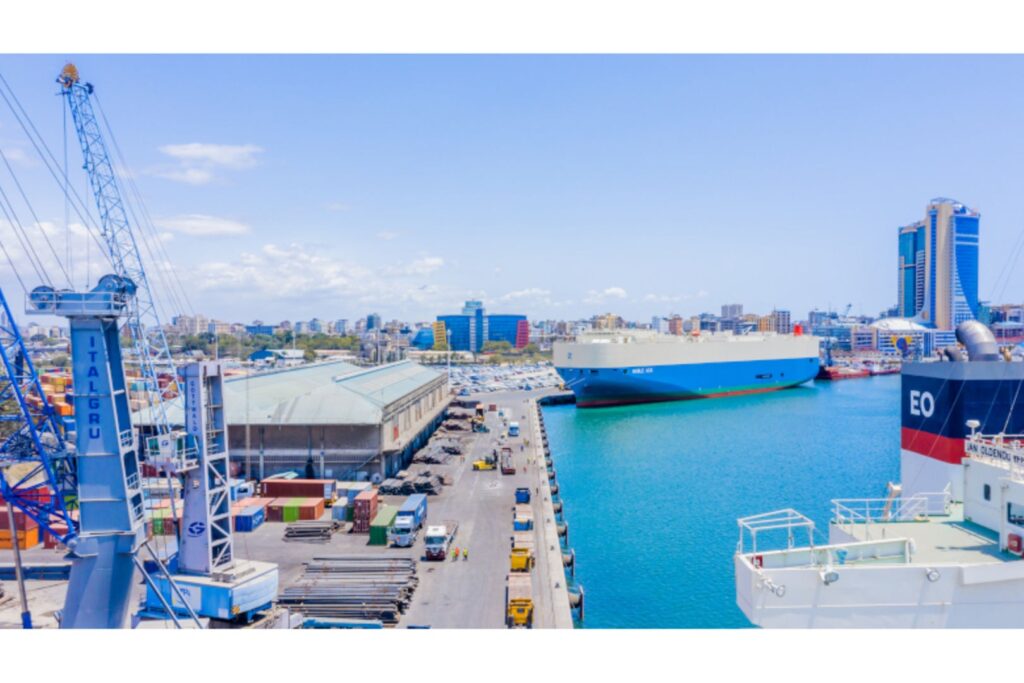
That momentum is most visible at the Port of Dar es Salaam. TPA says the port handled a record 27.7 million tonnes of cargo in the 2024/25 financial year, up from 18 million tonnes in 2021/22, driven by infrastructure upgrades, modern equipment and greater private-sector participation.
According to the acting port director, Abed Gallus, cargo handling grew by nearly 17% in 2024/25, the strongest performance since the port opened. Since global operators DP World and Tanzania East Africa Gateway Terminal Limited (TEAGTL) joined operations, capacity has risen sharply.
A key factor has been the Dar es Salaam Maritime Gateway Project, which deepened the harbour to 14.5 metres, allowing larger vessels to call. Average container ship service time has fallen from about 10 days to around three, cutting costs along regional trade corridors.
The port now handles more than 95% of Tanzania’s seaborne cargo, meaning operational improvements have a direct impact on the wider economy. Public–private partnerships, Gallus said, have improved equipment availability, night-shift productivity and berth scheduling.
Beyond immediate operational lessons, the Antwerp–Bruges visit also laid the groundwork for longer-term cooperation. The two port authorities have agreed to collaborate on skills development, planning, management systems and operational optimisation.
For Tanzania, the visit was more than a study tour. It was an investment in institutional capacity and international partnerships, aimed at translating global best practice into stronger ports, more efficient trade and greater public value from strategic state assets.
Notes to Editors
· Tanzania is positioning its ports as regional trade and logistics hubs serving East and Central Africa, with efficiency and reliability identified as key drivers of competitiveness.
· The Port of Dar es Salaam handled a record 27.7 million tonnes of cargo in the 2024/25 financial year, reflecting the impact of infrastructure upgrades, technology adoption and public–private partnerships.
· The Port of Antwerp–Bruges is Europe’s second-largest port and a global benchmark for technology-driven port management, integrated planning and sustainable maritime operations.
Media Contact:
Information Services Department and Office of The Chief Government Spokesman
E-mail: maelezotv@gmail.com
Phone: +255 754 750 765
Availability: EAT, UTC +3
ENDS