A fish may follow a lure without striking.
A lure may attract attention without producing any noticeable feedback through the rod.
Underwater structure may directly influence where fish hold, while the angler still sees only the surface.
For CanFish, the real challenge is not simply helping anglers “see more.”
It is understanding:
What kind of underwater information is actually useful at a particular moment in the fishing process?
That is why CanFish has not tried to build one device to solve every problem.
Instead, the brand has continued developing different products around different fishing decisions—from live underwater observation and reviewable lure footage to AI-assisted alerts and the further application of sonar, vision and navigation in fishing scenarios.
Different Fishing Decisions Need Different Information
CanFish traces its origin to 2019.
At the time, one of CHASING’s founding team members—a veteran angler with approximately 40 years of fishing experience who also worked as an R&D engineer—began asking a practical question: could the team’s long-standing expertise in underwater robotics be turned into tools that genuinely fit real fishing scenarios?
This was not simply about placing an underwater device into the fishing process.
The real question was:
What kind of underwater information does an angler actually need at different moments?
The brand’s earliest products first focused on underwater observation.
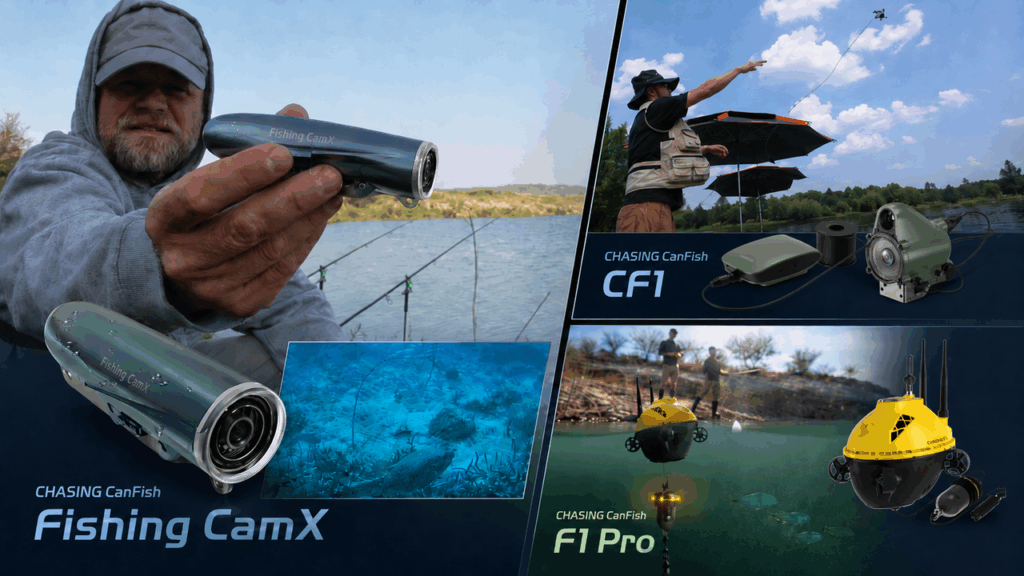
In 2020, CanFish F1 marked the beginning of CanFish’s early exploration. CanFish F1 Pro later added a rotatable camera and motorized depth adjustment, giving users greater flexibility in how they observed underwater conditions.
In 2023, CHASING CanFish CF1 brought castable live underwater observation into the portfolio.
CF1 serves situations in which anglers want to inspect visible underwater conditions during fishing rather than rely entirely on what can be inferred from above the surface.
In 2024, CHASING CanFish Fishing CamX addressed a different problem.
Designed for lure fishing, Fishing CamX records lure action and visible fish interactions for later review after the session.
It is not a live underwater monitoring system.
Its role is to preserve moments that may never be felt through the rod or noticed from above the surface.
A fish may follow a lure without striking.
A strike may fail to result in a hookup.
A lure action that looks normal from the boat may behave very differently underwater.
Reviewable footage gives anglers another way to examine those moments after the session.
In 2025, CanFish added AI-assisted fish activity alerts to CF1, using underwater imaging to identify visible fish activity under supported conditions and send alerts through the app.
These products do not perform the same task.
That is the point.
From Separate Tools to More Useful Fishing Information
Live observation can help anglers inspect visible underwater conditions.
Reviewable footage can preserve lure movement and fish interactions for later analysis.
AI-assisted detection can identify visible fish activity under supported conditions.
Sonar can add another layer of information about returns and underwater structure.
Each source of information has limits.
Video only shows what enters the frame.
Sonar still requires interpretation.
AI-assisted functions depend on data and specific operating conditions.
CanFish’s direction is therefore not based on the idea that one technology can eliminate uncertainty from fishing.
Instead, it is based on matching different information tools to different decisions—and, where genuinely useful, exploring how those sources can work together.
“We do not see smart fishing as replacing the angler,” said the Director of R&D at CHASING. “Experience, judgment and local knowledge still matter. Our goal with CanFish is to make underwater technology more useful throughout the fishing process—whether that means seeing something live, reviewing what happened later, receiving an alert or bringing multiple sources of information together.”
The Engineering Backbone Behind CHASING CanFish
CanFish operates as an independent brand dedicated to smart fishing, with its own product direction, target users and community positioning.
Behind the brand, CHASING supports CanFish product development through its long-standing capabilities in underwater robotics, engineering R&D and hardware manufacturing.
Founded in 2016, CHASING has approximately a decade of experience developing underwater systems for consumer and professional applications. To date, the company has completed eight generations of core product development and has continued building expertise across underwater power and propulsion, underwater communications, imaging, control systems, sonar, navigation, AI-assisted perception and computer vision.
For CanFish, that background matters.
Underwater fishing products face conditions that can vary significantly with depth, water clarity, current, freshwater or saltwater environments and the physical demands of different fishing methods.
Product development may involve:
- Waterproof reliability
- Underwater imaging
- Control systems
- Navigation
- Sensor integration
- Smart functions
The exact combination depends on the product itself and the real-world use scenario.
This is also an important distinction in how CanFish approaches product development.
The goal is not simply to transfer underwater robotics technology into fishing products. It is to identify a specific fishing problem first, then determine which underwater capabilities can deliver practical value in that scenario.
That support also extends beyond engineering and R&D.
CHASING has completed eight generations of core product development and accumulated more than 400 core intellectual property assets. Long-term product development and real-world application experience have given the company continued exposure to varied water environments, operating conditions and underwater system requirements.
CHASING also maintains its own R&D, testing and manufacturing systems, supported by an underwater intelligent robotics industrial base covering more than 50,000 square meters.
This allows CanFish to keep product decisions centered on real fishing needs while drawing on a more established environment for underwater hardware development, testing and manufacturing.
The relationship allows CanFish to remain focused on anglers and real fishing scenarios while benefiting from a broader foundation in underwater technology, engineering R&D and manufacturing.
The Next Step: Connecting More Sources of Fishing Information
CanFish’s current direction points toward greater integration.
Earlier products established distinct capabilities:
Live observation.
Underwater recording for lure fishing.
AI-assisted alerts.
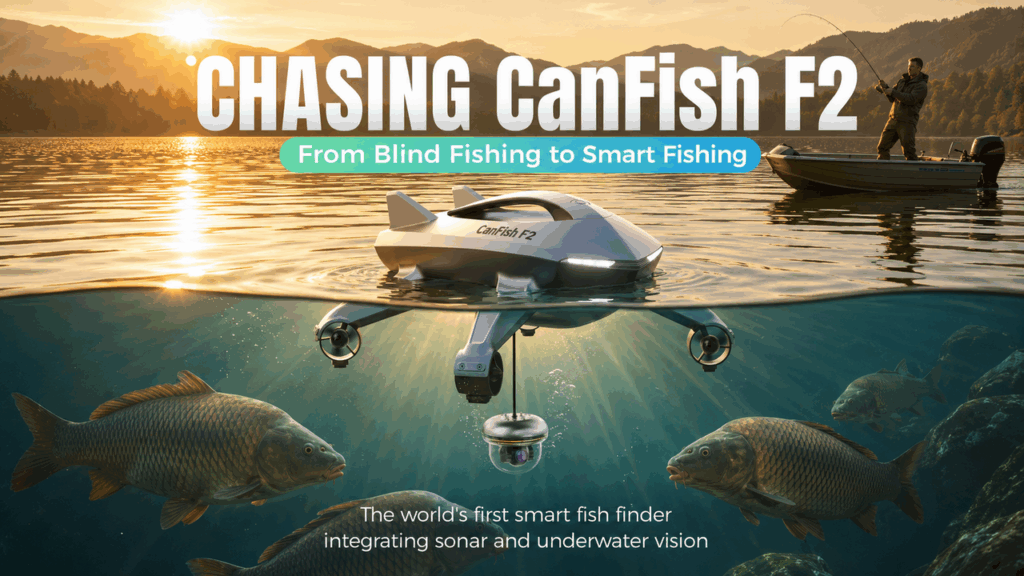
The brand is also moving CHASING CanFish F2 into production.
As a next-generation smart fishing system, CanFish positions F2 as the world’s first integrated fish finder to combine sonar, an underwater camera and AI, while also bringing navigation capabilities into the same system.
This direction is not simply about adding more features to one device.
Sonar can provide information about returns, water depth and underwater structure.
An underwater camera can show visible underwater conditions and fish activity that enter the frame.
AI-assisted functions can help identify visible fish activity under supported conditions.
Navigation can further influence how the device reaches, records and revisits specific areas of water.
These capabilities also connect with areas in which CHASING has built long-term system-level expertise, including sonar, underwater imaging, control, navigation and AI-assisted perception.
CHASING CanFish F2 is one part of this broader direction rather than the sole focus of the portfolio.
CHASING CanFish CF1 continues to serve live underwater observation.
CHASING CanFish Fishing CamX continues to serve anglers who want to review underwater footage from lure fishing.
AI-assisted alerts address another need in the fishing process.
The next question worth exploring is:
Can different forms of information become more useful when connected?
That does not mean every angler needs every tool.
It means CanFish is moving toward a broader product logic:
Different technologies can support different stages of fishing decisions.
Built Around What Anglers Cannot See
CanFish’s direction is not simply a sequence of hardware launches.
The brand is developing around a practical idea of smart fishing:
Making underwater information more visible, more reviewable and more useful, without trying to remove the uncertainty inherent in fishing.
Its brand line:
Explore More · Capture More
reflects that balance between technology, curiosity and real fishing experience.
Underwater content can also create another layer of value.
A recorded fish interaction.
An unexpected underwater scene.
A fishing discovery worth sharing.
Each can reveal something the angler did not know at the time. Those moments can also connect anglers across different waters and fishing styles.
CanFish began by exploring:
How can underwater technology help anglers see more of what was previously hidden beneath the surface?
Its next stage is about a broader question:
How can different forms of underwater information help anglers make better-informed fishing decisions?
Learn more about CanFish products and the brand’s approach to smart fishing technology:
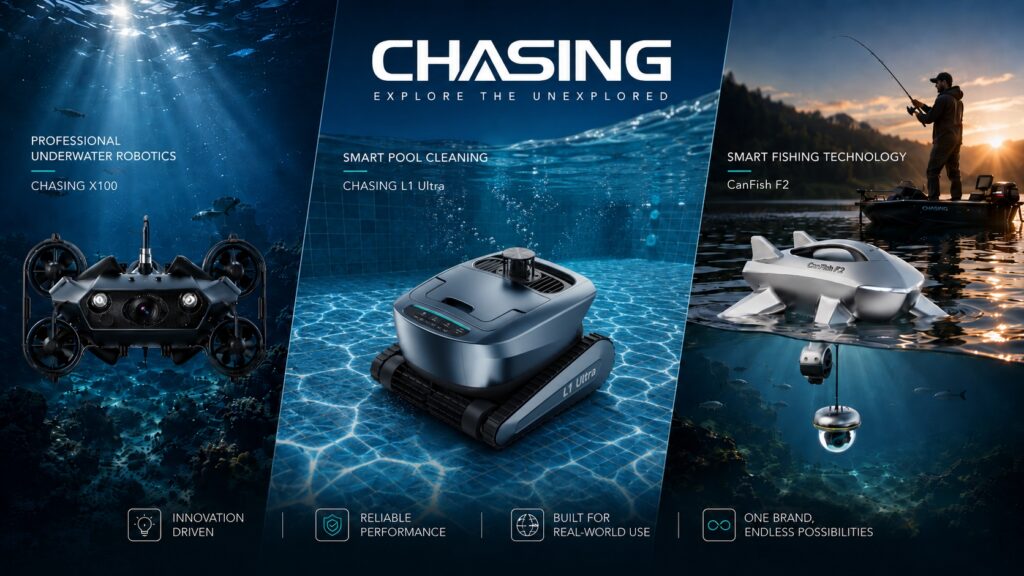
Founded in 2016, CHASING is an underwater technology company focused on the R&D, manufacturing and global development of intelligent underwater equipment. Its business spans professional underwater robots, smart pool cleaning systems and smart fishing technology.
CHASING products have reached more than 100 countries and regions worldwide, with overseas markets accounting for more than 85% of sales.
Guided by its brand philosophy, Explore the Unexplored, CHASING works to expand the boundaries of underwater exploration and bring intelligent underwater technology into more real-world applications.
Media Contact:
wenshuyue@chasing.com
ENDS