
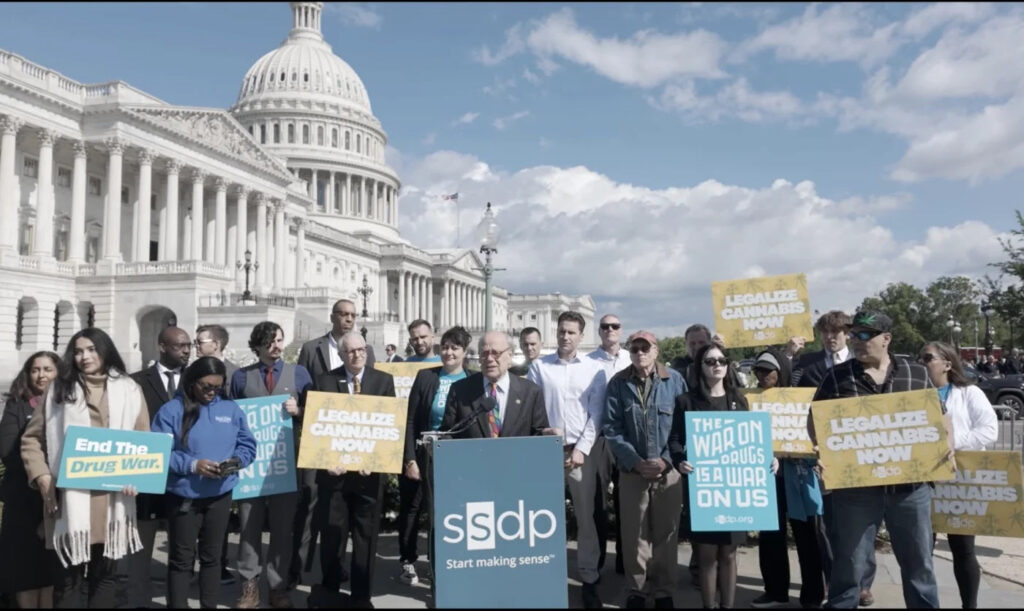
Advocates from across the political spectrum are gathering in the nation’s capital this week for the Third Annual Cannabis Week of Unity, a nationwide coalition effort to push Congress toward comprehensive federal cannabis reform rooted in justice, equity, and repair.
From May 12 through May 14, 2026, the Cannabis Unity Coalition, the largest-ever bipartisan coalition of cannabis advocates from the political left, right, and the industry, will lead a coordinated mobilization to turn public support into political pressure and demand immediate federal action in support of cannabis decriminalization, prisoner release, and record clearing and restoration of rights for those negatively impacted by cannabis prohibition.
The week’s events include a congressional press conference, a full-day lobbying effort targeting every Senate and House office, educational meetings on federal cannabis legislation, and evening coalition events designed to strengthen collaboration across the movement.
In 2024 and 2025, the coalition united more than 35 organizations, meeting with every office in both the House and Senate to push forward federal reform and ensure that justice for those harmed by prohibition remained central, not secondary, to legalization efforts.
This year, 44 member organizations have all united around the same message: Decriminalize Now.
“Rescheduling is progress, but it is not legalization and it will not deliver the promises that President Trump, former President Biden, and the American people hope to see,” said Kat Murti, Executive Director of Students for Sensible Drug Policy (SSDP), the lead convener of the coalition. “Cannabis is still not federally legal and our families and communities are still paying the price. Nearly 3,000 Americans remain behind bars in federal prison for cannabis-related offenses and there were close to 200,000 cannabis arrests last year alone, most of them for simple possession. Rescheduling will not change that. Congress must heed the voice of the American people and finally federally legalize cannabis and restore justice to those harmed by over a century of prohibition.”
SSDP was the second organization to join the Cannabis Unity Coalition when it was formed by the Last Prisoner Project (LPP) in November 2023 with the goal of recentering justice in the conversation about cannabis policy. LPP served as the lead convener of the coalition in 2024 and 2025 before passing the reins to SSDP.
“Cannabis reform is the most popular issue in American politics, and now that the President has signaled he is open to reform, it’s on Congress to pass a comprehensive legalization bill that centers the release of cannabis prisoners who should no longer be incarcerated,” said Jason Ortiz, Director of Strategic Initiatives at LPP. “LPP stands ready to work with the Cannabis Caucus co-chairs and the Cannabis Unity Coalition to pass a full descheduling bill like the MORE Act to finally end the nightmare that has been cannabis prohibition, and create a path for everyone incarcerated for cannabis crimes to rejoin their families and become full members of society.”
PRESS CONFERENCE AND LOBBY DAY
At 10:00 a.m. ET on Wednesday, May 13, advocates and lawmakers will gather at the House Triangle near the U.S. Capitol for an official Cannabis Week of Unity press conference featuring remarks from Cannabis Caucus Co-Chairs Congresswoman Ilhan Omar (D-MN) and Congresswoman Dina Titus (D-NV), Congressman Steve Cohen (D-TN), who is one of the leading advocates for clemency for federal cannabis prisoners, coalition leaders from both right-of-center and left-of-center advocacy organizations, impacted individuals, and representatives from cannabis industry groups to call for full federal legalization, prisoner release, and restoration of rights.
Following the press conference, coalition members will fan out across Capitol Hill for a full day of congressional lobbying and education meetings from 11:00 a.m. to 5:00 p.m. Organizers say advocates will meet with congressional offices across both chambers to discuss a package of 13 cannabis and hemp reform bills addressing descheduling, sentencing reform, veterans’ access, expungement, housing protections, and hemp regulation.
Central among those bills is the MORE Act (H.R. 5068), the coalition’s preferred framework for comprehensive federal cannabis reform. The legislation would remove cannabis from the Controlled Substances Act, eliminate federal criminal penalties for cannabis activity, create pathways for expungement and resentencing, establish community reinvestment funding, and expand opportunities for small cannabis businesses.
Advocates will also educate lawmakers on bipartisan measures including the STATES 2.0 Act (H.R. 2934), which would align federal law with state cannabis programs; the PREPARE Act (H.R. 2935 / S. 3576), which establishes a federal commission to develop a pathway to post-prohibition cannabis regulation; and the Evidence-Based Drug Policy Act (H.R. 3082), which would remove federal barriers preventing the Office of National Drug Control Policy from researching cannabis legalization.
Additional priorities include the Clean Slate Act (H.R. 3114 / S. 1580), which would automatically seal certain federal cannabis records, and veterans-focused legislation including the Veterans Cannabis Use for Safe Healing Act (H.R. 966) and the Veterans Equal Access Act (H.R. 1384), both aimed at protecting veterans’ access to state medical cannabis programs through the Department of Veterans Affairs.
Housing protections and hemp regulation are also major focus areas for the coalition. Organizers say advocates will push for passage of the Marijuana in Federally Assisted Housing Parity Act as well as several hemp bills intended to create clear federal safety standards while preserving legal pathways for hemp-derived cannabinoid products.
CONGRESSIONAL LEADERSHIP
Congressman Steve Cohen, U.S. Representative from Tennessee’s 9th Congressional District since 2007, will provide remarks at the press conference. Throughout his time in Congress, Rep. Cohen has been a consistent voice for cannabis policy reform, raising concerns about the harms of prohibition, the barriers it creates to scientific research, and the disproportionate impact of drug enforcement on communities. That leadership was made especially clear on 4/20, a day widely associated with celebration of cannabis culture, when the Congressman hosted a Congressional briefing and spoke at a press conference organized by SSDP featuring individuals who had received life sentences for cannabis and recently received clemency from President Trump.
Congresswoman Dina Titus, U.S. Representative from Nevada’s First Congressional District, will also provide remarks at the press conference. Congresswoman Titus has been one of the most active federal voices for cannabis reform in Congress. A long-standing advocate for reforming the nation’s marijuana laws, she currently serves as Co-Chair of the Congressional Cannabis Caucus. In that role, she has championed federal banking reform for cannabis businesses and legislation to expand cannabis academic research. Most recently, she co-introduced the Higher Education Marijuana Research Act to eliminate federal barriers preventing universities from conducting meaningful cannabis research and to protect institutions and researchers engaged in that work. She has also co-sponsored the bipartisan STATES 2.0 Act, which would ensure the federal government does not interfere with states or tribes that have chosen to legalize cannabis, and the RESPECT Resolution, which calls for equitable cannabis policy that addresses the disparities caused by the War on Drugs, including unjust incarceration and unequal enforcement.
Congresswoman Ilhan Omar, U.S. Representative from Minnesota’s 5th Congressional District, who will provide remarks at the press conference, has been one of Congress’s most committed champions of cannabis reform. She currently serves as Co-Chair of the Congressional Cannabis Caucus, where she has pledged to be louder than her predecessors and to build bipartisan coalitions. Her legislative record on the issue is extensive: she has backed the Marijuana Opportunity Reinvestment and Expungement (MORE) Act to decriminalize cannabis at the federal level, and co-introduced the RESPECT Resolution, which calls on Congress to address, reverse, and repair the consequences of the failed War on Drugs, including record expungement, community investment, and equitable access to the cannabis industry for those most harmed by prohibition. Most recently, she introduced the Higher Education Marijuana Research Act alongside Rep. Titus to remove outdated federal barriers blocking universities from conducting critical cannabis research. For Congresswoman Omar, this is fundamentally a justice issue, and she has been a consistent voice on how cannabis laws have disproportionately impacted communities of color, noting that in Minnesota, Black residents were 5.4 times more likely to be arrested for cannabis offenses despite equal rates of use across racial groups.
AN URGENT NEED FOR REFORM
Organizers say the goal of Cannabis Week of Unity is not simply to celebrate legalization progress, but to remind lawmakers that federal prohibition continues to inflict harm every day it remains in place.
“Every day Congress refuses to decriminalize cannabis is another day Americans are arrested, workers are punished, veterans are denied access, and lives are damaged over a substance safer than alcohol,” said Christopher Cano of Suncoast NORML. “Federal prohibition is not just outdated, it is discriminatory, wasteful, and morally indefensible.”
“Congress has had more than half a century to correct the mistake of putting cannabis in Schedule I and criminalizing consumers at the federal level. In that time, there have been countless lives ruined, resources squandered, and opportunities wasted because of these misguided policies,” said Morgan Fox, Political Director at the National Organization for the Reform of Marijuana Laws (NORML). “Lawmakers must end prohibition and start repairing the harms that it has caused immediately if we ever hope to see truly sensible and just cannabis laws in this country.”
Law enforcement veterans and criminal justice reform advocates participating in the coalition argued that prohibition itself has fueled many of the harms associated with cannabis markets.
“Most of the problems associated with cannabis stem from its illegality, cartel involvement, illegal cultivation, violence in the illicit market, youth access, and unregulated, potentially unsafe products. Cannabis possession cases also consume valuable law enforcement and court resources that would be better directed toward serious crime. Law Enforcement Action Partnership (LEAP) understands from experience that legalization paired with strong regulation is the most effective way to protect public health and safety,” said Eric Sterling, Counselor to the Executive Director, LEAP and Former Counsel, U.S. House Judiciary Committee. “Congressional action is decades overdue.”
As meetings continue across Capitol Hill, coalition members say Congress faces a clear choice: continue defending a failed policy that much of the country has already rejected, or finally align federal law with science, public opinion, state policy, and basic principles of justice.
“If the definition of insanity is doing the same thing and expecting different results, there’s no set of policies more insane than the United States’s approach to drug policy, which continues to attempt prohibition despite predictable failure and harm,” said Michelle Minton, Managing Director of Drug Policy at Reason Foundation. “Unfortunately, it is the people who pay for this insanity with their tax dollars and lives.”
Despite growing state-level legalization and shifting public opinion, federal cannabis prohibition continues to produce severe and often disproportionate sentencing outcomes. Thousands of individuals remain incarcerated for nonviolent cannabis offenses, many serving decades-long or life sentences under mandatory minimums and conspiracy laws that were hallmarks of the War on Drugs.
“Sentencing policies that create unjust, arbitrary, or racially biased outcomes weaken trust in the criminal legal system and cause people to question the system’s legitimacy,” said Kevin Hagan, Director of Federal Legislative Affairs for Families Against Mandatory Minimums (FAMM). “Criminal justice reform starts with sentencing reform.”
THE HUMAN IMPACT
For many advocates, the urgency is grounded not in theory, but in lived experience. Families impacted by incarceration will walk the halls of Congress. Students will meet directly with lawmakers. Formerly incarcerated individuals will share stories that bridge the gap between policy and reality.
“Freedom Grow attends Unity Week every year to help decriminalize cannabis. We want cannabis to ultimately be descheduled and for all of our loved ones who are incarcerated to be released from prison and returned to their families,” said Executive Director of Freedom Grow, Kristin Flor, whose father tragically passed away in prison while serving time for operating a medical cannabis company. “Pedro Moreno was sentenced to LIFE and has been incarcerated for 28 years, Edwin Rubis was sentenced to 40 years and has been incarcerated for 27 years, Parker Coleman was sentenced to 60 years and has been incarcerated for 15 years, Kevin Harden was sentenced to 30 years and has been incarcerated for 14 years, Frank Rogers was sentenced to 19 years and has been incarcerated for 13 years, and the list goes on and on. Federal laws are still incarcerating people and separating families, while state laws are allowing for cannabis to be sold on street corners nationwide. This is unfair to those who are currently still suffering behind bars.”
Among the voices participating this year is SSDP Ambassador Jeremy Grove, author of the book Legalized, written while he was incarcerated in federal prison for cannabis offenses.
“For too long we have been made a joke,” Grove said. “Cannabis is the exit drug, it saves people’s lives, and people who protect nature and believe in nature should be the ones in charge of making decisions for this world. I fight for this plant for the men inside who will never see the light of day unless we get them out.”
Nearly 3,000 individuals are still incarcerated in federal prisons for cannabis-related offenses, many serving lengthy or life sentences for nonviolent conduct. At the same time, enforcement continues nationwide, with more than 190,000 marijuana-related arrests reported in 2024, over 90% for simple possession.
“We are not waiting for permission to heal our people anymore. Our sovereignty has always carried the right to care for our bodies, our lands, and our spirits. Plant medicines like cannabis are not new, they are part of our responsibility. This is the end of the permission era and the beginning of reclamation: of health, of dignity, and of our inherent human rights as Indigenous nations,” said Mary Jane Oatman, an enrolled member of the Nez Perce Tribe, descendant of the Delaware Tribe, and Executive Director of the Indigenous Cannabis Industry Association (ICIA).
The message of healing resonates strongly with veterans.
“This conversation is bigger than politics. It is about quality of life,” said United States Air Force combat veteran Ron Millward, one of the founders of the Balanced Veterans Network (BVN). “For years, many of us were handed prescriptions and told to just push through. But more veterans across this country are exploring cannabis as an alternative tool for wellness, recovery, pain management, sleep, and mental health.”
Advocates hope that drawing attention to the human cost of ongoing enforcement of federal cannabis prohibition will highlight the need for immediate federal legalization and restoration of rights.
“For decades, marijuana criminalization has disproportionately targeted people of color and low-income communities, leading to mass incarceration, family separation, deportation, and lost economic opportunities,” said Cat Packer, Director of Drug Markets and Legal Regulation at the Drug Policy Alliance (DPA). “Federally decriminalizing marijuana by fully removing it from the Controlled Substances Act is essential to addressing these harms.”
“Latino and Hispanic communities have been disproportionately impacted by cannabis prohibition, yet remain underrepresented in today’s legal market,” said Susie Plasencia, with the National Hispanic Cannabis Council. “Ending prohibition must include real retroactive justice, expungement, clemency, and release, so our communities are no longer criminalized or left behind.”
Advocates stress that without retroactive justice, legalization risks leaving the most impacted behind.
“While we continue building a responsible, equitable cannabis market here in Virginia, without federal alignment, our Black communities and entrepreneurs remain in a legally precarious position. Specifically, without federal reform, individuals remain exposed to potential federal enforcement,” said Chelsea Higgs Wise, Executive Director of Marijuana Justice. “True progress requires federal action that matches the reality on the ground, and provides the repair needed to stop criminalization, and move forward with expungements and releases.”
At its core, Cannabis Week of Unity is about closing the gap between a country that has largely moved on from prohibition, and a federal system that has not.
Throughout the week, advocates say the coalition’s message is that the contradiction between state legalization and federal prohibition has become impossible to justify.
“States that have legalized adult use markets have reduced cannabis arrests by 84% on average,” said Adam Smith, Executive Director of the Marijuana Policy Project (MPP). “Now, with the majority of Americans living in legal states, we are arresting 600,000 fewer people per year nationally. Meanwhile, according to CDC and NIDA data, putting cannabis behind a counter with age gating has driven teen use and teens’ access to cannabis are at historic lows. It’s time to protect our kids and stop arresting adults by ending the failed experiment of cannabis prohibition once and for all.”
The harms caused by over a century of cannabis prohibition remain deeply personal for many advocates.
“70% of people sentenced federally for cannabis possession are Hispanic/Latino,” said Jessica Gonzalez, President of the Latino Cannabis Alliance. “This is not a coincidence but a feature of our current system. Given that cannabis prohibition and immigration laws are both federal, Washington has fused them into a deportation pipeline. The Latino Cannabis Alliance stands with the Cannabis Unity Coalition because decriminalization is the floor, not the ceiling. We will not forget the deported, the detained, or the communities one cannabis charge away from exile. Our work spans borders, but it begins where this system was built. Prohibition began with a lie about our people. It ends with the truth from us.”
RESCHEDULING IS PROGRESS, NOT LEGALIZATION
On December 18, 2025, President Trump signed an executive order to reclassify marijuana from Schedule I to Schedule III, a move that was officially enacted by the Department of Justice on April 23, 2026. The DOJ issued a final order immediately moving two categories into Schedule III: FDA-approved drug products containing marijuana, and marijuana subject to a qualifying state medical marijuana license.
However, this move leaves adult-use cannabis in states where cannabis has been legalized still federally illegal. Interstate commerce is still prohibited. The broader system remains fragmented and state and federal law will continue to operate in tension. The Cannabis Unity Coalition is calling for Congress to finish the job that was started by rescheduling.
“As a cannabis operator, I see firsthand how prohibition still shapes this industry and who it leaves behind,” said Tiana Woodruff of the Minority Cannabis Business Association (MCBA). “Ending prohibition without expungement, clemency, and release is not reform, it’s selective progress. We have the opportunity now to correct harm, not just legalize it.”
The Cannabis Unity Coalition advocates for “descheduling,” the complete removal of marijuana from the Controlled Substances Act.
“While descheduling is lauded as a favored opinion amongst informed drug policy activists, and for good reason, it must be done with thoughtful and measured parameters that center equity amongst all market participants. Absent sensible regulatory parameters, descheduling will rapidly devolve into a corporate scramble for profit, a race to the bottom, and facilitate market consolidation that will irreparably harm the industry we have fought so hard to protect,” said Maggie Lavoie, Legal Fellow, Parabola Center for Law and Policy. “We want descheduling, but we want it where small and craft operators are given a meaningful seat at the table instead of yet another corporatized market where they are simply an item on the menu.”
Full reform will center justice for those who have been negatively impacted by cannabis criminalization, including restoration of rights that never should have been taken away.
“We said ‘Deschedule or Do Nothing’ because we understood then, as we do now, that incremental reform alone does not fully address the injustice and ongoing harms of prohibition. While the federal rescheduling order acknowledges the medicinal value of cannabis, moving state-licensed medical marijuana products to another category within prohibition is not the same as ending prohibition itself,” said Dasheeda Dawson, Board Chair of the Cannabis Regulators of Color Coalition (CRCC). “CRCC is prepared to engage the realities of rescheduling with the insight and experience our members have developed across the country while continuing to advocate for full descheduling and policies rooted in equity, justice, accountability, and repair.”
A GRASSROOTS MOVEMENT
“Unity Week represents the power of collective voices coming together to demand what should have happened long ago: descheduling cannabis and delivering real justice,” said Bill Levers, Co-founder of Beard Bros Pharms & Media and CEO of Freedom Grow. “While legal markets continue to drive jobs, innovation, and economic growth across the country, people are still in prison and paying the price for outdated prohibition. On behalf of Freedom Grow, we’re here in Washington, D.C. to make one thing clear: no more delays, no more excuses. Congress must align federal law with reality and finish the job.”
Members of the public are invited to attend the Cannabis Unity Coalition Mixer on Wednesday, May 13 at Hook Hall in Washington D.C., beginning at 7:00 p.m., where advocates, organizers, and supporters will gather to reflect on the day’s congressional outreach efforts and strengthen relationships across the growing movement for cannabis justice.
Those who can’t join in D.C. can still join the movement online by contacting their federal representatives and asking them to Decriminalize Now, urging their governor to grant clemency to those in their state still incarcerated for cannabis, and following along through the coalition’s livestream and social channels at @decriminalizenow on Instagram. Learn more and take action at decriminalizenow.org.
ABOUT THE CANNABIS UNITY COALITION
The Cannabis Unity Coalition is the largest bipartisan coalition of cannabis justice advocates working to end federal cannabis prohibition and repair the harms of the War on Drugs.
The Cannabis Unity Coalition is made up of a broad array of advocacy groups that span the political spectrum and includes Students for Sensible Drug Policy (SSDP), Last Prisoner Project (LPP), Drug Policy Alliance (DPA), National Organization for the Reform of Marijuana Laws (NORML), Parabola Center, Reason Foundation, Law Enforcement Action Partnership (LEAP), The Multidisciplinary Association for Psychedelic Studies (MAPS), National Cannabis Industry Association (NCIA), Minority Cannabis Business Association (MCBA), Indigenous Cannabis Industry Association (ICIA), Freedom Grow, Marijuana Justice, United Food and Commercial Workers Union (UFCW), Supernova Women, the National Association of Criminal Defense Lawyers (NACDL), the National Coalition for Drug Legalization (NCDL), Marijuana Policy Project (MPP), Mission Green, Latinas in Cannabis, the Equity Trade Network, Cannademix, the National Hispanic Cannabis Council (NHCC), Buds for Vets, Free Hearts, Rights and Reason Project, Ágora Ciudadanos Cambiando México, Balanced Veterans Network (BVN), Queen Mary Brands, Latino Cannabis Alliance, Beard Bros Media, the Ladies of Liberty Alliance (LOLA), the Forgotten Prisoner, Families Against Mandatory Minimums (FAMM), EcoCert, Skagit Organics, The Cannabis Alliance, Fireside Project, Freedom Brands, Cannabis Regulators of Color Coalition (CRCC), Baked by the River, Cannawarriors, Cannabis Wise Guys, and Dope CFO.
Media Contact:
Gina Giorgio
Director of Strategy and Development
Students for Sensible Drug Policy
ENDS