
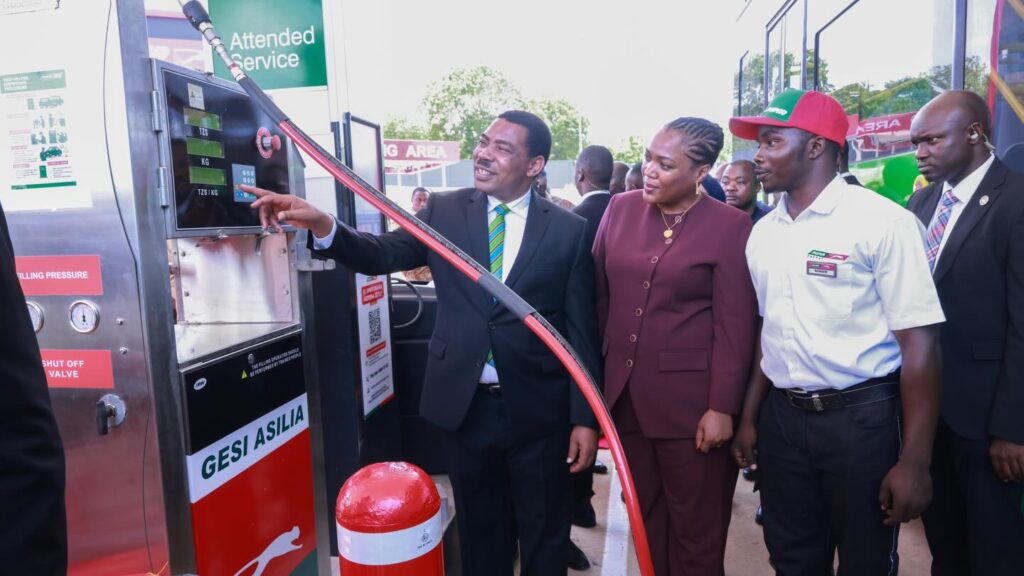
[PRESSWIRE] Dar es Salaam, Tanzania – 11 February, 2026 — Tanzania is aiming to accelerate the use of natural gas to reduce fuel costs and expand access to cleaner energy, Prime Minister Mwigulu Nchemba announced on Tuesday. This push aligns with the country’s efforts to transition towards more sustainable energy sources and enhance economic growth.
Nchemba instructed the Ministry of Energy to expedite the expansion of Tanzania’s natural gas network, noting that it would provide crucial benefits to households, transport operators, and small businesses by cutting operational costs and reducing dependence on imported fuels.
He made the comments during the inauguration of a new compressed natural gas (CNG) station in Salasala, Dar es Salaam, built at a cost of 13 billion Tanzanian shillings (approximately $5 million), and owned by global energy company Puma Energy.
“The Ministry of Energy should continue accelerating natural gas exploration so that it becomes a regular energy source for Tanzanians,” Nchemba said, emphasizing the potential for CNG to improve energy accessibility and sustainability. He also called for a broader adoption of CNG as a cleaner alternative to traditional fuels.
The initiative is part of Tanzania’s National Energy Policy and its long-term development plan, Vision 2050, which targets a more diverse and sustainable energy mix, with natural gas playing a central role in driving industrial growth, power generation, and cleaner transport systems.
In addition to natural gas expansion, Nchemba highlighted the government's efforts to boost clean cooking solutions. Within the first 100 days of President Samia Suluhu Hassan’s current term, the government distributed over 13,500 improved cookstoves, subsidized by 85%, and 28,653 liquefied petroleum gas (LPG) cylinders, subsidized by 50%.
Over 1,100 institutions serving more than 100 people daily have already transitioned to cleaner cooking methods, reducing reliance on firewood and charcoal.
The country currently boasts more than 15,000 vehicles running on CNG, with 11 CNG stations spread primarily across Dar es Salaam. The Ministry of Energy plans to increase the number of stations to 20 by June 2026, with expansions planned for Morogoro and Dodoma, two major cities in Tanzania.
"Natural gas is safer, more affordable, and contributes to sustainable development,” Nchemba added. The government's strategy also aims to lower fuel import costs and reduce carbon emissions, with CNG offering a greener alternative to traditional gasoline and diesel.
Tanzania’s efforts are part of a larger push for cleaner energy solutions both within Africa and globally. The International Energy Agency (IEA) reported in its 2023 Africa Energy Outlook that the continent is gradually embracing natural gas as part of its energy mix, with several countries expanding gas infrastructure to reduce reliance on coal and biomass, which are major pollutants.
Across sub-Saharan Africa, countries like Nigeria, Mozambique, and Uganda are also tapping into natural gas reserves to diversify energy sources and reduce greenhouse gas emissions.
In Mozambique, for instance, the Coral South floating liquefied natural gas (FLNG) project started production in 2022, marking a key milestone in the region's transition to cleaner energy.
In Tanzania, natural gas accounts for about 30% of domestic energy consumption, and efforts to increase its use are in line with the African Union’s Agenda 2063, which prioritizes energy access and sustainability.
The AU aims to ensure universal access to clean energy by 2030, with natural gas seen as a critical bridging fuel as countries transition from high-emission energy sources to renewables.
Globally, the move toward natural gas as a cleaner alternative to coal and oil is gaining momentum. According to the IEA’s World Energy Outlook 2023, global natural gas demand is expected to rise by 1.5% annually until 2030, driven by demand from emerging markets, particularly in Asia and Africa.
However, natural gas’s role in decarbonization efforts remains a subject of debate, with advocates pushing for its use as a short-term solution while emphasizing the need for long-term investment in renewable sources like solar, wind, and hydroelectric power.
In Europe, for example, natural gas is also increasingly seen as a cleaner alternative to coal for electricity generation. The European Union (EU) has allocated significant funding to improve natural gas infrastructure, particularly in countries that are transitioning from coal and nuclear power. Germany, a leader in renewable energy, has also diversified its energy mix by including more natural gas to ensure energy security as part of its Energiewende or energy transition policy.
Tanzania’s natural gas initiative is not only about cutting fuel costs but also about boosting energy security and economic resilience. As the country looks to industrialize, reliable and affordable energy is seen as a key enabler of growth.
By capitalizing on its vast natural gas reserves, Tanzania hopes to create a robust energy market that attracts investment, drives industrial output, and powers a growing manufacturing sector.
The expansion of CNG in the transport sector offers a practical alternative to rising global fuel prices and reduces Tanzania’s reliance on fuel imports, a critical issue for many African nations. In addition to cutting carbon emissions, this transition also helps alleviate the strain on national budgets spent on importing petroleum products.
- Tanzania is expanding the use of natural gas as part of its National Energy Policy and Vision 2050, which prioritise a diversified, affordable and sustainable energy mix.
- The government aims to increase compressed natural gas (CNG) adoption in transport, households and small businesses to reduce fuel import costs and carbon emissions.
- More than 15,000 vehicles in Tanzania currently run on CNG, supported by 11 stations concentrated in Dar es Salaam. The government plans to increase the number of stations to 20 by June 2026, including in Morogoro and Dodoma.
Media Contact:
Information Services Department and Office of The Chief Government Spokesman
E-mail: maelezotv@gmail.com
Phone: +255 754 750 765, +255 754 698 856, +255 759 714, +255 713 381 904
Availability: EAT, UTC +3
ENDS