
[PRESSWIRE] Dodoma, Tanzania – 2026-02-07 — 7 February, 2026
Tanzania has released more than 200 billion Tanzanian shillings (about $80 million) to scale up economic empowerment programmes targeting youth and women, Prime Minister Mwigulu Nchemba said, as the country seeks to accelerate inclusive growth under its long-term development agenda.
The funding forms part of the ruling Chama Cha Mapinduzi (CCM) party’s 2025–2030 election manifesto and the Fourth Implementation Plan of the National Development Vision 2050, which President Samia Suluhu Hassan pledged to begin implementing within the first 100 days of her second term.
Speaking at an event held at the Prime Minister’s Office in Dodoma, Nchemba said ministries and implementing institutions must ensure the funds reach intended beneficiaries and deliver measurable economic impact.
“Our President does not want these funds to remain within government coffers,” Nchemba said, urging agencies to prioritise disbursement efficiency and accountability.
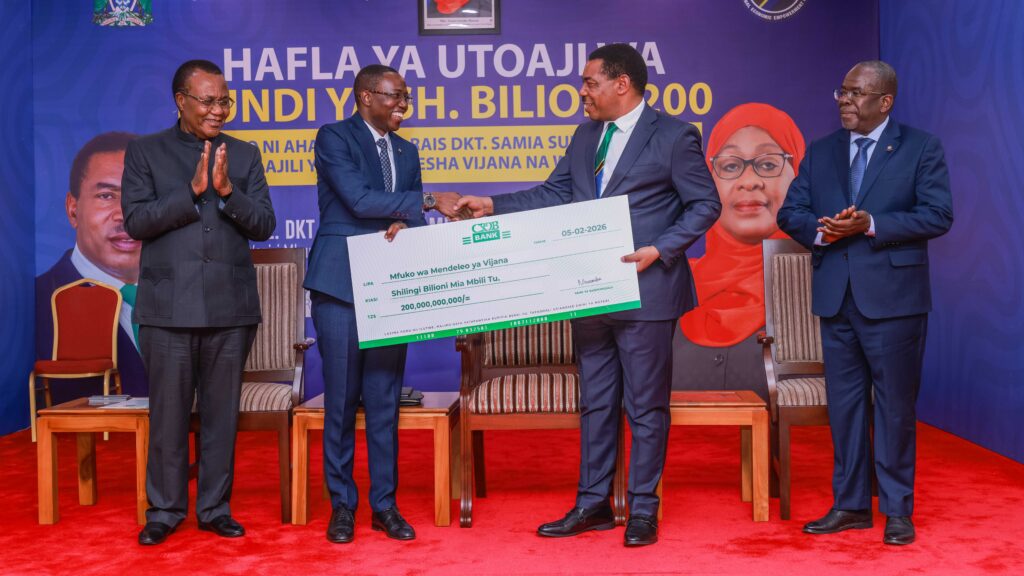
At the event, Finance Minister Khamis Mussa Omari presented a symbolic cheque to the prime minister, who formally handed it to the Minister of State for Youth Development, Joel Nanauka, on behalf of institutions overseeing the programmes.
Officials said the funds will be channelled through local commercial banks and existing empowerment schemes, including council-level programmes that allocate 10% of local government own-source revenues to youth, women and people with disabilities.
Nchemba said reforms had been introduced to tighten oversight, eliminate so-called ghost groups and prevent funds from being captured by unintended beneficiaries. He cited changes to the 4-4-2 programme as part of broader efforts to improve governance and impact.
He directed ministries to align their interventions with the national empowerment policy, shifting focus from fund administration to results such as job creation, enterprise sustainability and productivity growth.
Between 1984 and 2025, Tanzania established 75 empowerment funds and programmes aimed at youth and women. Between 2024 and 2025 alone, the government disbursed 66.9 billion shillings to more than 13,000 beneficiaries, according to official figures.
The latest funding is expected to support employment, production, food security and value addition, with priority sectors including agriculture, mining, industry, trade, fisheries, the creative arts and technology, officials said.
Across sub-Saharan Africa, youth and women remain disproportionately excluded from formal finance and productive employment. According to the World Bank, young people account for more than 60% of Africa’s unemployed, while women-owned businesses face an estimated $42 billion financing gap on the continent.
In East Africa, countries including Kenya, Rwanda and Uganda have expanded youth and women-focused credit schemes over the past decade, often combining concessional loans with training and market access. Rwanda, for example, channels youth and women financing through its Business Development Fund, while Kenya operates multiple youth and women enterprise funds linked to county governments.
Tanzania’s approach, combining national-level funding, local government allocations and banking-sector participation, places it among a growing group of African countries using public finance to crowd in private lending to underserved groups. Analysts say the effectiveness of such programmes depends heavily on governance, repayment discipline and linking finance to viable value chains.
The government says the latest disbursement is intended to support broad-based participation in Vision 2050, which aims to transform Tanzania into a high-income, competitive and inclusive economy, with youth and women positioned as central drivers of growth rather than marginal beneficiaries.
– The government has released more than 200 billion Tanzanian shillings (about $80 million) to expand economic empowerment programmes for youth and women.
– The funding forms part of the ruling CCM party’s 2025–2030 manifesto and the Fourth Implementation Plan of the National Development Vision 2050.
– Funds will be channelled through commercial banks and existing empowerment schemes, including the mandatory 10% local government allocation to youth, women and people with disabilities.
Media Contact:Information Services Department and Office of The Chief Government Spokesman E-mail: maelezotv@gmail.comPhone: +255 754 750 765, +255 754 698 856, +255 759 714, +255 713 381 904Availability: EAT, UTC +3 ENDS
ENDS