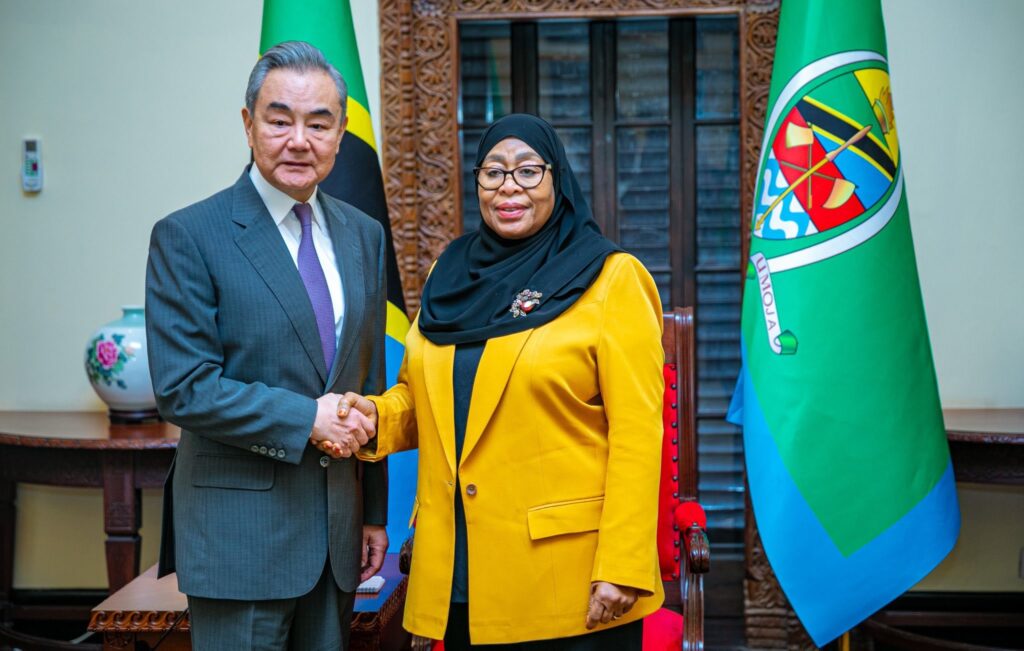
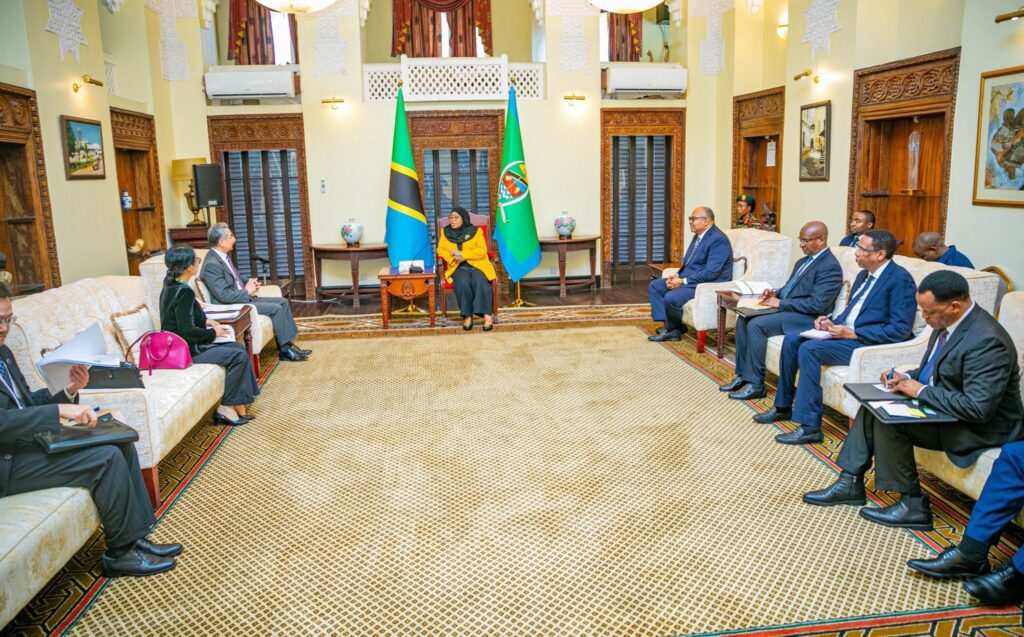
Speaking on Saturday at the State House in Dar es Salaam during a meeting with Chinese Foreign Minister Wang Yi, President Hassan underlined the need to expand exports, improve the trade balance, and promote both business and people-to-people exchanges. She also called for streamlined visa arrangements to facilitate easier movement between the two countries.
President Hassan outlined Tanzania’s strategic vision for revitalising the operations of the Tanzania–Zambia Railway Authority (TAZARA) and the related economic activities along its corridor, highlighting its potential to drive regional trade and growth.
Minister Wang Yi, in turn, reaffirmed China’s commitment to continued cooperation with the United Republic of Tanzania and described TAZARA as a historic symbol of the friendship between the two nations. He assured that China is ready to support the railway’s modernisation and ensure its effective utilisation.
Minister Wang also reiterated China’s support for Tanzania’s priority projects, including infrastructure development, water supply, clean cooking initiatives, and concessional financing. Both leaders reaffirmed their shared commitment to strengthening bilateral relations and advancing multilateral cooperation, built on decades of mutual respect and trust.
Earlier, during a press briefing, Minister Wang, who is on a two-day official visit, met with Tanzanian Foreign Minister Ambassador Mahmoud Thabit Kombo to discuss political, economic, and social aspects of the bilateral relationship. Ambassador Kombo emphasised that trust and mutual respect remain the foundation of Tanzania–China ties.
During their discussions, the leaders agreed on plans to modernise the TAZARA railway, converting it into an electric line. The project is intended both to honour Chinese workers who lost their lives during the railway’s construction and to boost regional trade and economic development.
Ambassador Kombo expressed the United Republic of Tanzania’s appreciation for China’s sustained support in implementing its national development agenda, particularly in sectors such as infrastructure, health, education, energy, and industry.
He reiterated the United Republic of Tanzania’s commitment to deepening collaboration with China to attract investment, trade, and technology that will stimulate economic growth and improve citizens’ livelihoods.
Minister Wang affirmed China’s readiness to continue supporting the United Republic of Tanzania’s development, noting that China remains a reliable partner not only for Tanzania but also for Africa through initiatives such as the Belt and Road Initiative (BRI) and the Forum on China–Africa Cooperation (FOCAC).
He confirmed that the TAZARA modernisation project would be carried out in close consultation with both the United Republic of Tanzania and Zambia, aiming to enhance the railway’s value as a regional development driver.
Chinese investment in the United Republic of Tanzania continues to grow. In 2025, the Tanzania Investment and Special Economic Zones Authority (TISEZA) registered 343 Chinese projects worth USD 3.1 billion, creating over 82,000 jobs. The TAZARA railway, stretching 1,860 kilometres—975 in the United Republic of Tanzania and 885 in Zambia—remains a powerful symbol of the enduring friendship, unity, and cooperation between the two nations.
Notes to Editors
• This story falls within Foreign Affairs and International Relations, with strong intersections in infrastructure development, trade, and investment diplomacy. It highlights Tanzania’s effort to recalibrate and deepen its long-standing strategic partnership with China through high-level political engagement and concrete development projects.
• The article places particular emphasis on the TAZARA railway as both a symbolic and practical anchor of Tanzania–China relations. Historically significant and economically underutilised, TAZARA is presented as a platform for renewed cooperation focused on modernisation, electrification, and regional trade facilitation involving Tanzania and Zambia.
• The piece underscores a broader diplomatic agenda that blends traditional state-to-state relations with economic objectives, including export expansion, investment attraction, technology transfer, and mobility facilitation. References to BRI and FOCAC situate the bilateral relationship within China’s wider Africa engagement framework.
Media Contact
Information Services Department and Office of the Chief Government Spokesman
E-mail: maelezotv@gmail.com
Phone: +255 754 750 765, +255 754 698 856, +255 759 714, +255 713 381 904
Availability: EAT, UTC +3
Ends