
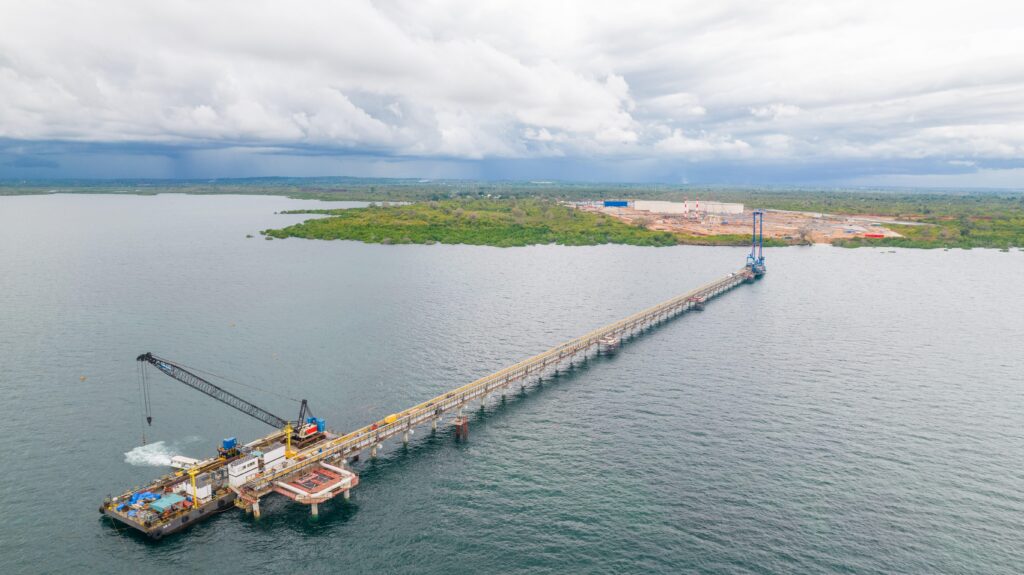
Officials from both countries say initial exports are scheduled for October 2026, following technical commissioning expected in July. Once operational, the pipeline will transport crude oil from western Uganda to Tanzania’s Indian Ocean port of Tanga, positioning Uganda among Africa’s oil-exporting nations and reinforcing Tanzania’s role as a regional energy and logistics hub.
Construction of the 1,443-kilometre pipeline, valued at about $5 billion, is now approaching completion. Project developers say overall progress has reached nearly 80 percent, with work entering its final and most intensive phase across both countries.
EACOP is designed to transport Uganda’s waxy crude, which must be heated to around 50°C to remain fluid. When completed, it will be the world’s longest heated crude oil pipeline, a significant engineering undertaking that includes pumping stations, storage facilities and a marine export terminal at Tanga.
At full capacity, the pipeline is expected to carry up to 230,000 barrels per day, with potential expansion to approximately 246,000 barrels. The project is led by TotalEnergies in partnership with China National Offshore Oil Corporation (CNOOC), Uganda National Oil Company and Tanzania Petroleum Development Corporation. Investment commitments to date exceed $3.3 billion, with all pipeline segments now laid, according to project officials.
Economic gains on both sides of the border
For Tanzania, the pipeline is expected to generate revenue through transit fees, port services, logistics and associated trade, while supporting employment and local business participation along the corridor. Officials say the project strengthens the country’s position as a strategic gateway for regional energy exports.
“This is a major economic catalyst for Tanzania,” said Energy Minister Deogratius Ndejembi, noting that the pipeline has already created jobs and expanded local content opportunities in construction, engineering and transport services.
Project sponsors estimate that more than 120,000 jobs have been generated during construction, alongside skills transfer in specialised areas such as pipeline engineering, logistics and environmental management.
For Uganda, EACOP is central to converting an estimated 6.5 billion barrels of discovered oil reserves into export revenue. Officials say pipeline transport costs are expected to average about $12.77 per barrel, improving the competitiveness of Ugandan crude on international markets.
Oil development is a key pillar of Uganda’s Vision 2040 strategy, which aims to expand the economy from roughly $40 billion to $500 billion over the coming decades. Authorities view the oil sector not only as a source of export earnings but also as a catalyst for industrialisation, infrastructure development and skills growth.
“This infrastructure is not only about exports,” said Uganda’s Energy Minister Ruth Nankabirwa. “It is about long-term transformation, industrial development and building national capacity.”
Momentum behind the project was reaffirmed at a high-level meeting in Dar es Salaam on 5 January, where ministers from both countries reviewed progress on pipeline construction, pumping stations and the marine export terminal. According to joint updates, completion has advanced from around 60 percent in early 2025 to nearly 79 percent by the end of the year.
Despite its economic promise, EACOP has faced sustained criticism from environmental groups concerned about climate change, biodiversity risks and the project’s carbon footprint. Project developers argue that robust environmental and social safeguards are in place and that oil revenues will help finance broader development and energy-transition goals.
Countdown to first oil
As commissioning approaches, attention is shifting to upstream readiness, global oil market conditions and the timely completion of supporting infrastructure. Officials in both countries remain confident the project will meet its targets.
If successful, the first shipment of crude in October 2026 will mark the culmination of nearly two decades of planning, signalling a new chapter for Uganda’s energy sector and cementing Tanzania’s strategic role in regional oil exports.
Notes to Editors
This story focuses on the energy and infrastructure sector, with strong regional integration and macroeconomic implications for East Africa. It documents the transition of Uganda from an oil producer-in-waiting to an emerging exporter, enabled by cross-border infrastructure anchored in Tanzania.
The article treats EACOP not simply as a pipeline, but as a strategic economic asset. For Uganda, it represents the monetisation of long-standing hydrocarbon discoveries and a cornerstone of Vision 2040, linking oil revenues to industrialisation, skills development and fiscal expansion. For Tanzania, it reinforces the country’s role as a regional logistics, transit and energy export hub via the Indian Ocean.
All figures cited—project cost, capacity, timelines, reserves and job creation—are drawn from official statements by project sponsors and government authorities. Timelines are framed cautiously, reflecting commissioning and export targets rather than guarantees.
Media Contact
Information Services Department and Office of the Chief Government Spokesman
Email: maelezotv@gmail.com
Phone: +255 754 750 765, +255 754 698 856, +255 759 714, +255 713 381 904
Availability: EAT (UTC +3)