
The results are visible in bustling urban centres, electrified villages and expanding industrial hubs, where more Tanzanians are connected to markets and services than ever before.
Under Vision 2025, the country has maintained average real GDP growth of around 6.2% between 2000 and 2024, according to official data, achieving lower-middle-income status in 2020.
Social progress has matched economic expansion: per capita income rose from roughly US$453 in 2000 to about US$1,277 by 2023, extreme poverty fell from 36% to 26%, life expectancy increased from 51 to 68 years, and maternal mortality dropped sharply to 104 deaths per 100,000 live births.
Improved infrastructure, education and water access have created a foundation for long-term investment, particularly in sectors that drive domestic demand and connect rural communities to regional markets.
Smallholder farmers in Morogoro, for example, report that better roads and electricity allow them to sell produce more efficiently, hire seasonal labour and invest in local processing.
Strategic partnership with China grows deeper
China has long been Tanzania’s most significant bilateral partner in investment and infrastructure. Over the years, Chinese engagement has extended beyond financing and construction to co-developing industrial capacity and regional connectivity.
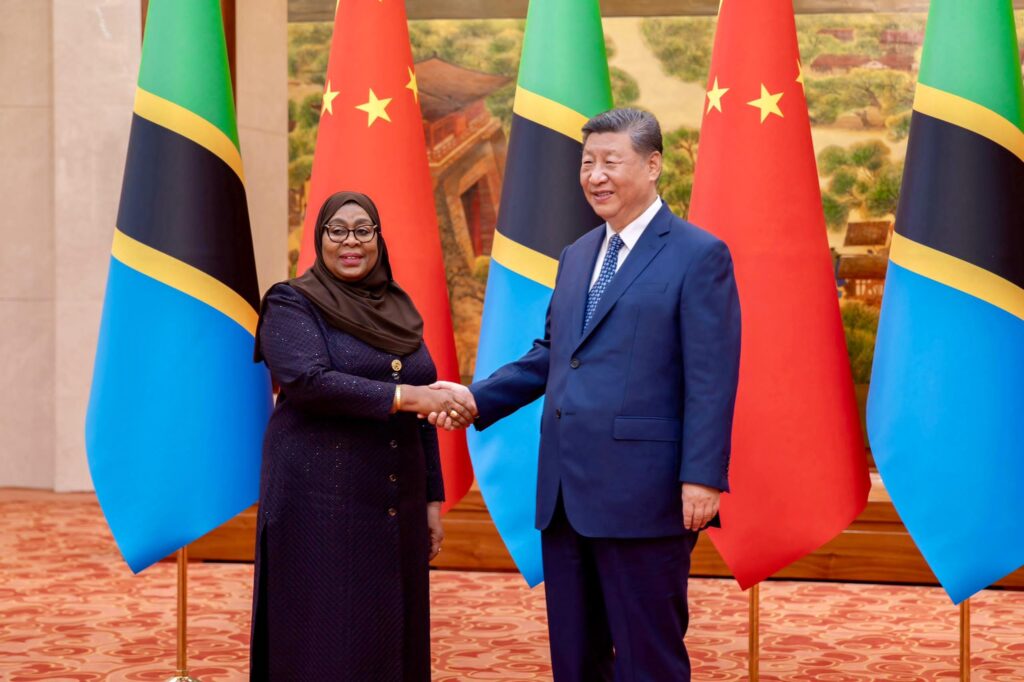
President Samia Suluhu Hassan recently reaffirmed Tanzania’s commitment to the partnership during a meeting with Chinese Foreign Minister Wang Yi at the State House in Dar es Salaam. The discussion emphasised expanding exports, improving the trade balance, promoting business and people-to-people exchanges, and streamlining visa processes to facilitate mobility.
President Samia also outlined plans to revitalise the Tanzania–Zambia Railway Authority (TAZARA), one of the most enduring symbols of the Tanzania–China partnership. Stretching 1,860 kilometres—975 km in Tanzania and 885 km in Zambia—the railway historically connects the two nations and regional trade corridors. Plans to modernise it into an electric line aim to honour the Chinese nationals who lost their lives during its construction while boosting regional commerce and industrial activity.
China’s Foreign Minister Wang Yi underscored Beijing’s commitment to ongoing cooperation, including support for TAZARA, infrastructure development, water supply, clean cooking initiatives and concessional financing. Both leaders reaffirmed a shared vision of sustainable, mutually beneficial economic and social cooperation, building on a long history of trust and strategic alignment.
China remains Tanzania’s leading source of bilateral investment. Official records from the Tanzania Investment Centre (TIC) show that between January 2021 and December 2023, 256 Chinese projects were registered, valued at around US$2.5 billion.
In 2025 alone, the Tanzania Investment and Special Economic Zones Authority (TISEZA) recorded 343 projects worth US$3.1 billion, creating over 82,000 jobs.
Cumulatively, between 1997 and 2024, TIC data indicate China registered 1,360 projects worth about US$11.5 billion, generating more than 155,000 jobs across manufacturing, commercial construction, agriculture, transport and services.
Major infrastructure projects include expansions of Dar es Salaam Port, modern rail links such as the Standard Gauge Railway (SGR), roads connecting rural regions to urban centres, and power generation and transmission upgrades. These investments underpin Tanzania’s role as a regional transit and logistics hub, lowering costs, improving efficiency and expanding economic opportunities across East and Central Africa.
Trade growth reinforces economic interdependence
Bilateral trade has grown steadily. In 2024, trade volume reached US$8.88 billion, making China Tanzania’s largest trading partner for the ninth consecutive year.
Tanzania exports agricultural products such as soybeans, sesame, avocados and minerals to China, while importing machinery, construction materials and industrial inputs.
Vision 2025’s industrialisation push is reflected in the growth of manufactured exports, from US$43 million in 2000 to roughly US$1.4 billion in 2024. Chinese-backed special economic zones and industrial parks provide integrated platforms where domestic labour, raw materials and capital interact, enabling Tanzania to diversify beyond raw-material exports into value-added production.
A hallmark of Vision 2025 has been its infrastructure-first approach. Chinese firms have been central to building roads, railways, ports and power facilities, creating the backbone for industrial growth. Reliable power and transport networks support small manufacturers, agro-processing, logistics and services—sectors that expand employment and domestic demand.
Agriculture, accounting for about 25.3% of GDP and employing roughly 65% of the workforce, benefits indirectly. Improved connectivity reduces post-harvest losses, enhances market access and encourages participation in value chains, aligning rural livelihoods with national industrialisation efforts. For investors, these improvements signal scalable, low-risk opportunities in agri-processing, logistics and equipment supply.
Industrial diversification and long-term development
Beyond infrastructure, Chinese engagement increasingly targets industrialisation. Joint ventures, industrial parks and manufacturing projects link Chinese capital with Tanzanian labour. Initiatives in ceramics, building materials, food processing and light manufacturing diversify the investment footprint and generate employment.
Projects in Bagamoyo and Dar es Salaam illustrate this trend. Designed to anchor long-term value chains, they support Vision 2025’s structural transformation goals and integrate Tanzania into regional production networks.
Political stability and policy continuity have underpinned the partnership. Tanzania’s consistent growth, delivery of large-scale projects and strengthened human capital demonstrate governance capacity, reducing perceived risks for Chinese investors.
High-level engagement through FOCAC and bilateral meetings helps align Tanzania’s development priorities with Chinese strategic investment objectives. Both sides emphasise shared commitments to infrastructure, industrialisation, education, health and people-to-people exchanges, reinforcing trust as the foundation of long-term cooperation.
Human impact: development experienced on the ground
For Tanzanians, Vision 2025 and Chinese-backed projects have transformed daily life. Smallholder farmers report improved roads and electricity that allow them to operate processing mills and expand market access.
Students in urban and rural schools benefit from improved facilities and digital learning tools. Entrepreneurs in industrial parks gain reliable energy and transport links that reduce operational costs and risks.
TAZARA’s modernisation, for instance, is expected to enhance trade corridors and stimulate economic activity in communities along the railway, while also commemorating the historical contributions of Chinese engineers who built the line.
As Vision 2025 approaches its conclusion in June 2026, Tanzania and China are poised to sustain and deepen cooperation. Emerging areas include renewable energy, digital infrastructure, agro-processing, industrial clusters and regional logistics networks. These projects promise long-duration returns while providing tangible benefits to Tanzanian communities through employment, skills development and improved services.
Notes to Editors
• This story is a long-form development and international partnership analysis examining how Tanzania’s National Development Vision 2025 has shaped economic transformation and deepened strategic cooperation with China over a 25-year period.
• The article positions Vision 2025 as a case study in gradual, stability-driven development, linking macroeconomic growth with tangible social outcomes such as poverty reduction, improved health indicators, infrastructure expansion and rising household incomes.
• China–Tanzania relations form the central external dimension of the story. Chinese engagement is presented as evolving from infrastructure financing to broader industrial co-development, including manufacturing, special economic zones, logistics corridors and skills transfer. Data from TIC and TISEZA provide empirical grounding for investment volumes, job creation and sectoral spread.
Media Contact
Information Services Department and Office of the Chief Government Spokesman
Email: maelezotv@gmail.com
Phone: +255 754 750 765, +255 754 698 856, +255 759 714, +255 713 381 904
Availability: EAT (UTC +3)
ENDS