
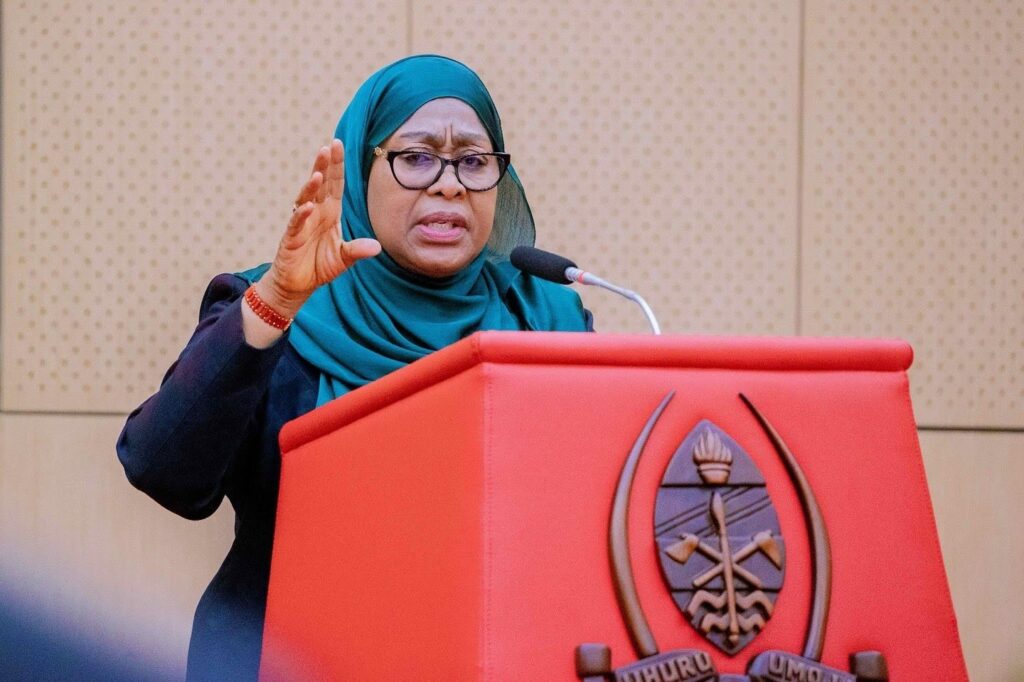
Speaking at a diplomatic reception at the State House in Dodoma, President Hassan said Tanzania recorded 5.9% economic growth in 2025 while keeping inflation at 3.3% and public debt at 48.2% of GDP, below the threshold considered risky for low-income countries.
“Our fundamentals remain strong,” she said, describing macroeconomic discipline as key to shielding the economy from global shocks.
She said confidence in Tanzania’s economy was reflected in capital markets, with market capitalisation on the Dar es Salaam Stock Exchange rising 34.3% last year to nearly 24 trillion Tanzanian shillings ($9.4 billion).
Tanzania’s stable outlook from Moody’s and Fitch Ratings has helped lower borrowing costs and attract investment, she said, adding that governance reforms and efforts to ease foreign currency pressures would continue.
Hassan said the country registered a record 927 investment projects in 2025, worth more than $11 billion, a 19% increase from the previous year and the highest since the investment promotion agency was established. The projects are expected to create more than 162,000 jobs, with nearly a third led by domestic investors.
“That confidence is coming both from global partners and from Tanzanians themselves,” she said, noting that dozens of the projects were expansions by existing investors.
She highlighted strong performance in agriculture, where food self-sufficiency reached 128%, and in mining, where production rose by more than 48%, driven by gold, coal and industrial minerals. To strengthen foreign reserves, the government now requires large-scale miners to refine and sell at least 20% of their gold to the central bank, she said.
Tourism has rebounded sharply, with revenues rising from $1.3 billion in 2021 to $4 billion by the third quarter of 2025, she said, adding that Tanzania’s designation as World’s Leading Safari Destination 2025 underscored investor and visitor confidence.
Hassan said Tanzania had expanded air connectivity through Air Tanzania to support trade and intra-African tourism, as part of a broader push to become a regional hub for logistics and commerce.
She also touched on Tanzania Development Vision 2050, which targets double-digit growth through industrialisation, productivity gains and value addition.
Key priorities include the blue and green economies, digital innovation and completion of the $42 billion liquefied natural gas project, which she said would place Tanzania firmly on the global energy map.
She said the country was also building an investment framework for critical minerals, aligning with a G20-backed agenda to support clean technologies.
“These resources must serve both the global energy transition and inclusive growth at home,” she said.
Infrastructure projects such as the Standard Gauge Railway, the East African Crude Oil Pipeline, due for completion in mid-2026, and the Julius Nyerere Hydropower Plant were described as foundations of a new industrial economy. Strategic developments including Bagamoyo port aim to unlock regional trade rather than serve prestige, she added.
President Hassan said Tanzania’s youth would be central to achieving its long-term ambitions, describing them as “the heartbeat” of the country’s growth agenda.
The creation of a Ministry of Youth under the President’s Office, she said, was intended to channel that energy into skills and productivity.
She also outlined a shift in health policy from aid dependence to investment, anchored in universal health insurance, pharmaceutical manufacturing and specialised care.
“A trillion-dollar economy cannot be built without a healthy workforce,” she said.
“Our direction is clear,” President Hassan told diplomats. “Tanzania is moving from exporting raw potential to exporting value, and we welcome partners who share that vision.”
Notes to Editors
• This story is a macroeconomic and investment policy briefing outlining Tanzania’s economic positioning as articulated by President Samia Suluhu Hassan during a diplomatic reception in Dodoma. It combines headline economic indicators with sectoral performance and long-term strategic direction.
• The article highlights Tanzania’s macroeconomic stability, citing 5.9% GDP growth in 2025, inflation held at 3.3%, and public debt at 48.2% of GDP—below internationally recognised risk thresholds for low-income economies. These fundamentals are presented as a buffer against global volatility and a foundation for sustained investor confidence.
• Capital market performance is underscored through growth at the Dar es Salaam Stock Exchange, alongside favourable sovereign outlooks from Moody’s and Fitch Ratings, which the government links to lower borrowing costs and improved access to finance.
Media Contact
Information Services Department and Office of the Chief Government Spokesman
Email: maelezotv@gmail.com
Phone: +255 754 750 765, +255 754 698 856, +255 759 714, +255 713 381 904
Availability: EAT (UTC +3)
ENDS