
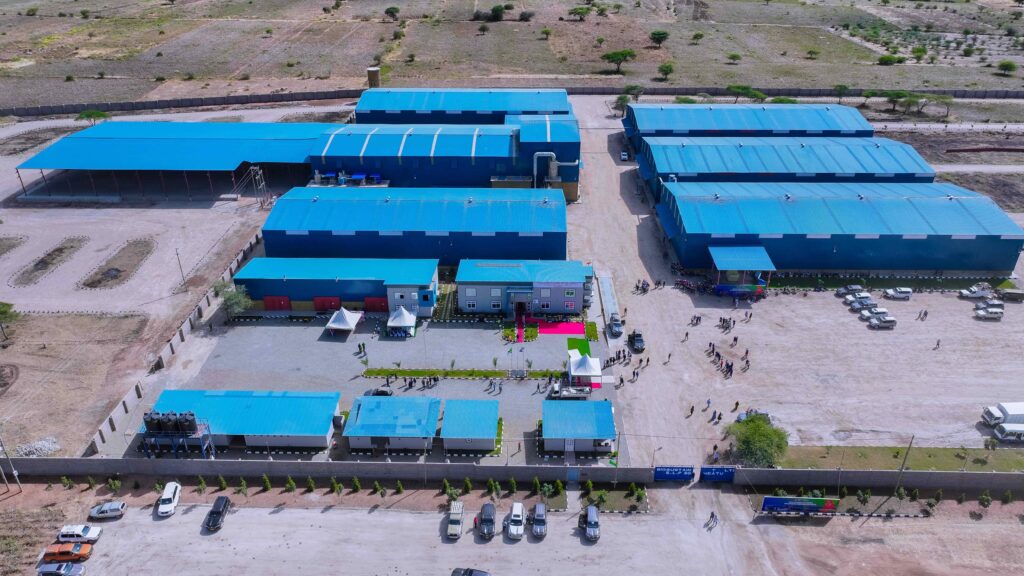
The government has pursued deliberate reforms aimed at increasing value addition and local content across key economic sectors, including mining, industry, agriculture, and manufacturing.
The reforms are anchored in strategic planning frameworks such as the Third National Five Year Development Plan (FYDP III), part of the broader Vision 2025, which prioritised competitiveness and industrialisation as drivers of human development.
The results are increasingly visible. Industry, including manufacturing and construction, accounted for 28.7% of GDP in 2024, marking a long-term rise in Tanzania’s industrial contribution.
In key extractive sectors, mining’s share of GDP rose to 10.1% in 2024, up from 9.1% in 2023, reflecting reforms to improve transparency, formalise markets, and strengthen regulatory oversight.
Tanzania’s increased participation in value chains is strongly driven by strengthened local content regulations. Under the amended Local Content Regulations of 2018, the government has reserved a list of goods and services for companies wholly owned by Tanzanians.
As a result, local procurement in mining reached 88% of total goods and services in 2024, up from TZS 1.85 trillion in 2018 to TZS 4.41 trillion in 2024, while Tanzanians now make up 97% of employees in mining operations.
President Samia Suluhu Hassan has framed this shift as part of a broader vision to ensure national resources benefit citizens directly.
In outlining reforms to the mineral sector, she noted: “Tanzania will stop exporting raw concentrates and aim to become a trading hub for minerals in East and Central Africa by 2030, retaining value within the country.”
Agriculture, which feeds the majority of Tanzanians, has also been central to this strategy.
President Samia has emphasised processing agricultural produce into higher-value products, such as flour and edible oils, to improve farmers’ incomes and expand export potential.
For farmers like Amina Msuya in Morogoro, this shift has practical impacts: “We used to sell raw harvests for small sums. Local processing means fairer prices and more stable income.”
The then Finance Minister Dr Mwigulu Lameck Nchemba, presenting the 2025/26 national budget, highlighted a fiscal policy focused on “inclusive economic transformation” that promotes domestic resource mobilisation, resilient investment, and job creation.
Planning and Investment Minister Prof Kitila Mkumbo added that Tanzania plans to save over Sh2.8 trillion annually by locally producing goods previously imported, notably sugar and edible oil, while expanding export markets for surplus products.
Tanzania’s regional trade performance underscores the impact of these reforms. In 2023, goods exports to other African countries were valued at approximately USD 2.65 billion, while imports stood at around USD 1.5 billion, showing a favourable balance of trade under frameworks such as the African Continental Free Trade Area (AfCFTA) and the East African Community (EAC).
By 2024, Tanzania ranked among the top ten African countries for intra-African export volumes, with exports reaching USD 3.24 billion, reflecting growing ties with EAC and Southern African Development Community (SADC) markets.
Value-added export growth under AfCFTA scenarios highlights Tanzania’s strong responsiveness to trade liberalisation. Projected growth in agricultural and food value-added exports stands at 13.2% over baseline levels, surpassing peers such as Ghana (4.1%) and South Africa (7.5%).
These figures suggest that Tanzania is particularly well positioned to benefit from continental integration and value chain development.
Tanzania also benefits from significant intra-regional trade growth. Within the EAC, total exports rose by 47.3% during a 2025 quarter, demonstrating robust expansion under regional integration.
While value-added export data varies across Africa, Tanzania consistently ranks among countries with meaningful domestic value content. According to UNCTAD Africa value-added export statistics, countries such as Zambia, Rwanda, and Ghana show strong forward and backward linkages, but Tanzania stands out for high domestic shares within key sectors.
Tanzania’s industrialisation and value addition strategy opens multiple avenues for foreign investment. Agro-processing, including flour mills, oil refineries, and food packaging facilities, offers opportunities to serve domestic markets and regional EAC and SADC partners.
The mining sector presents potential for local beneficiation, such as smelting and refining, especially for gold, graphite, and nickel.
Projections indicate that the overall mining sector could reach USD 6.6 billion by 2027, combining extraction and downstream opportunities.
Infrastructure development in energy, transport, and industrial parks, including mining-focused zones, enhances long-term prospects. Tanzania’s political stability and government emphasis on skills development and local partnerships further strengthen its investment climate.
However, challenges remain. Manufacturing’s GDP contribution, though growing, still hovers around 8–10%, constrained by infrastructure bottlenecks and reliance on imported intermediate inputs.
Ensuring local content regulations translate into deeper forward and backward linkages—such as domestic production of mining equipment—is critical to fully capture inland value.
Tanzania’s approach contrasts with broader African trends, where many countries still primarily export raw commodities. Under AfCFTA, while many member states struggle to localise productive capacity, Tanzania’s regulatory emphasis on domestic participation positions it as a model for regional industrialisation.
For global businesses, Tanzania offers a platform where investment aligns with local value addition, regional market access, and industrial growth. The country’s experience demonstrates that coherent policies, combined with incentives for domestic processing, can shift an economy from raw resource dependence to competitive industrial participation.
As policymakers pursue deeper linkages across agriculture, industry, and extractives, foreign investors capable of bringing technology, capital, and collaborative practices can find pathways to long-term engagement in a growing African economy.
Tanzania’s approach underscores a broader lesson for the continent: value addition and local content policy, backed by coherent strategies and incentives, can transform raw resource wealth into competitive industrial capacity.
Notes to Editors
• This story is an economic transformation and industrial policy analysis examining Tanzania’s shift from raw commodity exports toward value addition, domestic processing, and deeper participation in regional and continental value chains.
• The article situates Tanzania’s reforms within national planning frameworks—particularly FYDP III and Vision 2025—highlighting how regulatory changes, especially strengthened local content rules, are reshaping mining, agriculture, and manufacturing. It provides concrete data on rising industrial GDP contribution, mining sector growth, and increased local procurement and employment.
• A central editorial angle is local content as an industrialisation tool, showing how Tanzania has translated policy into measurable outcomes: 88% local procurement in mining, 97% Tanzanian employment, and trillions of shillings retained in the domestic economy. Presidential and ministerial statements reinforce the political commitment behind these reforms.
Media Contact
Information Services Department and Office of the Chief Government Spokesman
Email: maelezotv@gmail.com
Phone: +255 754 750 765, +255 754 698 856, +255 759 714, +255 713 381 904
Availability: EAT (UTC +3)
ENDS