
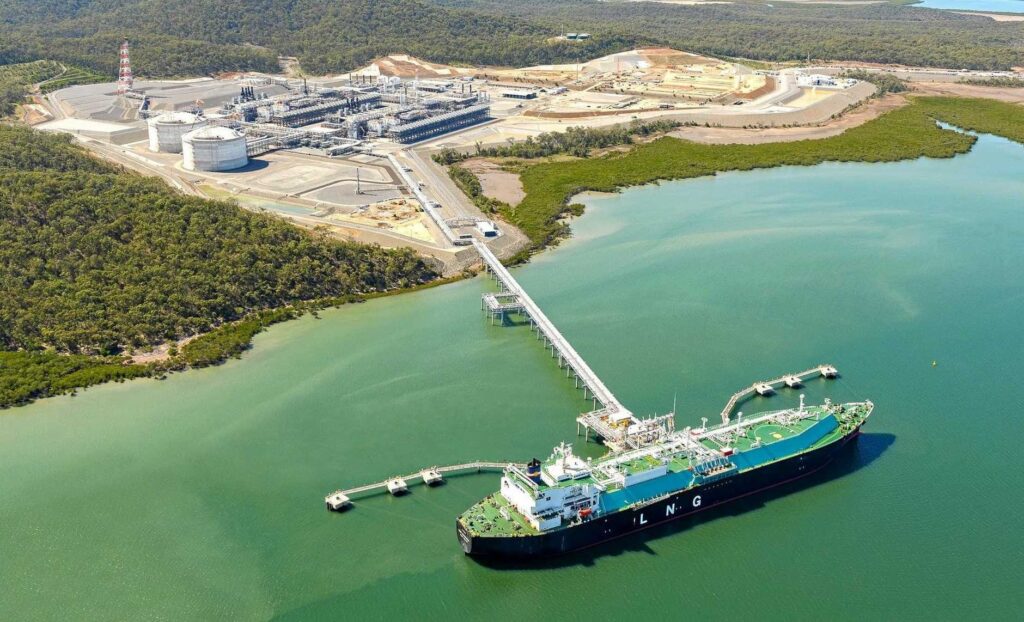
The government of the United Republic of Tanzania believes this mega project could reshape the country’s exports, investment flows, and the role of natural gas in national development.
Valued at around $42 billion and located in the Lindi region, the LNG project is seen by policymakers not simply as an energy investment but as a cornerstone of Tanzania’s broader economic transformation.
Authorities say it is intended to redefine the country’s export profile, strengthen public finances, and anchor long-term industrialisation.
The project took centre stage during high-level talks between Tanzania and the United States on 8 December 2025, when President Samia Suluhu Hassan met Andrew Lentz, the US chargé d’affaires ad interim, at State House in Dodoma.
According to the presidency, discussions focused on deepening economic, political, and security cooperation, reviewing progress on major investment projects, and confirming plans to finalise negotiations on the LNG venture ahead of its official signing.
The talks also covered the $942 million Tembo Nickel project in Ngara and ongoing preparations for the $300 million Mahenge Graphite project.
“These strategic projects are vital to the country, and we are determined to complete them to unlock jobs, strengthen investment, and improve the well-being of our citizens,” President Samia said.
She emphasised Tanzania’s open approach to international partnerships: “As a non-aligned nation, we are ready to cooperate with all partners who respect our sovereignty and share our development vision.”
Lentz reaffirmed the US commitment to working with Tanzania based on shared prosperity rather than aid dependency.
President Samia noted that more than 400 US companies currently operate in Tanzania, reflecting long-standing economic ties and stable investment conditions.
LNG as national economic strategy
Under Tanzania Development Vision 2050, natural gas—especially LNG—is identified as a strategic resource capable of accelerating the country’s transition to a more competitive, export-oriented economy.
The government views LNG not only as a way to monetise offshore gas reserves but also as a lever to move Tanzania away from dependence on unprocessed agricultural exports toward higher-value participation in global markets.
Officials report that the LNG project has already progressed through key preparatory stages, including commercial and legal negotiations with international energy companies, progress toward a Host Government Agreement (HGA), and reforms to the oil and gas policy and legal framework.
The LNG facility is expected to be developed in Lindi, alongside a broader expansion of the natural gas value chain, from upstream production to downstream utilisation.
The Tanzanian government insists that LNG is intended to operate as part of a wider industrial ecosystem, linking energy, logistics, skills development, and manufacturing.
By exporting LNG to international markets, the government aims to increase foreign exchange inflows, strengthen the balance of trade, and improve macroeconomic resilience.
Revenues from gas exports are expected to support industrialisation, infrastructure investment, and social services while reducing dependence on external borrowing.
Policy, governance, and local benefits
Unlike earlier extractive projects, the LNG venture is being developed under a strengthened governance framework. In recent years, Tanzania has clarified fiscal obligations, including taxes, royalties, and levies, enhanced oversight of strategic contracts, and expanded transparency and accountability requirements.
Mandatory local content provisions are included to ensure that natural resources deliver tangible domestic benefits in the form of revenue, employment, and skills transfer.
According to former Deputy Prime Minister and Energy Minister Doto Biteko, negotiations have been deliberately thorough to safeguard Tanzania’s long-term interests, stressing that natural gas resources must serve national development objectives.
The LNG project is structured as a partnership between the Tanzanian state and international energy companies, with local integration mandated throughout construction and operations. Tanzanian companies are prioritised for construction, logistics, and service roles, while skills development and technology transfer are embedded in project requirements. Officials anticipate that employment opportunities will extend beyond construction into long-term operations and downstream industries.
From a fiscal standpoint, LNG is expected to become a major source of government revenue through taxes, fees, levies, and profit shares. The government says this revenue could expand its capacity to finance healthcare, education, water, and infrastructure while enhancing public financial discipline.
Beyond direct employment, LNG is projected to create indirect jobs in transport, hospitality, manufacturing, and gas-dependent industries—helping to tackle youth unemployment and raise household incomes, especially in southern Tanzania.
Tanzania in Africa’s gas moment
Tanzania’s LNG ambitions come amid a broader continental push to harness natural gas as a transitional fuel for industrial growth. Several African governments see gas as a way to finance development while complementing renewable energy expansion.
While the Lindi LNG project is seen as a potential game changer that could position Tanzania as a regional energy hub—boosting trade, investment, and geopolitical influence—for President Samia’s government, LNG is about more than liquefaction trains and export terminals. It is a strategic tool to convert natural resources into lasting economic capacity.
If implemented as planned, the project could elevate Tanzania’s standing in regional and global energy markets while reshaping the domestic economy, extending the benefits of development from Lindi to communities and industries across the country and beyond.
Notes to Editors
• This story is a strategic energy and development analysis examining Tanzania’s proposed liquefied natural gas (LNG) project as a cornerstone of national economic transformation rather than a standalone extractive investment.
• The article situates the $42 billion Lindi LNG project within Tanzania’s long-term development frameworks, notably Vision 2050, highlighting how natural gas is being positioned as a lever for export diversification, fiscal strengthening, and industrialisation. It emphasises LNG as part of a broader value chain encompassing skills development, manufacturing, logistics, and downstream gas utilisation.
• A central editorial angle is the shift in Tanzania’s external engagement—particularly with the United States—from aid-centred cooperation to investment- and trade-driven partnership. High-level diplomatic engagement is used to underline investor confidence, policy continuity, and Tanzania’s non-aligned but open investment posture.
Media Contact
Information Services Department and Office of the Chief Government Spokesman
Email: maelezotv@gmail.com
Phone: +255 754 750 765, +255 754 698 856, +255 759 714, +255 713 381 904
Availability: EAT (UTC +3)
ENDS