
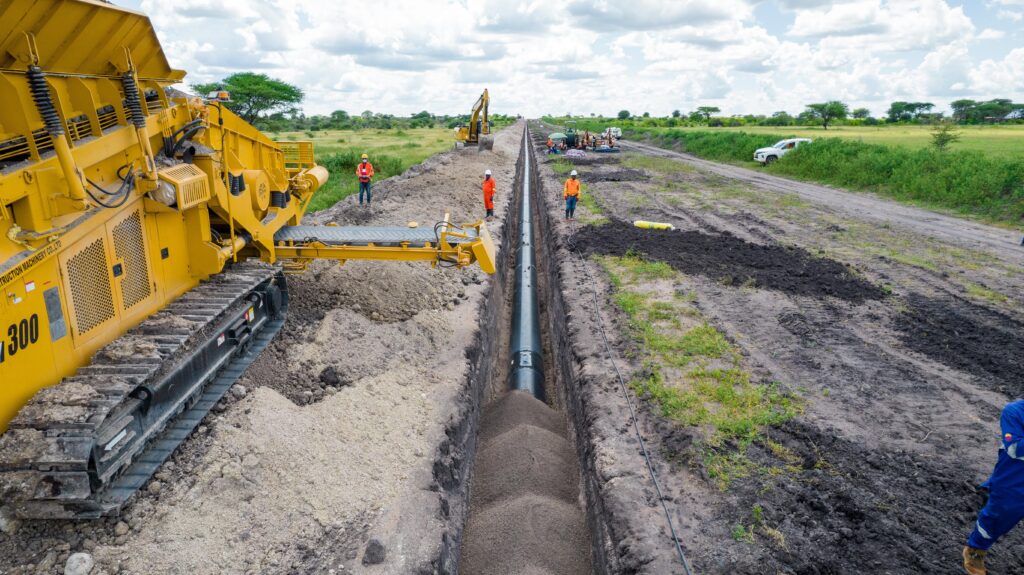
This project, among the largest energy infrastructure investments ever undertaken on the continent, embodies a shared vision of prosperity, employment and industrial transformation.
For Tanzania and Uganda, it is far more than a conduit for crude oil: it represents a strategic investment in local skills, regional integration and long-term growth.
Official progress reports indicate that the pipeline has reached approximately 79% overall completion, with operations expected to be finalised by July 2026 — a remarkable achievement given the scale of engineering and logistical work involved.
Work on the pipeline has been under way since September 2021, and its make-up is complex: six pumping stations (two in Uganda and four in Tanzania) will keep oil flowing steadily over vast distances and challenging terrain, and over 1,400 kilometres of pipe have already been welded together.
The progress to date reflects meticulous planning and strong collaboration between both governments and international partners.
As Gerson Msigwa, Permanent Secretary in Tanzania’s Ministry of Information, Culture, Arts and Sports, said on Tuesday during a briefing on the project’s advancement, “The milestones achieved so far demonstrate our commitment to delivering a project that will benefit our region for decades.”
“EACOP,” he added, “is already delivering tangible economic benefits to Tanzanians and Ugandans alike.”
Employment figures illustrate that impact vividly. Statistics released in early 2026 show that the project has created around 12,000 jobs for citizens of both Tanzania and Uganda, encompassing youth and local community participation in construction and related activities.
This is a remarkable feat for any single infrastructure project, particularly in a region where formal employment opportunities can be limited.
The pipeline has engaged workers from diverse backgrounds, from entry-level site labour to highly skilled technical roles in welding, electrical systems and environmental monitoring.
By creating thousands of jobs, including roles that provide on-the-job training and new skill sets, EACOP is doing more than just channel oil: it is channelling opportunity directly into local economies. Workers involved in fabrication, logistics and engineering support are gaining skills that will serve them far beyond the completion of the pipeline.
Tanzania’s Deputy Minister of Energy, Salome Makamba, stresses how employment and local participation are central to the project’s design: “Through employment creation and increased local participation, Tanzanians are not only earning income today but building capacities that will support tomorrow’s energy economy.”
Training programmes linked to the project have been rolled out in technical colleges and on construction sites, where young Tanzanians and Ugandans undergo formal instruction in fields ranging from instrument calibration to safety-critical operations.
This emphasis on human capital is fully aligned with both countries’ broader development strategies, which prioritise skilled labour as a driver of industrialisation and competitiveness.
These initiatives, officials say, are not short-term fixes but long-term investments in regional human capital — investments that could pay dividends as both countries diversify into related energy and infrastructure sectors in the decades ahead.
Financing, partnership and economic confidence
EACOP’s financing structure itself is a reflection of confidence in the region’s economic prospects. The project has mobilised capital through a mix of shareholder equity and structured loans, with major contributions from its owners: TotalEnergies (62%), Uganda National Oil Company (15%), Tanzania Petroleum Development Corporation (15%) and CNOOC (8%).
In March 2025, EACOP Ltd announced the closing of the first tranche of external financing provided by a syndicate of regional and international lenders including Afreximbank, Standard Bank, Stanbic Bank Uganda, KCB Bank Uganda and the Islamic Corporation for the Development of the Private Sector (ICD). This marked a major project milestone and is expected to underpin the remaining phases of construction and the pipeline’s eventual operational setup.
Successful financing through reputable institutions not only facilitates project delivery but signals market faith in East Africa’s regulatory environment and growth trajectory. It underscores the perception that large-scale infrastructure can thrive here, providing jobs and supporting broader industrial ecosystems.
The structured investments and forward planning also protect public interests. Shareholder agreements and government guarantees help ensure that host countries receive appropriate returns on their resource endowments, with mechanisms to channel revenue into development priorities such as education, health and public services.
Infrastructure gains beyond the pipeline
While the primary function of EACOP is to transport crude oil, its construction has catalysed a host of infrastructural improvements that will outlast the pipeline itself.
Across Tanzania’s regions from Tanga to Singida, road upgrades totalling hundreds of kilometres have improved local connectivity, making it easier for farmers to bring produce to markets, students to attend schools and traders to access new commercial nodes. Parallel investments in water supply systems have enhanced access to clean water for tens of thousands of residents, improving quality of life and public health outcomes.
These catalytic effects are changing the everyday experience of people living along the pipeline’s route, expanding economic opportunity and reducing isolation.
Local businesses have also benefited significantly. According to verified project data, billions of Tanzanian shillings have been injected into domestic supply chains through procurement of services and supplies from local enterprises. From transport companies to hospitality services, this spending has rippled outward, supporting small and medium-sized enterprises in towns and villages across the pipeline corridor.
Such multiplier effects are critical to ensuring that the pipeline’s economic benefits are widespread and embedded within the broader economy, rather than confined to a narrow industrial enclave.
Regional cooperation and economic integration
The pipeline project also symbolises what is achievable when neighbouring states collaborate effectively. Uganda, a landlocked country with abundant oil reserves in the Lake Albert region, has for decades sought a reliable export route to global markets. Tanzania, with its strategic Indian Ocean coastline and growing transport infrastructure, offers exactly that pathway.
This mutually beneficial arrangement strengthens economic ties, supports shared development objectives and enhances regional stability.
Uganda’s Energy and Mineral Development Minister, Dr Ruth Nankabirwa, has emphasised this point, stating that EACOP’s benefits extend beyond borders: “This project has attracted billions of dollars in investment and enhances infrastructure, expertise and economic opportunities for both Uganda and Tanzania.”
The pipeline, therefore, is not merely a piece of energy infrastructure; it is a conduit for deeper integration within the East African Community and a platform for enhanced trade and cooperation.
From construction to operation
As EACOP moves steadily toward completion, scheduled for mid-2026, both governments are preparing for its operational phase. This includes establishing regulatory frameworks, safety systems and maintenance capacity to ensure the pipeline’s long-term reliability.
Once operational, the pipeline will serve as a reliable link between Ugandan oil production and international markets. Its expected throughput capacity of more than 246,000 barrels per day, up from earlier estimates of around 216,000 barrels, will position East Africa as a significant player in global energy supply chains.
Officials anticipate that the pipeline will generate substantial fiscal revenues through transit fees, corporate taxes and associated levies, further bolstering public budgets and development financing.
EACOP is already reshaping lives, skills and communities well before it begins commercial operations. The thousands of jobs created, the skills transferred, the businesses supported and the infrastructure built are tangible signs of a positive transformation rooted in cooperation and strategic vision.
As Permanent Secretary Msigwa aptly summarised: “EACOP is not just about moving oil; it is about realising opportunities for our citizens, strengthening regional partnership, and building foundations for sustainable, shared prosperity.”
With steadfast progress toward its July 2026 completion, the East African Crude Oil Pipeline stands as a testament to what can be achieved when ambition, planning and partnership come together in service of inclusive growth.
Notes to Editors
- This is an analytical infrastructure and energy feature, not a breaking news report. It focuses on economic impact, employment, skills transfer, regional integration and development spillovers rather than only construction milestones.
- The story is grounded in official project data and government briefings, with figures on completion rates, employment, financing and infrastructure benefits reflective of publicly disclosed EACOP updates as of early 2026.
- Emphasis is placed on human capital development, local content and multiplier effects, positioning EACOP as a regional development catalyst rather than a single-purpose oil transport project.