Cool air moves through a dense forest while the lake, set beneath the escarpment of the Great Rift Valley, reflects early light in silver and gold.
As visibility improves, an unusual sight begins to emerge: a lion, not on the ground where it is typically found, but resting across the branch of a tree. The behaviour, rare among lions, has become one of the park’s most distinctive features.
“This is a place where nature constantly surprises,” said Assistant Commissioner for Conservation and Chief Park Warden, Yustina Andrew Kiwango, describing the phenomenon as a story of adaptation and survival.
According to Kiwango, the lions climb trees for reasons linked to their environment. In the park’s hot and humid conditions, elevation provides cooler air and shade, helping regulate body temperature. The behaviour also helps them avoid biting insects common on the ground and offers a safe resting place with a clear view of their surroundings.
Across Africa, lions are generally ground-dwelling animals, unlike leopards which are naturally adapted for climbing. In Manyara, however, this behaviour has evolved through social learning.
“Scientifically, this is not common among lions,” she said. “It is learned within specific groups. Cubs grow up watching adults climb trees, and over time, the behaviour is passed from one generation to another.”
This makes the lions of Manyara not only visually striking but also scientifically significant, representing a rare example of learned behaviour within a species.
Beyond its lions, Lake Manyara reveals a complex ecological system that reflects both natural resilience and Tanzania’s broader efforts to promote sustainable tourism grounded in peace and environmental stewardship.
At the park’s entrance lies a lush groundwater forest sustained not only by rainfall but by underground springs flowing from the Rift Valley escarpment. Unlike the dry savanna beyond, the forest remains green throughout the year.
Towering tree species—including fig (Ficus sycomorus), Trichilia emetica, Croton macrostachyus and African mahogany (Khaya anthotheca)—form a dense canopy that filters sunlight, retains moisture and creates a cool microclimate.
“This forest is the heart of biodiversity in Manyara,” Kiwango said, noting its role as a refuge for wildlife.
During the dry season, when surrounding landscapes turn brown, the forest becomes a sanctuary. Elephants gather in its shade, monkeys move through the canopy, and birdlife intensifies, drawn by water and vegetation.
“It serves as a sanctuary for wildlife during the dry season, supports species that cannot survive in harsher savanna conditions, and helps stabilise soil and maintain the water cycle,” she explained.
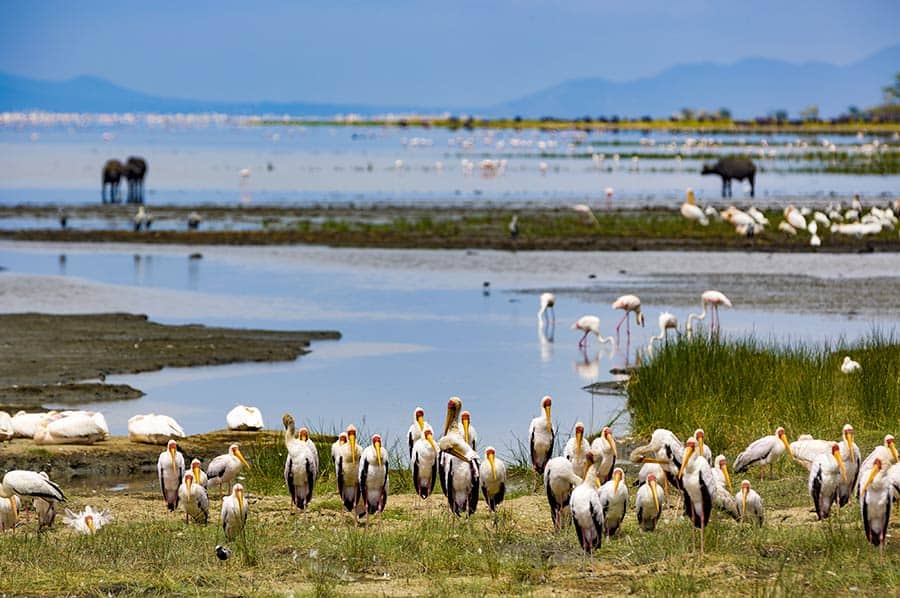
From this green zone, the terrain opens into plains that lead to the lake itself—a shallow, enclosed basin with no outlet. Fed by rivers and underground springs, the lake accumulates minerals as water evaporates, increasing its alkalinity.
“This has a major impact on aquatic life,” Kiwango said. “Not many fish can survive in such conditions.”
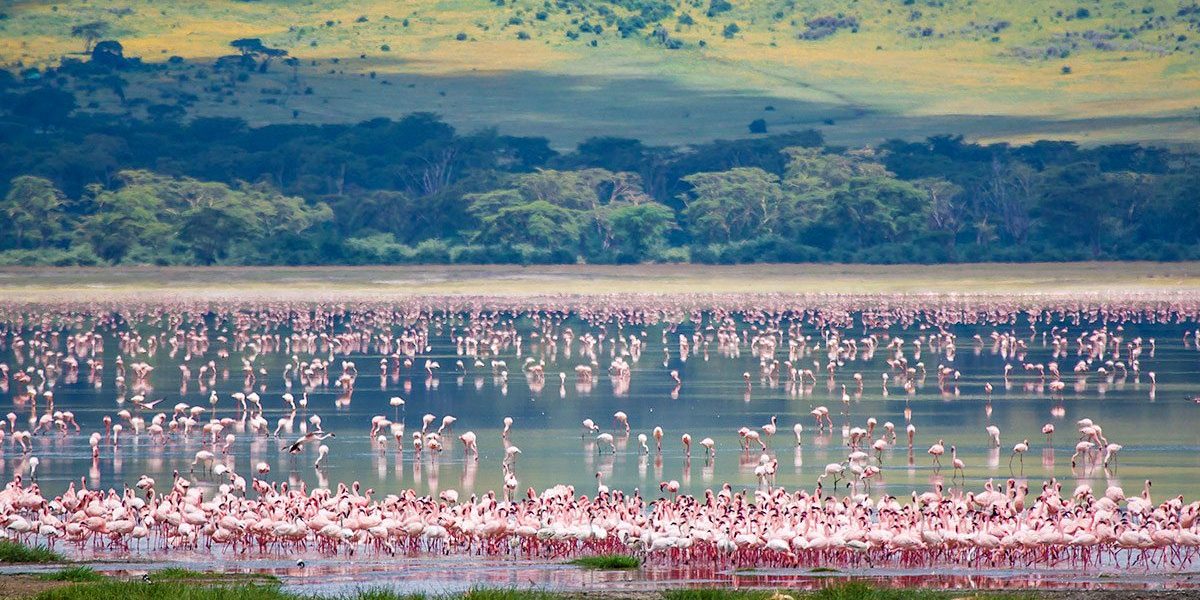
Yet these conditions support algae and specialised microorganisms, forming the base of the food chain that sustains flamingos.
At certain times of the year, thousands of flamingos gather along the shoreline, turning it shades of pink—a spectacle widely featured in global productions, including those by National Geographic.
In this way, the lake illustrates a broader ecological principle: even microscopic organisms can sustain some of the most iconic wildlife species.
Despite its relatively small size, the park contains about seven distinct ecosystems, including groundwater forest, acacia savanna, floodplains, the alkaline lake, permanent springs, the Rift Valley escarpment and miombo woodland.
Each contributes to a highly diverse environment supporting a wide range of species. The miombo woodland, introduced into the park’s ecological framework after 2009, adds further variation, bringing species not found in other zones.
“The park is a living mosaic,” Kiwango said. “Each ecosystem plays a unique role.”
Like many natural systems, Lake Manyara undergoes seasonal changes. During the rainy season, particularly between March and May, the lake expands—sometimes covering up to two-thirds of the park. In dry periods, water recedes, exposing mudflats and salt pans.
“The lake is very shallow, often just a few metres deep, which means small changes in rainfall can significantly affect its size,” she said.
In recent years, however, these fluctuations have become less predictable due to climate change.
“In the past five years, water levels have risen significantly, submerging some grazing areas,” Kiwango said. “At the same time, reduced alkalinity has affected algae growth, which is the main food source for flamingos.”
As a result, flamingos—particularly the lesser flamingo (Phoeniconaias minor)—adjust their movements depending on food availability.
“When food becomes scarce, they migrate to other areas,” she said. “Too little or too much water can disrupt the balance they depend on.”
These shifts reflect broader global environmental concerns highlighted by organisations such as the United Nations Environment Programme, which have pointed to increasing ecosystem vulnerability to climate variability.
Despite these challenges, Lake Manyara remains a place of resilience, where ecosystems adapt and persist.
For Tanzania, this resilience aligns closely with government efforts under President Samia Suluhu Hassan to promote tourism as a key pillar of economic growth, anchored in peace, stability and environmental sustainability.
National strategies have focused on conservation, infrastructure development and international promotion, positioning the country as a secure and attractive destination for visitors.
The tranquillity experienced in Manyara reflects this broader environment. Stability and cohesion have become central to Tanzania’s tourism narrative, reinforcing confidence among travellers and investors alike.
As the sun sets behind the Rift Valley escarpment, casting long shadows across the lake, Lake Manyara stands as more than a natural attraction. It represents an intersection of biodiversity, climate awareness and national vision.
From tree-climbing lions to groundwater forests and algae-driven ecosystems, the park tells a continuous story of adaptation—one that mirrors Tanzania’s own efforts to balance conservation, development and unity.
Ultimately, Lake Manyara is not only a destination but an evolving natural system, offering insight into how ecosystems, and nations, can sustain themselves through change while maintaining a foundation of peace and stability.
Notes to Editors
· Lake Manyara National Park is located in northern Tanzania, at the base of the Great Rift Valley escarpment, and is managed by Tanzania National Parks Authority.
· The park is internationally recognised for its tree-climbing lions, a rare behavioural adaptation believed to be transmitted through social learning within specific prides.
· Unlike most African lions, which are primarily ground-dwelling, Manyara’s lions climb trees to regulate body temperature, avoid insects, and gain vantage points over their environment.
Media Contact:
Information Services Department and Office of The Chief Government Spokesman
E-mail: maelezotv@gmail.com
Phone: +255 754 750 765; +255 754 698 856; +255 759 714; +255 713 381 904
Availability: EAT, UTC +3