
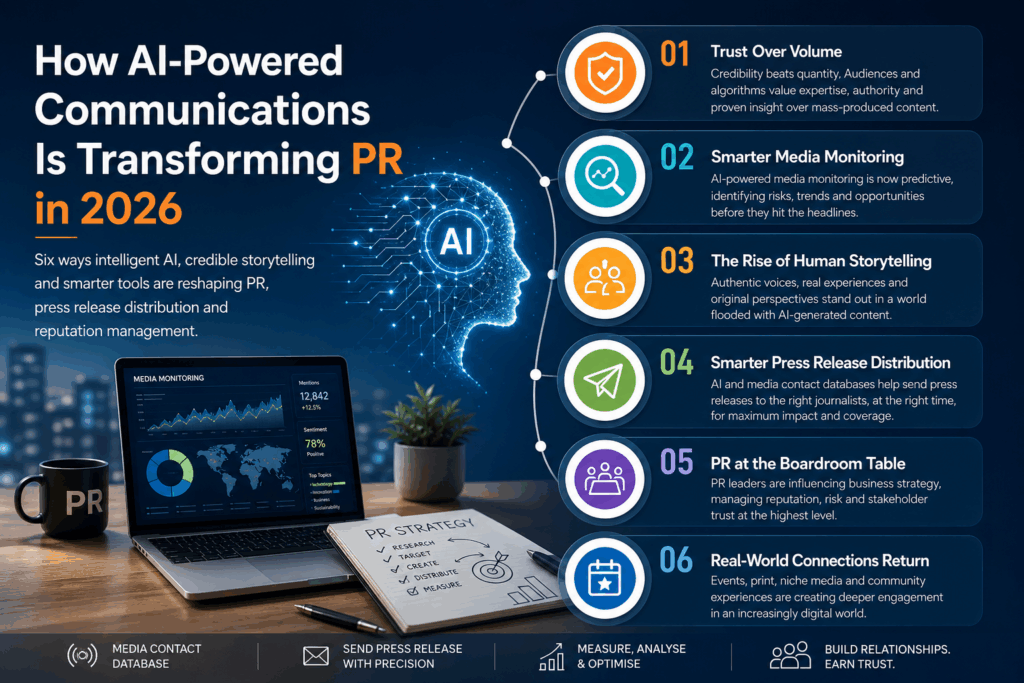
Artificial intelligence is no longer an experimental add-on for communications teams. In 2026, AI has become embedded across the entire PR workflow, from media monitoring and analytics to press release distribution and journalist targeting.
But while automation is accelerating many parts of the industry, the real shift is happening elsewhere. Brands are discovering that trust, authority and human credibility matter more than ever in a digital environment flooded with machine-generated content.
The agencies and businesses succeeding in 2026 are not simply producing more content. They are learning how to combine intelligent AI tools with strategic communications, credible storytelling and meaningful audience engagement.
Here are six major developments reshaping the PR industry this year.
1. Trust Is Replacing Content Volume
For years, digital marketing focused heavily on publishing at scale. Businesses pushed out endless blog posts, social media updates and SEO-driven articles in an attempt to dominate search rankings.
That approach is becoming less effective.
AI-generated content has dramatically increased online noise, making audiences more sceptical and search platforms more selective. Today, algorithms increasingly prioritise trusted sources, recognised expertise and authoritative commentary.
This is changing how PR campaigns are planned. A strong industry report, a respected executive interview or a well-targeted press release distribution campaign now delivers more value than mass-produced content created purely for clicks.
Companies looking to send press release campaigns successfully in 2026 are focusing more on relevance, credibility and strategic targeting rather than sheer volume.
2. Media Monitoring Has Become Predictive
Modern media monitoring is evolving far beyond tracking headlines and mentions.
AI-powered analytics tools can now identify emerging narratives, detect reputational risks earlier and analyse audience sentiment across multiple channels in real time. Communications teams are using predictive insights to react faster to breaking stories and identify opportunities before competitors.
This gives PR professionals a stronger role inside organisations because reputation management is increasingly tied to business risk, investor confidence and public trust.
In 2026, media monitoring is not simply about measuring coverage after publication. It is becoming a strategic intelligence function that shapes decision-making across the entire organisation.
3. Human Storytelling Is Becoming More Valuable
As AI-generated text becomes more common online, audiences are gravitating toward communication that feels genuine and personal.
Readers are becoming increasingly skilled at recognising overly polished corporate messaging or synthetic content lacking personality and emotion.
This has created what many agencies now describe as a “humanity premium.”
Authentic commentary, expert insights, behind-the-scenes perspectives and real-world experiences are outperforming generic marketing copy. Executive thought leadership, employee-driven storytelling and opinion-led journalism are becoming far more effective for audience engagement than heavily scripted brand statements.
For PR professionals, this reinforces the importance of human creativity, emotional intelligence and editorial judgment, qualities that AI still struggles to replicate effectively.
4. Press Release Distribution Is Becoming Smarter
The fundamentals of press release distribution are also changing rapidly.
AI tools can now help identify which journalists are most likely to engage with specific stories, determine the best distribution timing and optimise headlines for both search visibility and editorial appeal.
At the same time, high-quality targeting is becoming more important than mass outreach.
Companies using advanced media contact database technology are refining campaigns to reach highly relevant journalists, broadcasters, podcasters, bloggers and industry analysts instead of relying on outdated bulk distribution methods.
In many cases, smaller highly targeted campaigns are generating stronger media pickup than large untargeted distributions.
Businesses looking to send press release campaigns successfully in 2026 are investing more heavily in data quality, audience segmentation and journalist relationship management.
5. PR Teams Are Moving Closer to the Boardroom
The growing complexity of global communications is pushing PR departments into a more influential position within organisations.
Political instability, economic uncertainty, online misinformation and public activism are creating communications challenges that affect entire businesses rather than isolated departments.
As a result, PR leaders are increasingly advising executives on corporate reputation, crisis management, investor confidence and stakeholder trust.
The traditional separation between marketing, corporate communications and public affairs is beginning to disappear. Many organisations now require a unified communications strategy capable of managing media relations, customer perception, employee engagement and regulatory scrutiny simultaneously.
In 2026, PR is becoming a core business function rather than simply a promotional tool.
6. Real-World Experiences Are Returning
Despite the dominance of digital platforms, there is growing evidence that audiences are craving more personal and physical experiences.
Consumers, particularly younger demographics, are showing renewed interest in live events, specialist publications, independent media and community-driven experiences that feel authentic and less controlled by algorithms.
This shift is encouraging brands to invest more in experiential PR campaigns, industry gatherings, private communities and offline engagement strategies.
While digital communication remains critical, many successful campaigns now combine online visibility with real-world interaction to create stronger emotional connections.
For PR agencies, this represents a return to traditional strengths: relationship building, storytelling and creating memorable experiences that audiences genuinely value.
AI Will Support PR — Not Replace It
Although artificial intelligence is transforming communications workflows, the most effective PR strategies still depend heavily on human expertise.
AI can assist with research, analytics, media monitoring, content optimisation and distribution efficiency, but it cannot fully replace editorial instinct, creativity, strategic judgment or emotional understanding.
The future of PR will belong to agencies and brands capable of combining intelligent automation with authentic communication and trusted storytelling.
In an increasingly crowded digital environment, credibility has become one of the most valuable assets a business can possess.