
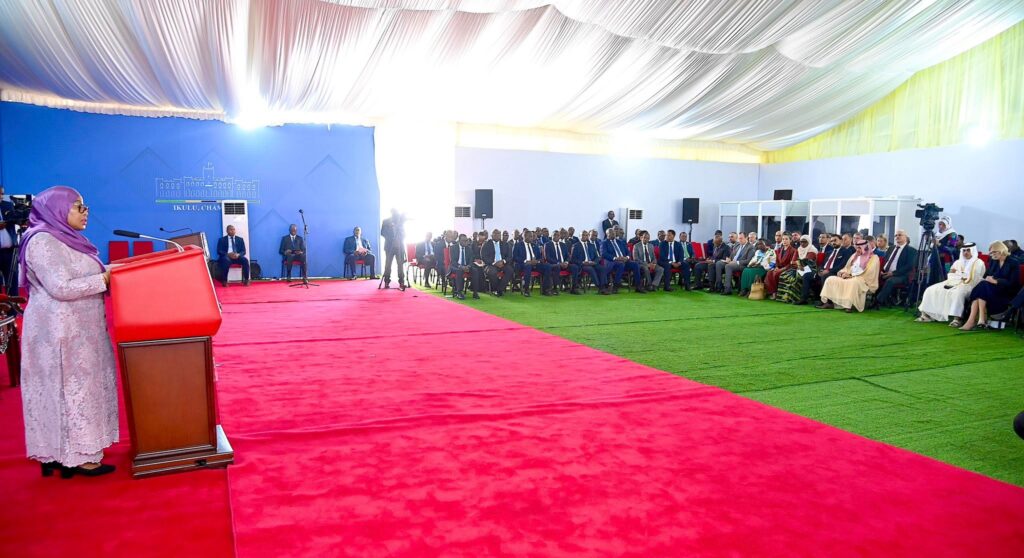
Speaking at a diplomatic reception in the capital Dodoma, Hassan said Tanzania’s foreign policy was guided by a clear choice to build consensus rather than take sides.
“Tanzania will not seek to take sides in a divided world,” she said. “We will seek to build bridges that bring the world together.”
She said Tanzania had deepened bilateral ties in 2025 through high-level exchanges that translated political goodwill into concrete economic outcomes.
“These visits have solidified our relations in areas of mutual interest,” she said, adding that the government was focused on implementing agreements through joint commissions and cooperation frameworks.
President Hassan stressed the importance of strategic partnerships across major global blocs, starting with China, which she said was central to regional connectivity.
She cited the $1.4 billion revitalisation of the historic TAZARA railway, launched under the China–Zambia–Tanzania Prosperity Belt, as a project that would position Tanzania as a logistics gateway for southern Africa.
“Our geography, our youth and our peace converge here,” she said, calling on more partners to join the corridor.
She pointed to cooperation with Russia on the $1.2 billion Mkuju River uranium project, describing it as a move beyond raw extraction. “We are unlocking value, technology and industrial jobs for our youth,” she said.
With the United States, Hassan described the $2.1 billion Kabanga nickel project as emblematic of a shift in Tanzania’s investment model.
“This is not business as usual,” she said. “We are not just opening a mine; we are launching a modern, green industrial revolution,” underscoring the project’s focus on domestic refining and value addition.
President Hassan said Tanzania’s diplomatic footprint was expanding, welcoming Slovakia and Hungary to the country’s diplomatic community following the opening of their embassies in Dar es Salaam.
“Our economic diplomacy is growing deeper and wider,” she said.
At the regional level, she reaffirmed Tanzania’s commitment to integration, describing the country as a driver of cooperation within the East African Community and a founding pillar of the Southern African Development Community (SADC).
Tanzania had moved from “cautious protectionism to proactive leadership” in facilitating the free movement of goods, labour and services, she said.
She described Tanzania as a “consensus builder” in regional peace efforts, citing its role in hosting a joint EAC–SADC summit that harmonised fragmented peace initiatives.
“Just as our challenges are shared, so must be our solutions,” she said, invoking the principle of “African solutions for African problems”.
On the continental stage, Hassan said Tanzania’s role as Third Vice Chairperson of the African Union and a member of the AU Peace and Security Council had allowed it to champion diplomacy and constitutional order.
“Dialogue and African-led solutions remain the surest path to lasting stability,” she said.
She said Tanzania was also using its AU mandate to push implementation of the African Continental Free Trade Area, noting a positive trade balance under the bloc’s Guided Trade Initiative. As AfCFTA champion for women and youth in trade, she urged global partners to back financial inclusion.
“Trade must work for women and young people if it is to work for Africa,” she said.
Hassan defended multilateralism at a time of rising unilateralism, calling it “essential, not optional”, and said Tanzania had used global platforms in 2025 to argue for a fairer international financial system.
“We refuse to be mere spectators in debates that affect our sovereignty,” she said.
Marking the 80th anniversary of the United Nations, she said Tanzania remained committed to a rules-based global order.
“Peace, development and human dignity are inseparable,” she said, calling for reforms that amplify the voice of developing countries.
President Hassan described Tanzania as “non-aligned but multi-engaged”, open to partnerships that respect autonomy while delivering shared prosperity.
“We seek trade, not just aid; technology transfer, not just assistance,” she said.
“Our doors are open, our policy is clear, and our resolve is firm,” the Tanzanian leader told diplomats. “Let us move from dialogue to delivery, and from shared intent to shared impact.”
Ends
DODOMA, Jan 15 (Reuters) — President Samia Suluhu Hassan on Thursday put bilateral partnerships at the centre of Tanzania’s foreign policy, telling foreign envoys that the country was deepening ties across East and West through investment-led diplomacy aimed at trade, jobs and regional connectivity.
Speaking at a diplomatic reception in the capital Dodoma, Hassan said 2025 had been marked by intensive high-level exchanges that translated political relations into concrete economic cooperation.
“Through these visits, we have solidified our relations in areas of mutual interest,” she said, adding that Tanzania would prioritise the implementation of agreements reached through joint commissions and other bilateral platforms.
She singled out China as a key partner in Tanzania’s regional ambitions, citing the launch of the China–Zambia–Tanzania Prosperity Belt and the $1.4 billion revitalisation of the TAZARA railway. The project, she said, would restore a historic corridor while positioning Tanzania as a logistics gateway for southern Africa.
“This is about turning our geography into opportunity,” Hassan said, inviting additional partners to join the initiative.
Relations with Russia were highlighted through the $1.2 billion Mkuju River uranium project, which Hassan said marked a shift from raw resource exports to industrial development.
“We are moving beyond extraction to secure technology, skills and thousands of industrial jobs for our youth,” she said.
With the United States, Hassan pointed to the $2.1 billion Kabanga nickel project as an example of a new investment model focused on value addition.
“This is not business as usual,” she said. “We are not just opening a mine; we are building a modern, green industrial base,” stressing commitments to domestic refining and local employment.
Hassan said Tanzania’s expanding diplomatic network reflected growing confidence in its economy, welcoming Slovakia and Hungary following the opening of their embassies in Dar es Salaam.
“Our diplomatic family continues to grow because our partnerships deliver shared prosperity,” she said.
Beyond major powers, she said Tanzania valued bilateral cooperation across Africa, Europe, Asia and the Americas, noting that partner countries and international organisations had played a significant role in supporting national development goals.
“Our approach is simple,” Hassan said. “We seek partnerships that respect our sovereignty and produce tangible results for our people.”
She described Tanzania as “non-aligned but multi-engaged”, engaging with all partners on the basis of mutual benefit rather than ideology.
“We are building bridges, not choosing sides,” she said.
Closing her remarks, Hassan urged diplomats to help turn agreements into action.
“Let us move from dialogue to delivery,” she said. “Our doors are open, our policy is clear, and our commitment to partnership is firm.”
Notes to Editors
- This story focuses on Tanzania’s evolving foreign policy doctrine, articulated by President Samia Suluhu Hassan as “sovereign pragmatism” — a non-aligned yet highly engaged approach that prioritises trade, investment, technology transfer, and shared prosperity over ideological alignment.
- Set against a backdrop of global geopolitical fragmentation, the article highlights Tanzania’s deliberate choice to act as a bridge-builder, deepening bilateral relations across major global blocs including China, the United States, Russia, and European partners, while maintaining policy autonomy.
- Key infrastructure and investment projects are used as case studies of economic diplomacy in action, notably the revitalisation of the TAZARA railway with China, the Kabanga nickel project with the United States, and uranium development with Russia. These projects underscore Tanzania’s shift away from raw resource exports toward value addition, domestic refining, and industrial job creation.
Media Contact:
Information Services Department and Office of the Chief Government Spokesman
Email: maelezotv@gmail.com
Phone: +255 754 750 765, +255 754 698 856, +255 759 714, +255 713 381 904
Availability: EAT (UTC +3)
ENDS